Adams Grove in Southampton County, Virginia — The American South (Mid-Atlantic)
John Y. Mason's Home
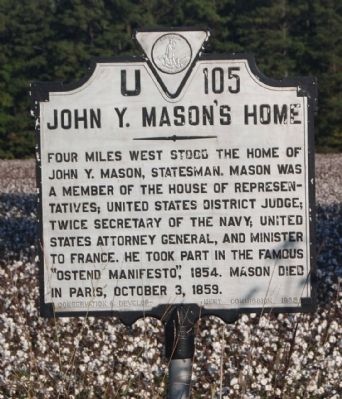
Photographed by Mike Stroud, October 15, 2011
1. John Y. Mason's Home Marker
Erected 1932 by Conservation and Development Commission. (Marker Number U-105.)
Topics and series. This historical marker is listed in this topic list: Government & Politics. In addition, it is included in the Virginia Department of Historic Resources (DHR) series list. A significant historical date for this entry is October 3, 1880.
Location. 36° 41.171′ N, 77° 23.083′ W. Marker is in Adams Grove, Virginia, in Southampton County. It is on Southhampton Pkwy (U.S. 58) near Adams Grove Road, on the right when traveling west. Touch for map. Marker is in this post office area: Drewryville VA 23844, United States of America. Touch for directions.

Regionally, this marker is in Coastal Virginia and in the Hampton Roads Metropolitan Area. It is also in the American South, specifically in the Upper South,
this page online
Other nearby markers. At least 8 other markers are within 9 miles of this marker, measured as the crow flies: Tarleton's Movements (a few steps from this marker); Emporia-Greensville County Armory (approx. 6 miles away); Company “M” 116th Infantry Regiment (approx. 6 miles away); Sussex County / Greensville County (approx. 7.2 miles away); Memorial League WWI Memorial (approx. 8.3 miles away); Greensville County Training School (approx. 8.4 miles away); Emporia Railroad History (approx. 8.4 miles away); Samuel Wilbert Tucker (1913~1990) (approx. 8.6 miles away).
Also see . . .
1. John Young Mason , from Wikipedia. 16th and 18th United States Secretary of the Navy (Submitted on October 24, 2011, by Mike Stroud of Bluffton, South Carolina.)
2. The Ostend Manifesto. was a document written
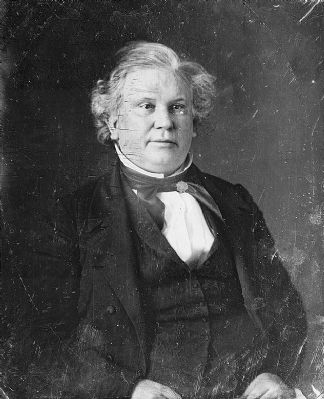
Library of Congress, `
2. John Y. Mason
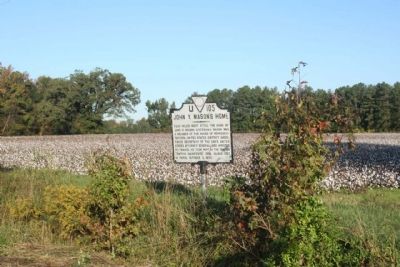
Photographed by Mike Stroud, October 15, 2011
3. John Y. Mason's Home Marker
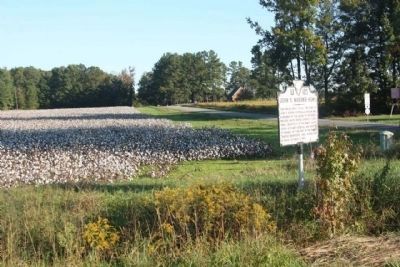
Photographed by Mike Stroud, October 15, 2011
4. John Y. Mason's Home Marker, seen near Adams Grove Road
Credits. This page was last revised on December 27, 2019. It was originally submitted on October 19, 2011, by Mike Stroud of Bluffton, South Carolina. This page has been viewed 1,229 times since then and 66 times this year. Photos: 1, 2, 3, 4. submitted on October 24, 2011, by Mike Stroud of Bluffton, South Carolina.
