Camden in Kershaw County, South Carolina — The American South (South Atlantic)
Prisoners of War
Photographed by Anna Inbody, October 2, 2011
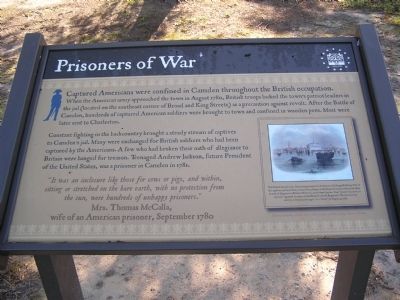
1. Prisoners of War Marker
Constant fighting in the backcountry brought a steady stream of captives to Camden’s jail. Many were exchanged for British soldiers who had been captured by the Americans. A few who had broken their oath of allegiance to Britain were hanged for treason. Teenaged Andrew Jackson, future President of the United States, was a prisoner in Camden in 1781.
“It was an inclosure like those for cows or pigs, and within, sitting or stretched on the bare earth, with no protection from the sun, were hundreds of unhappy prisoners.” Mrs. Thomas McCalla, wife of an American prisoner, September 1780
Topics and series. This historical marker is listed in this topic list: War, US Revolutionary.
this page online
Location. 34° 14.095′ N, 80° 36.105′ W. Marker is in Camden, South Carolina, in Kershaw County. It can be reached from Broad Street. The marker is located in the Historic Camden Revolutionary Battle Site. Touch for map. Marker is in this post office area: Camden SC 29020, United States of America. Touch for directions.

Regionally, this marker is in the Midlands and in the Olde English District. It is also in the American South and specifically in the Deep South. Globally, it is in North America, the Western Hemisphere, the Western World, and the Anglosphere. Historically, it finds itself in what was once the territory of the Mississippian Culture, one of the original Thirteen Colonies, one of the Confederate States of America, and the Antebellum South.
Other nearby markers. At least 8 other markers are within walking distance of this marker: Kershaw House (a few steps from this marker); Joseph Kershaw (1728-1791) (within shouting distance of this marker); Southeast Redoubt (about 300
Photographed by Anna Inbody
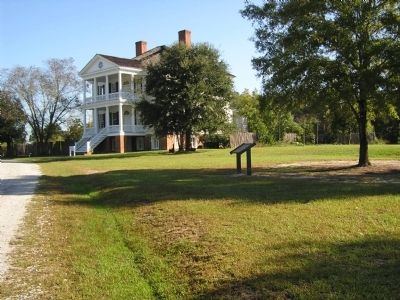
2. Overview
Kershaw House can be seen in the back ground
Photographed by Bill Coughlin, November 5, 2017
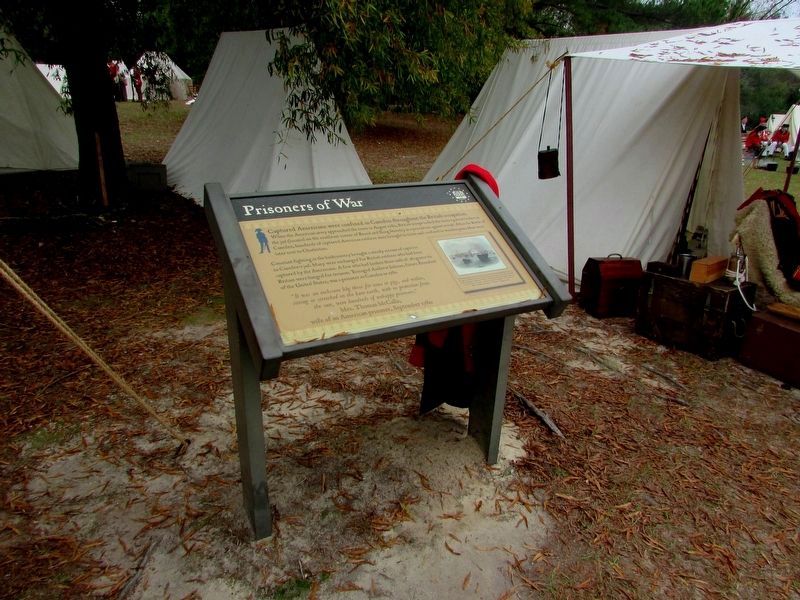
3. Prisoners of War Marker
Photographed by Bill Coughlin, November 5, 2017
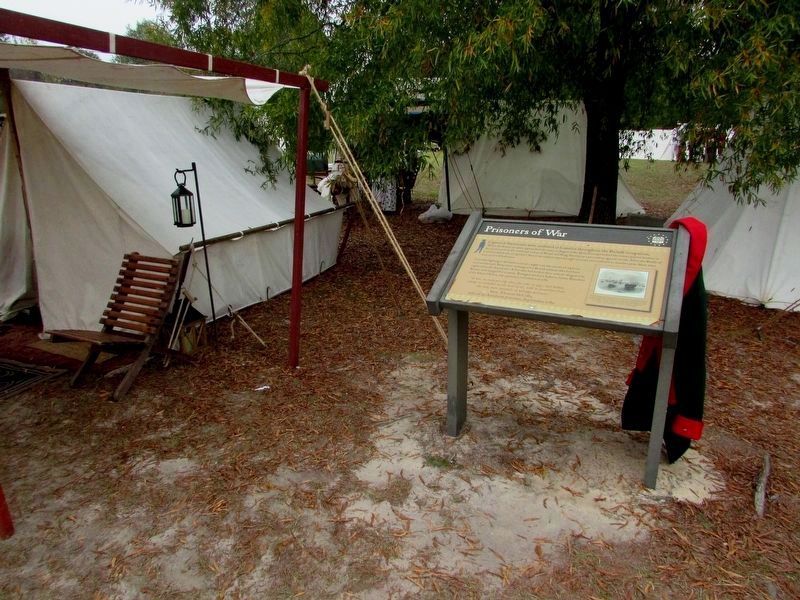
4. Marker at Historic Camden
Photographed by Anna Inbody, October 2, 2011
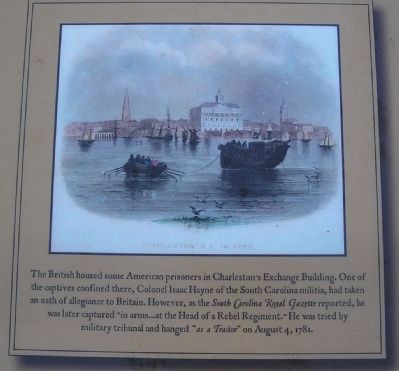
5. Picture on the marker
Charleston, S. C. in 1780
The British housed some American prisoners in Charleston’s Exchange Building. One of the captives confined there, Colonel Isaac Hayne of the South Carolina militia, had taken an oath of allegiance to Britain. However, as the South Carolina Royal Gazette reported, he was later captured “in arms … at the Head of a Rebel Regiment.” He was tried by military tribunal and hanged “as a Traitor” on August 4, 1781. Exchange Building, Charles Town, 1780. Courtesy of South Carolina Historical Society.
The British housed some American prisoners in Charleston’s Exchange Building. One of the captives confined there, Colonel Isaac Hayne of the South Carolina militia, had taken an oath of allegiance to Britain. However, as the South Carolina Royal Gazette reported, he was later captured “in arms … at the Head of a Rebel Regiment.” He was tried by military tribunal and hanged “as a Traitor” on August 4, 1781. Exchange Building, Charles Town, 1780. Courtesy of South Carolina Historical Society.
Credits. This page was last revised on November 8, 2017. It was originally submitted on November 3, 2011, by Anna Inbody of Columbia, South Carolina. This page has been viewed 1,523 times since then and 129 times this year. Photos: 1, 2. submitted on November 3, 2011, by Anna Inbody of Columbia, South Carolina. 3, 4. submitted on November 7, 2017, by Bill Coughlin of Woodland Park, New Jersey. 5. submitted on November 3, 2011, by Anna Inbody of Columbia, South Carolina. • Craig Swain was the editor who published this page.
