Near Fort Gaines in Clay County, Georgia — The American South (South Atlantic)
Toney-Standley House
Photographed by Tim Fillmon, circa 1993
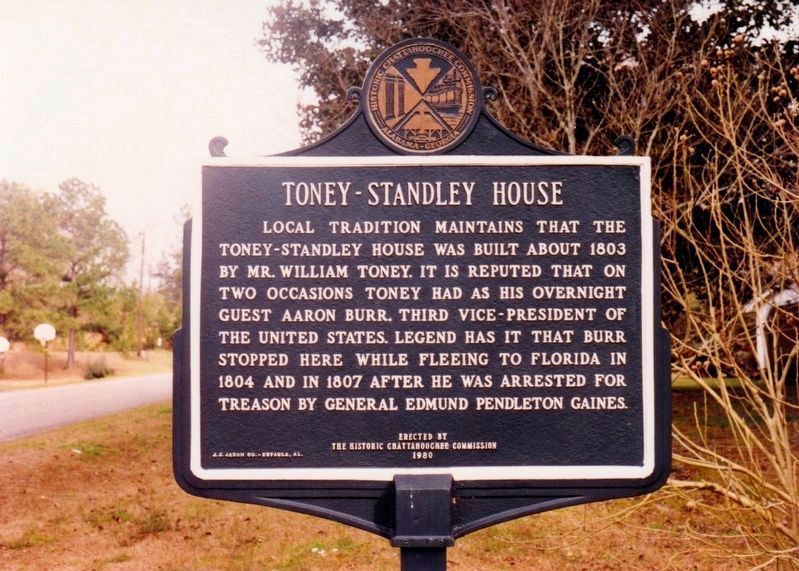
1. Toney-Standley House Marker Side 1
Local Tradition maintains that the Toney-Standley House was built about 1803 by Mr. William Toney. It is reputed that on two occasions Toney had as his overnight guest Aaron Burr, third Vice- President of the United States. Legend has it that Burr stopped here while fleeing to Florida in 1804 and in 1807 after he was arrested for Treason by General Edmund Pendleton Gaines.
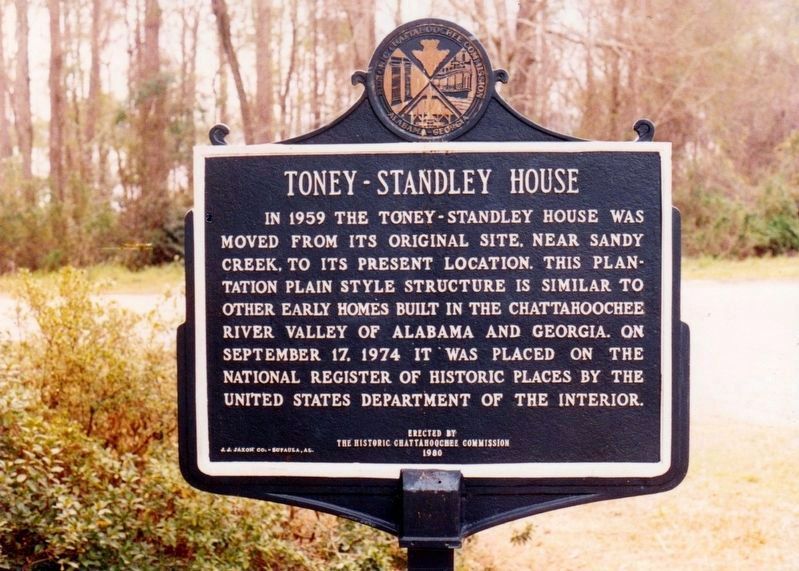
Side 2:
In 1959 the Toney-Standley House was moved from its original site, near Sandy Creek, to its present location. This Plantation Plain styles structure is similar to other early homes built in the Chattahoochee River Valley of Alabama and Georgia. On September 17, 1974 it was placed on the National Register of Historic Places by the United States Department of The Interior.
Erected 1980 by Historic Chattahoochee Commission.
Topics. This historical marker is listed in this topic list: Notable Buildings. A significant historical month for this entry is September 1912.
Location. Marker has been reported missing. It was located near 31° 42.929′ N, 85° 5.354′ W. Marker was near Fort Gaines, Georgia, in Clay County. It was at the intersection of
this page online

Regionally, this marker was on Georgia’s Coastal Plain. It was also in the American South and specifically in the Deep South. Globally, it was in North America, the Western Hemisphere, the Western World, and the Anglosphere. Historically, it found itself in what was once the territory of the Mississippian Culture, one of the original Thirteen Colonies, one of the Confederate States of America, and the Antebellum South.
Other nearby markers. At least 8 other markers are within 7 miles of this location, measured as the crow flies: New Lowell United Methodist Church / New Lowell School (approx. one mile away); Indian Treaty Boundary Line (approx. 4 miles away in Alabama); Mt. Gilead Baptist Church (approx. 5.4 miles away); a different marker also named Indian Treaty Boundary Line (approx. 5½ miles away in Alabama); 1814 Boundary / Founding of Fort Gaines (approx. 6.3 miles away); Oketeyeconne / Chattahoochee Theater
Photographed by Tim Fillmon, circa 1993
2. Toney-Standley House Marker Side 2
Another marker is no longer nearby. White Oak United Methodist Church (was approx. 6.8 miles away in Alabama but has been confirmed missing).
More about this marker. The marker was known to have been standing in 2003. The text for the missing marker was taken from "Chattahoochee Trace Historical Markers in Alabama and Georgia," published by the Historical Chattahoochee Commission in 1983.
Photographed by David Seibert, August 14, 2011
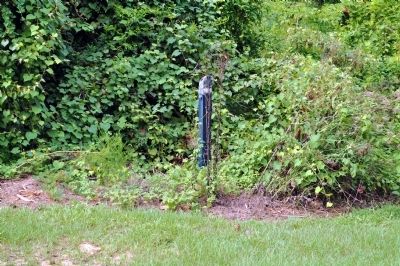
3. Toney-Standley House Marker Post
Photographed by David Seibert, August 14, 2011
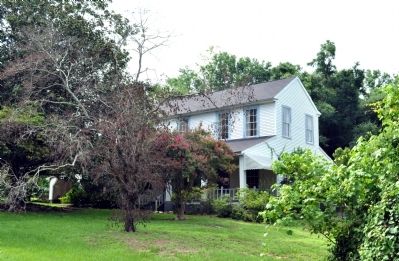
4. Toney-Standley House
The original end chimneys were lost when the house had to be moved due to the damming of the Chattahoochee River to create the Walter F. George Reservoir.
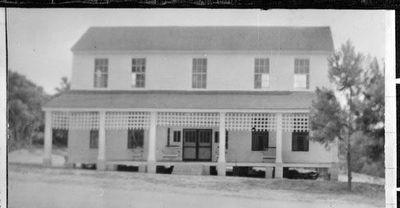
5. Toney-Standley House, date unknown
Courtesy Georgia Archives, the University System of Georgia
Credits. This page was last revised on October 8, 2020. It was originally submitted on December 18, 2011, by David Seibert of Sandy Springs, Georgia. This page has been viewed 1,190 times since then and 62 times this year. Photos: 1, 2. submitted on October 6, 2020, by Tim Fillmon of Webster, Florida. 3, 4. submitted on December 18, 2011, by David Seibert of Sandy Springs, Georgia. 5. submitted on September 25, 2015, by J. Makali Bruton of Washington, District of Columbia. • Craig Swain was the editor who published this page.
