Gaslamp Quarter in San Diego in San Diego County, California — The American West (Pacific Coastal)
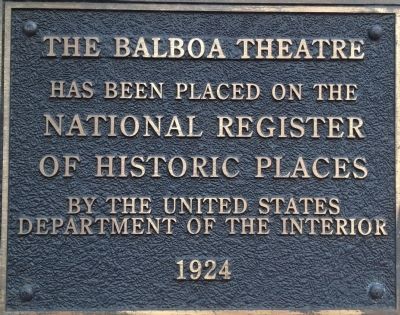
Balboa Theatre
Photographed by Dean Whittle, January 3, 2012
1. Balboa Theatre Marker
Has been placed on the
National Register
of Historic Places
by the United States
Department of the Interior
1924
Topics. This historical marker is listed in these topic lists: Arts, Letters, Music • Entertainment. A significant historical year for this entry is 1924.
Location. 32° 42.88′ N, 117° 9.69′ W. Marker is in San Diego, California, in San Diego County. It is in the Gaslamp Quarter. It is at the intersection of 4th Avenue and Broadway Court / E Street on 4th Avenue. This is a three way intersection. Marker is located at the Westfield Horton Plaza. Touch for map. Marker is at or near this postal address: 199 Horton Plaza, San Diego CA 92101, United States of America. Touch for directions.

Regionally, this marker is in California’s Peninsular Ranges. It is also in the American Borderlands and on the Pacific Coast. Globally, it is in North America, on the Ring of Fire, in the Pacific Rim, in the Western Hemisphere, in the Western World, and in the Anglosphere. Historically, it finds itself in what was once New Spain and also Mexico’s Alta California.
Other nearby markers. At
this page online
Also see . . . National Register of Historic Places Nomination Form.
National Register Nomination Form's Statement of Significance: The Balboa Theatre building, built in 1924, is an excellent example of the early 20th-century Spanish Colonial Revival movement. Contextually, it directly relates to the 1915-1916 Panama-California International Exposition that is credited with launching this movement. The Balboa Theatre building meets Criterion A in the area of broad patterns of entertainment and the performing arts. Significance is demonstrated in its design to accommodate both first rate(Submitted on July 11, 2025, by Douglass Halvorsen of Klamath Falls, Oregon.)legitimate and cinematic presentations. In 1923 the owner/developer signed the largest motion picture distribution contract in California anticipating the cinematic trend for downtown San Diego. The Balboa Theatre building meets Criteria C in the area of architecture as one of the best commercial examples of the Spanish Colonial style, in San Diego, borrowing directly from the Exposition and utilizing many of the same contractors, designers and craftsmen. The architect William Wheeler was also an accomplished musical performer who built many features into the interior that enhanced the acoustics and performance spaces. The Balboa is one of the last remaining theatres from the 1920's still in existence in San Diego.Photographed by Dean Whittle, January 3, 20122. Entrance - Balboa TheatreMarker is visible on the right facing the Mall walkway.
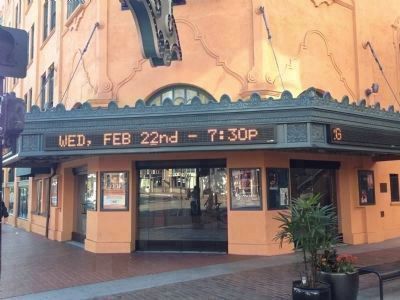
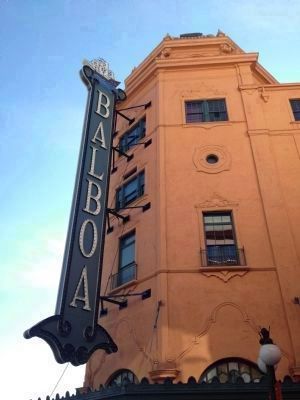
Photographed by Dean Whittle, January 3, 2012
3. Balboa Theatre
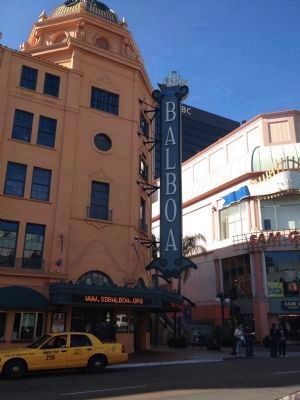
Photographed by Dean Whittle, January 3, 2012
4. Balboa Theatre Marker
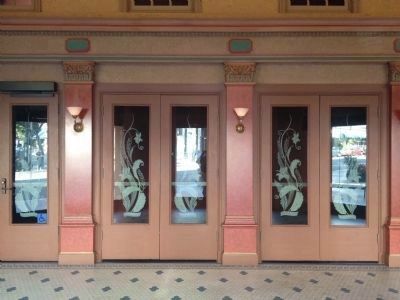
Photographed by Dean Whittle, January 3, 2012
5. Balboa Theatre Lobby Entrance
This view is from outside the entrance doors looking through the windows to the inner doors which lead to the lobby.
Photographed by Dean Whittle, January 3, 2012
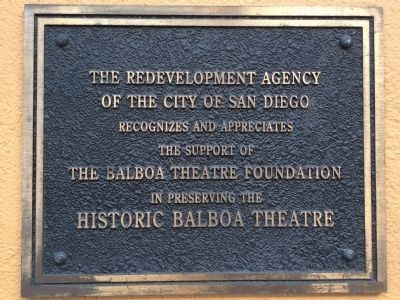
6. Balboa Theatre Marker
of San Diego
recognizes and appreciates
the support of
The Balboa Theatre Foundation
in preserving the
Historic Balboa Theatre
Credits. This page was last revised on January 27, 2026. It was originally submitted on January 3, 2012, by Dean Whittle of San Diego, California. This page has been viewed 927 times since then and 33 times this year. Last updated on January 9, 2012, by Michael Kindig of Elk Grove, California. Photos: 1, 2, 3, 4, 5, 6. submitted on January 3, 2012, by Dean Whittle of San Diego, California. • Syd Whittle was the editor who published this page.
