Harleston Village in Charleston in Charleston County, South Carolina — The American South (South Atlantic)
95 Ashley Avenue
Mayor William A. Courtnay House
circa 1840
Photographed by Mike Stroud, December 18, 2011
1. 95 Ashley Avenue Marker
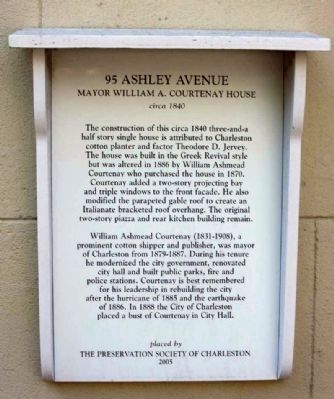
William Ashmead Courtenay (1831 - 1908), a prominent cotton shipper and publisher, was mayor of Charleston from 1879 - 1887. During his tenure he modernized the city government, renovated city hall and built public parks, fire and police stations Courtenay is best remembered for his leadership in rebuilding the city after the hurricane of 1885 and the earthquake of 1886. In 1888 the City of Charleston placed a bust of Courtenay in City Hall.
Erected 2005 by The Preservation Society of Charleston.
Topics and series. This historical marker is listed in these topic lists: Architecture
this page online
Location. 32° 46.787′ N, 79° 56.618′ W. Marker is in Charleston, South Carolina, in Charleston County. It is in Harleston Village. It is on Ashley Avenue near Montagu Street, on the left when traveling north. Touch for map. Marker is at or near this postal address: 95 Ashley Avenue, Charleston SC 29401, United States of America. Touch for directions.

Regionally, this marker is in Historic Charleston and in the Lowcountry. It is also in the American South, specifically in the Deep South, and on the Eastern Seaboard. Globally, it is in the North Atlantic Region, North America, the Western Hemisphere, the Western World, and the Anglosphere. Historically, it finds itself in what was once the territory of the Mississippian Culture, one of the original Thirteen Colonies, one of the Confederate States of America, and the Antebellum South.
Other nearby markers. At least 8 other markers are within walking distance of this marker: Glover - Sottile House (about
Photographed by Mike Stroud, December 18, 2011
2. 95 Ashley Avenue and Marker
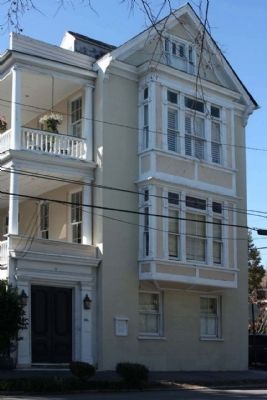
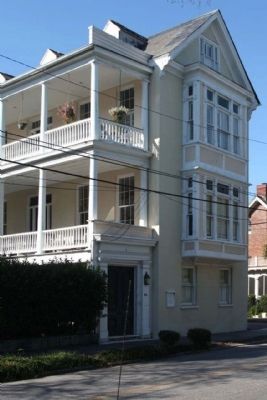
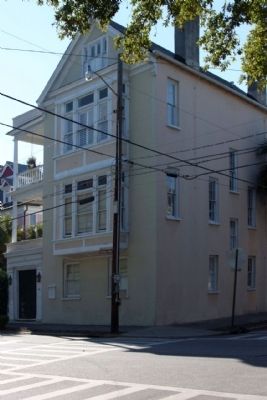
Regarding 95 Ashley Avenue. Mayor William Ashmead Courtenay's residence. Courtenay (1831-1908) was mayor of Charleston from 1879 to 1887. He used his business expertise to professionalize the city administration and made many permanent improvements, including the paving of major streets, such as King and Meeting streets, for the first time. His home was an older single house which was remodeled in the Queen Anne style, sometime between 1883 and 1893 .
(Mazyck & Waddell, illus. 2, 71; Archer, 7; News & Courier , Sept . 1, 1882: Sept . 2 , 1883.)
Additional commentary.
1. William Ashmead Courtenay
Served in General Lee's Army of Northern Virginia as a soldier in Joseph B. Kershaw's brigade in
Photographed by Mike Stroud, December 18, 2011
3. 95 Ashley Avenue
— Submitted January 18, 2012, by Mike Stroud of Bluffton, South Carolina.
Photographed by Mike Stroud, December 18, 2011
4. 95 Ashley Avenue Marker
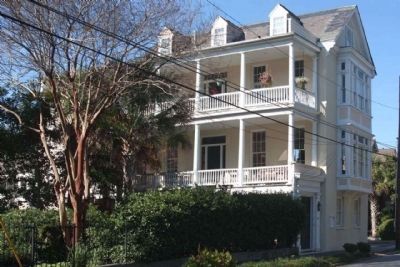
Photographed by Mike Stroud, December 18, 2011
5. 95 Ashley Avenue
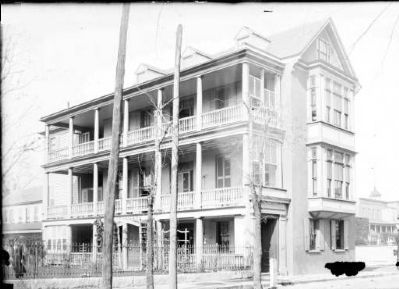
The University of South Carolina Library, George LaGrange Cook, c.1880-1895
6. 95 Ashley Avenue
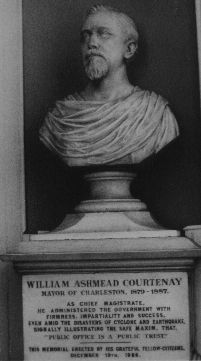
The University of Arkansas Press
7. the William Ashmead Courtenay Bust, as mentioned
Mayor of Charleston, 1879-1887
As Chief Magistrate
He administered the government with
firmness, impartiality and success.
Even amid the disasters of cyclone and earthquake,
signally illustrating the safe maxim, that,
"PUBLIC OFFICE IS A PUBLIC TRUST"
This memorial erected by his grateful fellow-citizens,
December 19th, 1888.
The following biography is reprinted from "The News and Courier" Charleston, SC Dec. 15, 1952, page 16:
William A. Courtenay Ranks With the City's Greatest Mayors A bust of William Ashmead Courtenay, considered by many persons to have been Charleston's greatest mayor, occupies a niche in the corner of the committee room to the west of the City Council Chamber in City Hall. It is almost as if this likeness of the man who guided Charleston's destinies through its greatest disaster, the 1886 earthquake, watches over the deliberations of the committees which mold the policies of city government.
Credits. This page was last revised on February 16, 2023. It was originally submitted on January 18, 2012, by Mike Stroud of Bluffton, South Carolina. This page has been viewed 1,004 times since then and 40 times this year. Photos: 1, 2, 3, 4, 5, 6, 7. submitted on January 18, 2012, by Mike Stroud of Bluffton, South Carolina.
