South San Jose in Santa Clara County, California — The American West (Pacific Coastal)
Ng Shing Gung
Temple of Five Gods
Photographed by Barry Swackhamer, January 25, 2012
1. Ng Shing Gung Marker
[Photo caption:]
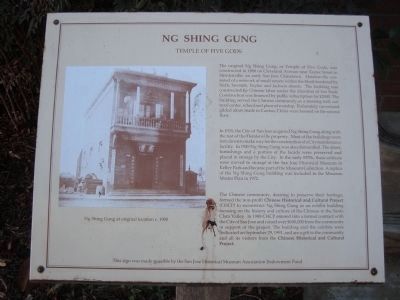
Ng Shing Gung at original location c. 1900.
Ng Shing Gung at original location c. 1900.
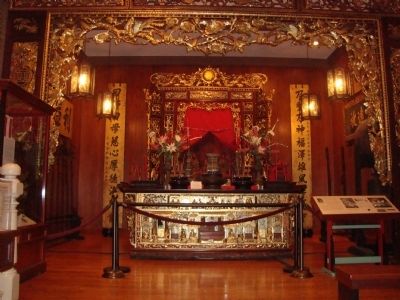
In 1931, the City of San Jose acquired Ng Shing Gung along with the rest of the Heinlenville property. Most of the buildings were torn down to make way for the construction of a City maintenance facility. In 1949 Ng Shing Gung was also dismantled. The altar furnishings and a portion of the facade were preserved and placed in storage by the City. In the early 1970s, these artifacts were moved to storage at the San Jose Historical Museum in Kelly Park and became part of the Museum Collection. A replica of
this page online
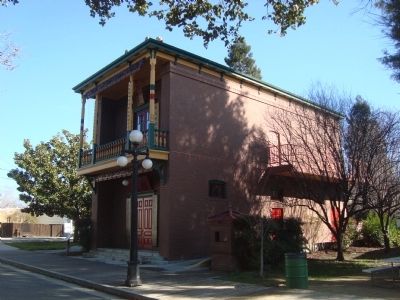
The Chinese community, desiring to preserve their heritage, formed the non-profit Chinese Historical and Cultural Project (CHCP) to reconstruct Ng Shing Gung as an exhibit building focusing on the history and culture of the Chinese in Santa Clara Valley. In 1988 CHCP entered into formal contract with the City of San Jose and raised over $600,000 from the community in support of the project. The building and the exhibits were dedicated on September 29, 1991, and are a gift to the community and all its visitors from the Chinese Historical and Cultural Project.
This sign was made possible by the San Jose Historical Museum Association Endowment Fund.
Erected by San Jose Historical Museum Association.
Topics. This historical marker is listed in this topic list: Asian Americans. A significant historical month for this entry is September 1956.
Location. This marker has been replaced by another marker nearby. It was located near 37° 19.191′ N, 121° 51.492′ W. Marker was in San Jose, California, in Santa Clara County. It was in South San Jose. It could be reached from
Photographed by Joseph Alvarado, June 24, 2023
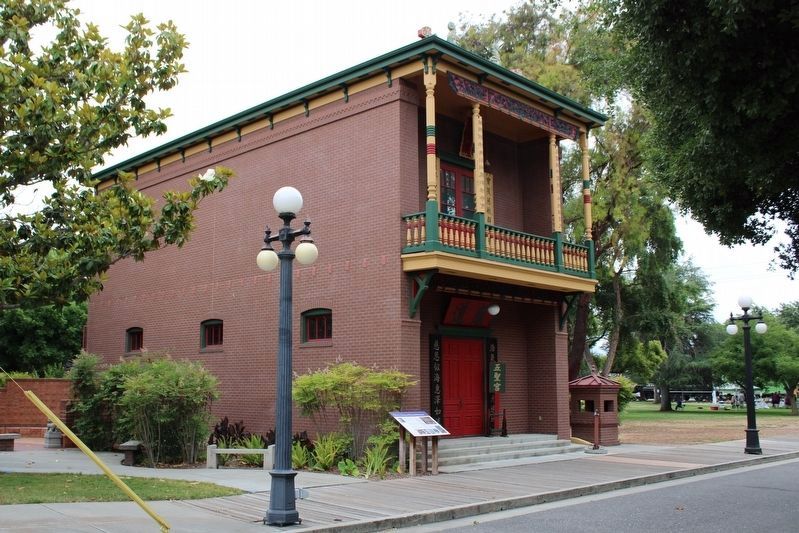
2. Replacement Marker

Regionally, this marker was in California’s San Francisco Bay Area, in Silicon Valley, and on the Coast Ranges. It was also on the American Pacific Coast. Globally, it was in North America, on the Ring of Fire, in the Pacific Rim, in the Western Hemisphere, in the Western World, and in the Anglosphere. Historically, it found itself in what was once New Spain and also Mexico’s Alta California.
Other nearby markers. At least 8 other markers are within walking distance of this location: Replica 1888 Ng Shing Gung – Temple of Five Gods (here, next to this marker); The Printing Office (within shouting distance of this marker); The Print Shop (within shouting distance of this marker); Dr. Warburton’s Office (within shouting distance of this marker); Pacific Hotel (within shouting distance of this marker); Mayor Janet Gray Hayes (within shouting distance of this marker); O’Brien’s (within shouting distance of this marker); Rod Diridon Sr. Trolley Barn
Photographed by Barry Swackhamer, January 25, 2012
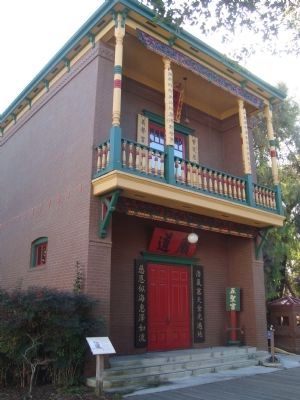
3. Ng Shing Gung and Marker
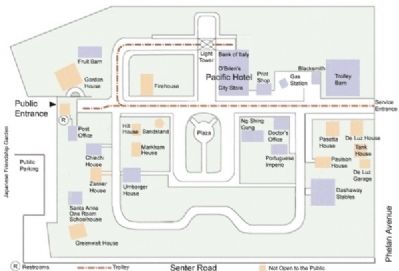
More about this marker. This marker is located in History Park, a part of Kelly Park.
Related marker. Click here for another marker that is related to this marker. Replica 1888 Ng Shing Gung – Temple of Five Gods
Photographed by Barry Swackhamer, January 25, 2012
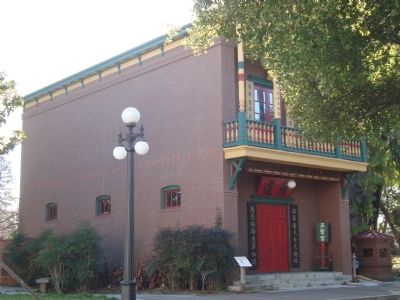
4. The Ng Shing Gung Temple
Photographed by Barry Swackhamer, January 25, 2012
5. The Ng Shing Gung Temple
Photographed by Barry Swackhamer, January 29, 2012
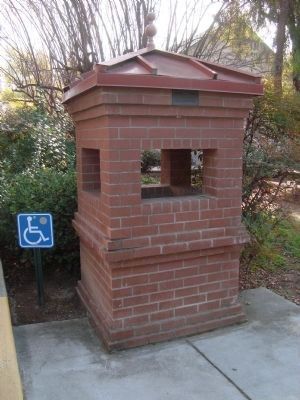
6. Siew Yee Lo
[The plaque near the top of the Siew Yee Lo reads:]
An important part of the worship practice was the use of the Siew Yee Lo or “Burning Offerings Oven.” Paper offerings, paper money and incense were burned in the oven depending on the occasion. This is a replica of the Siew Yee Lo which stood next to the original Ng Shing Gung.
An important part of the worship practice was the use of the Siew Yee Lo or “Burning Offerings Oven.” Paper offerings, paper money and incense were burned in the oven depending on the occasion. This is a replica of the Siew Yee Lo which stood next to the original Ng Shing Gung.
Photographed by Barry Swackhamer, January 29, 2012
7. Ng Shing Gung Shrine
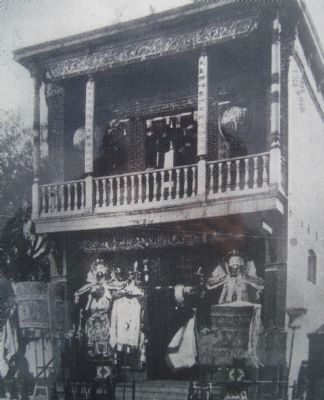
8. Ng Shing Gung at original location c. 1900.
Photographed by Barry Swackhamer
9. Map of History Park
Credits. This page was last revised on February 12, 2026. It was originally submitted on February 3, 2012, by Barry Swackhamer of Brentwood, California. This page has been viewed 1,278 times since then and 51 times this year. Photos: 1. submitted on February 3, 2012, by Barry Swackhamer of Brentwood, California. 2. submitted on June 25, 2023, by Joseph Alvarado of Livermore, California. 3, 4, 5, 6, 7, 8, 9. submitted on February 3, 2012, by Barry Swackhamer of Brentwood, California. • Syd Whittle was the editor who published this page.
