Melbourne Village in Brevard County, Florida — The American South (South Atlantic)
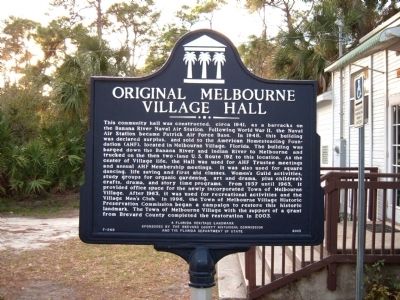
Original Melbourne Village Hall
Photographed by Jamie Cox, February 13, 2012
1. Original Melbourne Village Hall Marker
this page online
Erected 2005. (Marker Number F-542.)
Topics. This historical marker is listed in these topic lists: Arts, Letters, Music • Charity & Public Work • Entertainment • War, World II. A significant historical year for this entry is 1941.
Location. 28° 5.091′ N, 80° 39.884′ W. Marker is in Melbourne Village, Florida, in Brevard County. It is on Hall Drive. Marker is located at the end of Hall Drive which is a dirt road as of 2012. Hall Drive can be reached from Dayton Boulevard off of US 192. Touch for map. Marker is in this post office area: Melbourne FL 32904, United States of America. Touch for directions.

Regionally, this marker is in the Space Coast. It is also in the American South and on the Eastern Seaboard. Globally, it is in the North Atlantic Region, North America, a Gulf of Mexico state, the Western Hemisphere, the Western World, and the Anglosphere. Historically, it finds itself in what was once New Spain, the territory of the Mississippian Culture, one of the Confederate States of America, and the Antebellum South.
Photographed by Jamie Cox, February 13, 2012
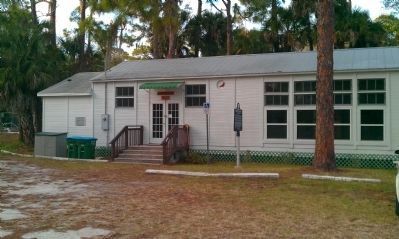
2. Original Melbourne Village Hall
Formerly a barracks at NAS Banana River
Other nearby markers. At least 8 other markers are within 3 miles of this marker, measured as the crow flies: The Hernandez-Capron Trail (approx. one mile away); Union Cypress Railway (approx. 1.3 miles away); Naval Air Station Melbourne (approx. 2.1 miles away); Lincoln Hotel (approx. 2.3 miles away); Land Yacht Port-O-Call (approx. 2.3 miles away); Holy Trinity (approx. 2.6 miles away); Florida Institute of Technology (approx. 2.8 miles away); Little Red Schoolhouse (approx. 2.9 miles away).
Another marker is no longer nearby. Holy Trinity Episcopal Church (was approx. 2.6 miles away but has been confirmed missing).
Additional keywords. NAS
Photographed by Jamie Cox, February 13, 2012
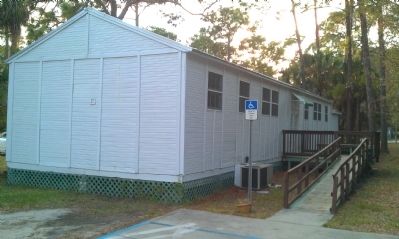
3. Original Melbourne Village Hall
Photographed by Jamie Cox, February 13, 2012
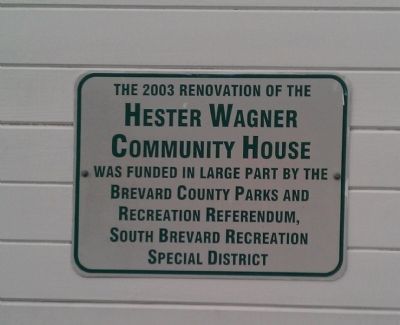
4. Hester Wagner Community House
aka Melbourne Village Hall
Credits. This page was last revised on January 26, 2020. It was originally submitted on February 17, 2012, by Jamie Cox of Melbourne, Florida. This page has been viewed 1,317 times since then and 70 times this year. Photos: 1, 2, 3, 4. submitted on February 17, 2012, by Jamie Cox of Melbourne, Florida. • Craig Swain was the editor who published this page.
