Asylum Hill in Hartford in Capitol Region, Connecticut — The American Northeast (New England)
Harriet Beecher Stowe House
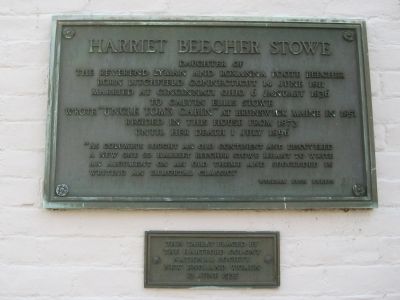
Photographed by Michael Herrick, February 1, 2012
1. The Historical Marker Database - Add A Marker Step 2 Marker
Daughter of the Reverend Lyman and Roxanna Foote Beecher. Born Litchfield Connecticut 14 June 1811. Married at Cincinnati Ohio 6 January 1836 to Calvin Ellis Stowe. Wrote "Uncle Tom's Cabin" at Brunswick Maine in 1851. Resided in this house from 1837 until her death 1 July 1896.
"As Columbus sought an old continent and discovered a new one so Harriet Beecher Stowe meant to write an argument on an old theme and succeeded in writing an immortal classic."
William Lyon Phelps
Erected 1935 by The Hartford Colony, National Society of New England Women.
Topics. This historical marker is listed in these topic lists: Arts, Letters, Music • Women. A significant historical date for this entry is June 14, 1811.
Location. 41° 46.009′ N, 72° 42.012′ W. Marker is in Hartford in Capitol Region, Connecticut. It is in Asylum Hill. It is on Forrest Street 0.1 miles south of Farmington Avenue, on the right when traveling south. Touch for map. Marker is at or near this postal address: 77 Forrest Street, Hartford CT 06105, United States of America. Touch for directions.

Regionally, this marker is in the Connecticut River Valley and
this page online
Other nearby markers. At least 8 other markers are within walking distance of this marker: 915-917 West Boulevard (approx. 0.7 miles away); 919-921 West Boulevard (approx. 0.7 miles away); 927-929 West Boulevard (approx. 0.7 miles away); 935-937 West Boulevard (approx. 0.7 miles away); 939-941 West Boulevard (approx. 0.7 miles away); 943-945 West Boulevard (approx. 0.7 miles away); 947-949 West Boulevard (approx. 0.7 miles away); 951-953 West Boulevard (approx. ¾ mile away). Touch for a list and map of all markers in Hartford.
Regarding Harriet Beecher Stowe House. The Harriet Beecher Stowe Center preserves and interprets Stowe's Hartford home and the Center's historic collections, promotes vibrant discussion of her life and work, and inspires commitment to social justice and positive change.
Also see . . .
1. Harriet Beecher Stowe on Wikipedia.
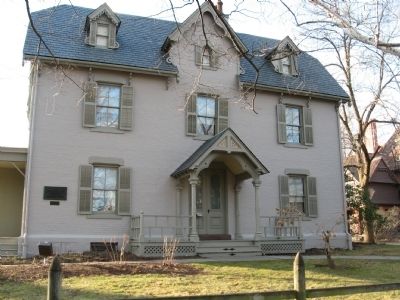
Photographed by Michael Herrick, February 1, 2012
2. Harriet Beecher Stowe House
2. Harriet Beecher Stowe Center. (Submitted on March 3, 2012, by Michael Herrick of Southbury, Connecticut.)
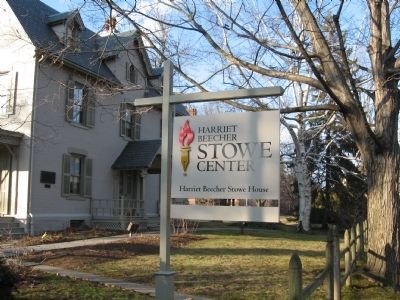
Photographed by Michael Herrick, February 1, 2012
3. Harriet Beecher Stowe Center
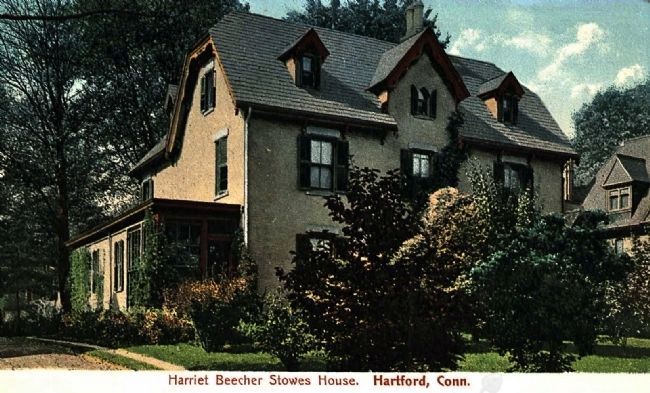
circa 1905
4. Harriet Beecher Stowe House

Photographed by Allen C. Browne, August 9, 2015
5. Harriet Beecher Stowe
This 1853 portrait of Harriet Beecher Stowe by Alanson Fisher hangs in the National Portrait Gallery in Washington, DC.
“Excluded from public professions, cultivated women sought other avenues for their talents. From discussing the issues of the day in informal salon gatherings, it was a short step for women to become writers, especially since the antebellum period saw a burgeoning number of magazines catering to women. So Harriet Beecher Stowe started a career that made her one of the most popular novelists of the nineteenth century. Stowe's place in American history was sealed with her novel Uncle Tom's Cabin (1851-52), which sold 300,000 copies in its first year. Uncle Tom's Cabin was a reform novel; Stowe was motivated to write it by the Fugitive Slave Law and the effect that slavery had in destroying the African American family. No more effective charge could be made in a nation that, both North and South, revered the family as the foundation of society.” — National Portrait Gallery
“Excluded from public professions, cultivated women sought other avenues for their talents. From discussing the issues of the day in informal salon gatherings, it was a short step for women to become writers, especially since the antebellum period saw a burgeoning number of magazines catering to women. So Harriet Beecher Stowe started a career that made her one of the most popular novelists of the nineteenth century. Stowe's place in American history was sealed with her novel Uncle Tom's Cabin (1851-52), which sold 300,000 copies in its first year. Uncle Tom's Cabin was a reform novel; Stowe was motivated to write it by the Fugitive Slave Law and the effect that slavery had in destroying the African American family. No more effective charge could be made in a nation that, both North and South, revered the family as the foundation of society.” — National Portrait Gallery
Credits. This page was last revised on May 19, 2026. It was originally submitted on March 3, 2012, by Michael Herrick of Southbury, Connecticut. This page has been viewed 1,366 times since then and 33 times this year. Photos: 1, 2, 3. submitted on March 3, 2012, by Michael Herrick of Southbury, Connecticut. 4. submitted on November 8, 2014. 5. submitted on August 10, 2015, by Allen C. Browne of Silver Spring, Maryland.
