Near Moncks Corner in Berkeley County, South Carolina — The American South (South Atlantic)
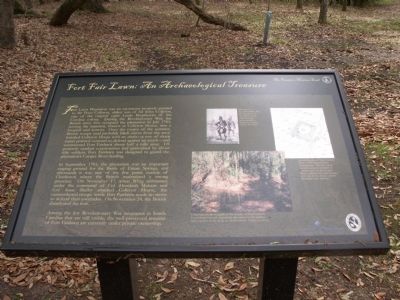
Fort Fair Lawn: An Archeaological Treasure
Photographed by Anna Inbody, March 24, 2012
1. Fort Fair Lawn: An Archeaological Treasure Marker
Fair Lawn Plantation was an enormous property granted to Sir Peter Colleton, oldest son of Sir John Colleton, one of the original eight Lords Proprietors of the Carolina colony. During the Revolutionary War, the British army first occupied the plantation in July 1781, turning the mansion, known as Colleton House, into a hospital and armory. Over the course of the summer, British troops (and probably black slaves from the area) fortified Colleton House with an abatis ~ a row of sharp stakes pointed outward to defend against an attack ~ and constructed Fort Fairlawn about half a mile away. Of primarily earthen construction and garrisoned by about fifty soldiers, Fort Fairlawn was designed to guard the plantation’s Cooper River landing.
In September 1781, the plantation was an important staging ground for the Battle of Eutaw Springs, and afterwards it was one of the few posts outside of Charleston where the British maintained a strong presence. On November 17, when Whig militiamen under the command of Col. Hezekiah Maham and Col. Isaac Shelby attacked Colleton House, the outnumbered troops inside Fort Fairlawn made no move
this page online
Among the few Revolutionary War structures in South Carolina that are still visible, the well-preserved remains of Fort Fairlawn are currently under private ownership.
Erected 2012 by Francis Marion Trail Commission of Francis Marion University.
Topics and series. This historical marker is listed in these topic lists: Colonial Era • War, US Revolutionary. In addition, it is included in the Francis Marion Trail series list. A significant historical month for this entry is July 1781.
Location. 33° 11.6′ N, 79° 58.317′ W. Marker is near Moncks Corner, South Carolina, in Berkeley County. It can be reached from Stony Landing Road. Marker is inside Old Santee Canal Park. Touch for map. Marker is in this post office area: Moncks Corner SC 29461, United States of America. Touch for directions.

Regionally, this marker is in the Lowcountry and in Santee Cooper Country. It is also in the American South, specifically in the Deep South, and on the Eastern Seaboard. Globally, it is in the North Atlantic Region, North America, the Western Hemisphere, the Western World,
Photographed by Anna Inbody, March 24, 2012
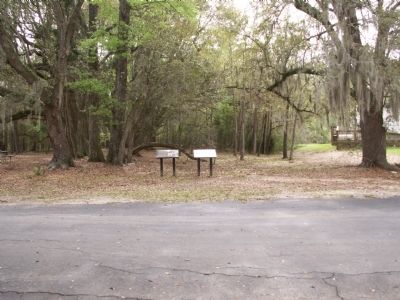
2. Overview
Other nearby markers. At least 8 other markers are within walking distance of this marker: Colleton House: “Unmanly Practices” or Legitimate Target? (a few steps from this marker); Too Formidable to Take (within shouting distance of this marker); C.S.S. David / Little David Replica (within shouting distance of this marker); From Plantation to Fort (within shouting distance of this marker); Berkeley County Museum and Heritage Center: A County's Story (within shouting distance of this marker); Santee Cooper Hydroelectric & Navigation Project (within shouting distance of this marker); Berkeley County Confederate Monument (within shouting distance of this marker); Preserving the Past for the Future (about 300 feet away, measured in a direct line). Touch for a list and map of all markers in Moncks Corner.
Photographed by Anna Inbody, March 24, 2012
3. Drawing on the Marker
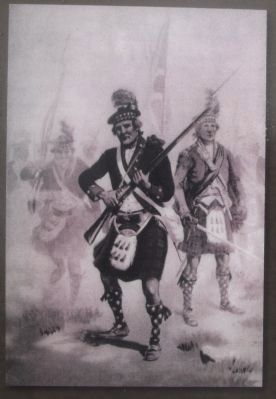
Drawing of a Scottish soldier. The 84th Regiment of the British Army, a Scottish unit, garrisoned Fort Fairlawn. Courtesy Charles M. Lefferts.
Photographed by Anna Inbody, March 24, 2012
4. Drawing on the Marker
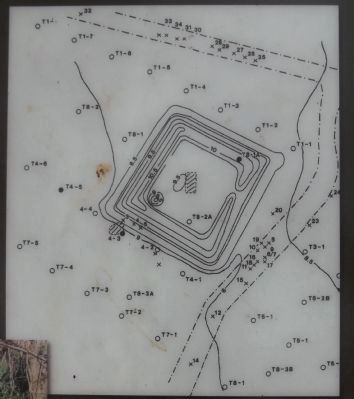
Layout drawing of Fort Fairlawn from a 1990 archaeological investigation. The four-sided earthen structure included an entrance port on the Cooper River, a cistern for water storage, and a protective moat.Courtesy Brockington and Associates
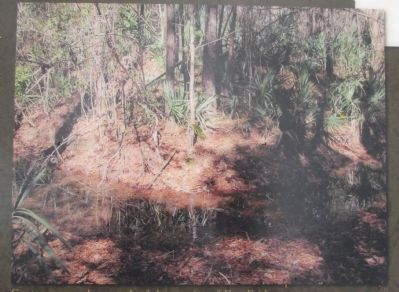
Photographed by Anna Inbody, March 24, 2012
5. Photograph on marker
Contemporary photograph of the remains of Fort Fairlawn. Even overgrown with vegetation, one corner of the earthen walls and part of the moat are clearly visible.Courtesy Cathi Lee
Credits. This page was last revised on May 26, 2026. It was originally submitted on March 25, 2012, by Anna Inbody of Columbia, South Carolina. This page has been viewed 5,387 times since then and 126 times this year. Photos: 1, 2, 3, 4, 5. submitted on March 25, 2012, by Anna Inbody of Columbia, South Carolina. • Bill Pfingsten was the editor who published this page.
