
Central Vancouver in Metro Vancouver, British Columbia — Canada’s West Coast (North America)
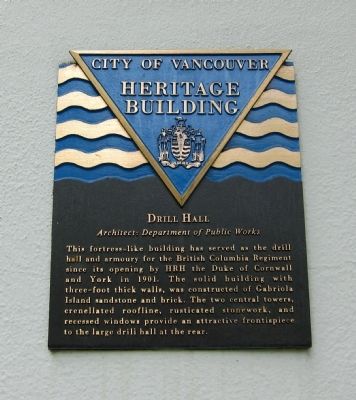
Drill Hall
City of Vancouver Heritage Building
| — | Architect: Department of Public Works | — |
Photographed by Andrew Ruppenstein, July 1, 2011
1. Drill Hall Marker
Topics and series. This historical marker is listed in these topic lists: Military • Notable Buildings. In addition, it is included in the Canada, Vancouver, City of Vancouver Heritage Buildings series list. A significant historical year for this entry is 1901.
Location. 49° 16.769′ N, 123° 6.652′ W. Marker is in Vancouver, British Columbia, in Metro Vancouver. It is in Central Vancouver. It is at the intersection of Beatty Street and Dunsmuir Street, on the right when traveling north on Beatty Street. Touch for map. Marker is at or near this postal address: 620 Beatty Street, Vancouver BC V6B 2L9, Canada. Touch for directions.

Regionally, this marker is on British Columbia’s Lower
this page online
Other nearby markers. At least 8 other markers are within walking distance of this marker: Sherman (a few steps from this marker); Ram Mk II (a few steps from this marker); 64 Pounder Guns (a few steps from this marker); Sun Tower (approx. 0.2 kilometers away); Edgett Building (approx. 0.2 kilometers away); Percy Williams Statue (approx. 0.2 kilometers away); Vancouver Daily Province 67 Years (approx. 0.3 kilometers away); Terry Fox Plaza (approx. 0.3 kilometers away). Touch for a list and map of all markers in Vancouver.
Also see . . .
1. The British Columbia Regiment. The Regiment's website, includes an extended historical section. (Submitted on April 8, 2012.)
2. Armoury. HistoricPlaces.ca's page for Drill Hall. On the Hall's historical value: Constructed as the regimental headquarters for the local militia, the Armoury is closely associated with the building campaign undertaken in conjunction with the development of the Active Volunteer Militia during the period preceding the First World War. During the First World War, the structure functioned as both training and recruitment centres.
Photographed by Andrew Ruppenstein, July 1, 2011
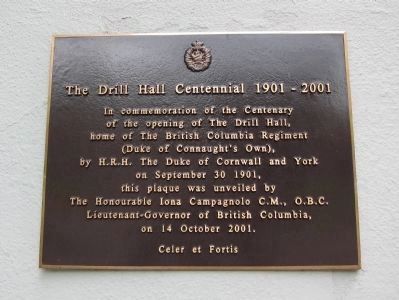
2. Drill Hall Centennial Plaque
Just to the left of the entrance to Drill Hall is a plaque commemorating the centennial of the opening of Drill Hall.
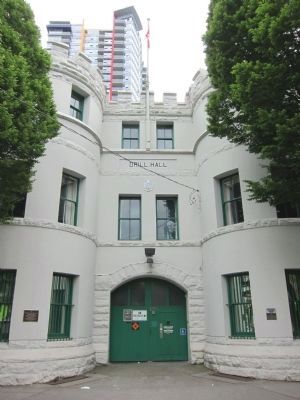
Photographed by Andrew Ruppenstein, July 1, 2011
3. Drill Hall Entrance and Marker
The marker is visible here to the right of the entrance, with the Drill Hall centennial plaque also visible to the left of the entrance.
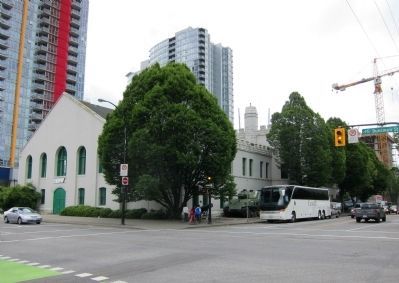
Photographed by Andrew Ruppenstein, July 1, 2011
4. Drill Hall, view from north (across Dunsmuir)
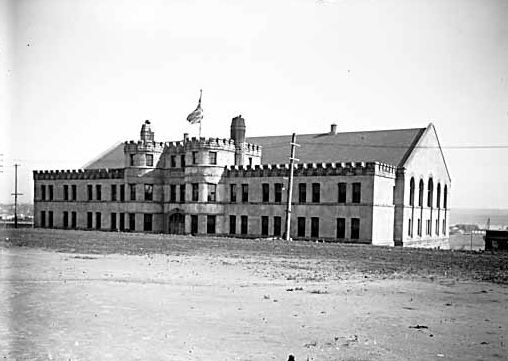
Photographed by Philip Timms, 1906
5. Drill Hall, 1906 - view from west (image courtesy of Vancouver Public Library)
Credits. This page was last revised on December 22, 2025. It was originally submitted on April 8, 2012, by Andrew Ruppenstein of Lamorinda, California. This page has been viewed 1,017 times since then and 16 times this year. Photos: 1, 2, 3, 4, 5. submitted on April 8, 2012, by Andrew Ruppenstein of Lamorinda, California. • Bill Pfingsten was the editor who published this page.
