Central Vancouver in Metro Vancouver, British Columbia — Canada’s West Coast (North America)
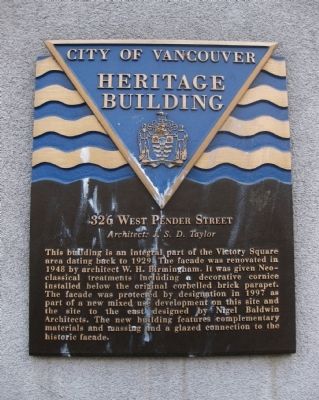
326 West Pender Street
City of Vancouver Heritage Building
| — | Architect: J.S.D. Taylor | — |
Photographed by Andrew Ruppenstein, June 8, 2010
1. 326 West Pender Street Marker
Topics and series. This historical marker is listed in this topic list: Notable Buildings. In addition, it is included in the Canada, Vancouver, City of Vancouver Heritage Buildings series list. A significant historical year for this entry is 1929.
Location. 49° 16.941′ N, 123° 6.687′ W. Marker is in Vancouver, British Columbia, in Metro Vancouver. It is in Central Vancouver. It is on West Pender Street close to Hamilton Street, on the right when traveling east. Touch for map. Marker is at or near this postal address: 326 West Pender Street, Vancouver BC V6B 1T1, Canada. Touch for directions.

Regionally,
this page online
Other nearby markers. At least 8 other markers are within walking distance of this marker: BC Permanent Building (a few steps from this marker); Vancouver Daily Province 67 Years (about 90 meters away, measured in a direct line); Here Stood Hamilton (about 90 meters away); Victory Square Cenotaph (about 120 meters away); Victory Square (about 120 meters away); Royal Bank of Canada Building (about 120 meters away); Dominion Building (about 120 meters away); Edgett Building (about 150 meters away). Touch for a list and map of all markers in Vancouver.
Also see . . . McBeath and Campbell Building. HistoricPlaces.ca's page for 326 West Pender Street. On the building's heritage value: "... Built in 1929, the facade of the McBeth and Campbell Building is valued for the simple Classical Revival influence displayed in its design, demonstrating the late persistence of traditional Period Revival styles. The building is characterized by an overall clarity of form and lightness of appearance with an austere but elegant facade of vertical proportions. It is notable for its lack of ornamental motifs, which are often aligned with such traditional styles, due partially to its late date of construction, when many designers were turning away from historic ornamentation towards a minimal modernism, and also due to the utilitarian nature of the business it housed."
Photographed by Andrew Ruppenstein, June 9, 2010
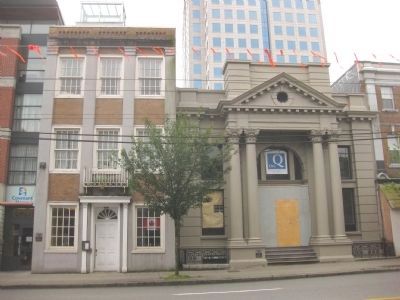
2. 326 West Pender Street and Marker
Depicted above are 326 West Pender (on the left), and the BC Permanent Building (also plaqued, on the right). The 326 West Pender marker is on the eastern (picture-left) corner of the building.
Credits. This page was last revised on December 22, 2025. It was originally submitted on April 15, 2012, by Andrew Ruppenstein of Lamorinda, California. This page has been viewed 855 times since then and 30 times this year. Photos: 1, 2. submitted on April 15, 2012, by Andrew Ruppenstein of Lamorinda, California. • Syd Whittle was the editor who published this page.
