Near Westville in Walton County, Florida — The American South (South Atlantic)
Alford’s Mill
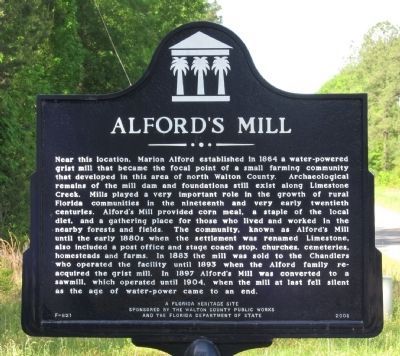
Photographed by Paul Fehrenbach, April 10, 2012
1. Alford’s Mill Marker
Erected 2008 by Walton County Public Works and the Florida Department
this page online
Topics. This historical marker is listed in these topic lists: Industry & Commerce • Settlements & Settlers. A significant historical year for this entry is 1864.
Location. 30° 59.306′ N, 86° 3.616′ W. Marker is near Westville, Florida, in Walton County. It is at the intersection of Oak Grove Road and Alford Road, on the right when traveling east on Oak Grove Road. Marker is approximately two miles northeast of the intersection of Oak Grove Road and County Road 181. Touch for map. Marker is at or near this postal address: 1791 Oak Grove Road, Westville FL 32464, United States of America. Touch for directions.

Regionally, this marker is on the Florida Panhandle. It is also in the American South, specifically in the Deep South, and on the Gulf Coast. Globally, it is in the North Atlantic Region, North America, a Gulf of Mexico state, the Western Hemisphere, the Western World, and the Anglosphere. Historically, it finds itself in what was once New Spain, the territory of the Mississippian Culture, one of the Confederate States of America, and the Antebellum South.
Other nearby markers. At
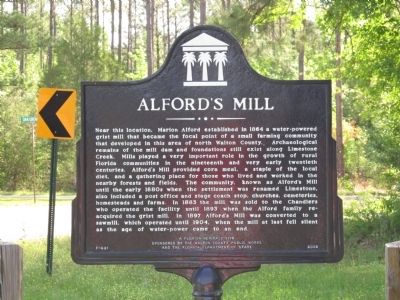
Photographed by Paul Fehrenbach, April 10, 2012
2. Alford’s Mill Marker reverse, with the same text
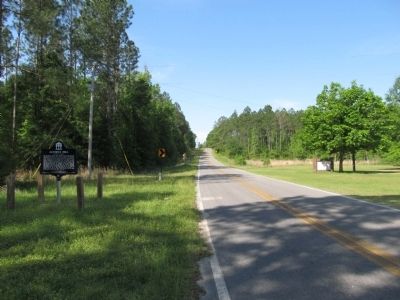
Photographed by Paul Fehrenbach, April 10, 2012
3. Alford’s Mill Marker
Looking west from intersection of Oak Grove and Alford Roads.
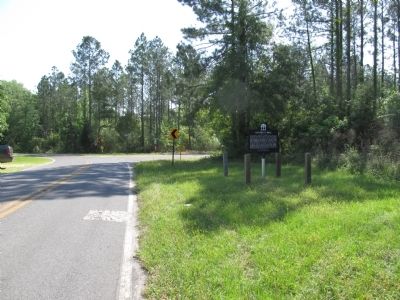
Photographed by Paul Fehrenbach, April 10, 2012
4. Alford’s Mill Marker
This view is looking east.
Credits. This page was last revised on July 22, 2018. It was originally submitted on April 24, 2012, by Paul Fehrenbach of Richfield, Wisconsin. This page has been viewed 1,812 times since then and 71 times this year. Photos: 1, 2, 3, 4. submitted on April 24, 2012, by Paul Fehrenbach of Richfield, Wisconsin. • Craig Swain was the editor who published this page.
