Five Points in Asheville in Buncombe County, North Carolina — The American South (South Atlantic)
The University of North Carolina at Asheville
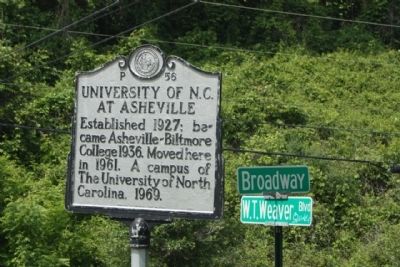
Photographed by Mike Stroud, May 19, 2012
1. The University of North Carolina at Asheville Marker
Erected 1976 by Division of Archives and History. (Marker Number P-56.)
Topics and series. This historical marker is listed in this topic list: Education. In addition, it is included in the North Carolina Division of Archives and History series list. A significant historical year for this entry is 1927.
Location. 35° 36.694′ N, 82° 33.973′ W. Marker is in Asheville, North Carolina, in Buncombe County. It is in Five Points. It is at the intersection of Broadway (State Highway 1791) and WT Weaver Blvd, on the right when traveling north on Broadway. Touch for map. Marker is in this post office area: Asheville NC 28801, United States of America. Touch for directions.

Regionally, this marker is in North Carolina’s Mountains. It is also in the American South, specifically in the Upper South, in Appalachia, and specifically in Southern Appalachia. Globally, it is in North America, the Western Hemisphere, the Western World, and the Anglosphere. Historically, it finds itself in what
this page online
Other nearby markers. At least 8 other markers are within walking distance of this marker: Buncombe Turnpike (within shouting distance of this marker); Zelda Fitzgerald (within shouting distance of this marker); Battle of Asheville (approx. ¼ mile away); a different marker also named Battle of Asheville (approx. 0.4 miles away); Riverside Cemetery (approx. 0.6 miles away); Richmond Pearson (approx. 0.7 miles away); Locke Craig (approx. ¾ mile away); Kiffin Y. Rockwell (approx. ¾ mile away). Touch for a list and map of all markers in Asheville.
Another marker is no longer nearby. 1st U.S. Colored Heavy Artillery (was approx. ¾ mile away but has been confirmed missing).
Regarding The University of North Carolina at Asheville. The University of North Carolina at Asheville was established in 1927 as Buncombe County Junior College, under the auspices of the Buncombe County Board of Education. The college operated separately as a free
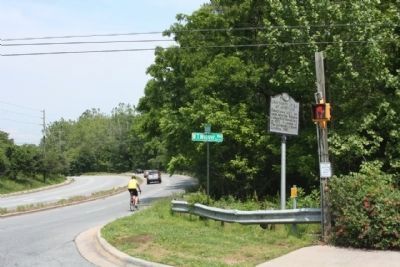
Photographed by Mike Stroud, May 19, 2012
2. The University of North Carolina at Asheville Marker seen along Broadway, looking north
The General Assembly approved state support for the college in 1955, and when the same body provided for the community college system in 1957, Asheville-Biltmore College was the first institution to qualify as a state supported community college. By 1958 the college, with the help of community leaders, launched a development campaign that eventually gave the institution the financial backing to purchase a 157-acre tract of land on the north side of town and to construct seven buildings there. The campus officially moved to the site in 1961. At the recommendation of the Governor’s Commission on Education Beyond High School, Asheville-Biltmore
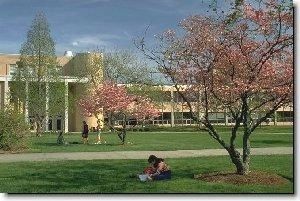
The University of North Carolina at Asheville
3. The University of North Carolina at Asheville
Credits. This page was last revised on June 1, 2025. It was originally submitted on May 21, 2012, by Mike Stroud of Bluffton, South Carolina. This page has been viewed 750 times since then and 26 times this year. Photos: 1, 2. submitted on May 23, 2012, by Mike Stroud of Bluffton, South Carolina. 3. submitted on May 21, 2012, by Mike Stroud of Bluffton, South Carolina.
