Haw Creek in Asheville in Buncombe County, North Carolina — The American South (South Atlantic)
Forster A. Sondley
1857 - 1931
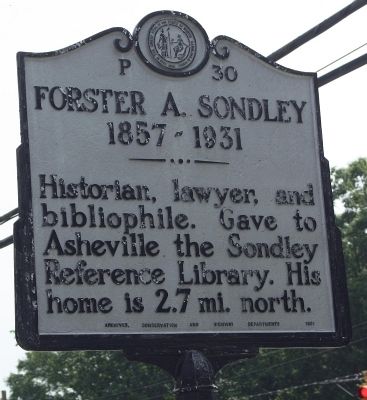
Photographed by Mike Stroud, May 19, 2012
1. Forster A. Sondley Marker
Erected 1951 by Archives, Conservation and Highway Departments. (Marker Number P-30.)
Topics and series. This historical marker is listed in these topic lists: Charity & Public Work • Education. In addition, it is included in the North Carolina Division of Archives and History series list.
Location. 35° 35.343′ N, 82° 30.015′ W. Marker is in Asheville, North Carolina, in Buncombe County. It is in Haw Creek. It is at the intersection of Tunnel Road (U.S. 70) and Beverly Road, on the right when traveling west on Tunnel Road. Touch for map. Marker is in this post office area: Asheville NC 28805, United States of America. Touch for directions.

Regionally, this marker is in the Mountains. It is also in the American South, specifically in the Upper South, in Appalachia, and specifically in Southern Appalachia. Globally, it is in North America, the Western Hemisphere, the Western World, and the Anglosphere. Historically, it finds itself in what was
this page online
Other nearby markers. At least 8 other markers are within 3 miles of this marker, measured as the crow flies: The American Chestnut / Chestnut Restoration (approx. 0.2 miles away); America’s Favorite Drive (approx. 1.8 miles away); Lee's School (approx. 1.8 miles away); Private George Avery (approx. 2.2 miles away); Allen High School (approx. 2½ miles away); Lillian Exum Clement Stafford (approx. 2.7 miles away); Allen School (approx. 2.7 miles away); Asheville's Enslaved People (approx. 2.7 miles away). Touch for a list and map of all markers in Asheville.
Regarding Forster A. Sondley. Foster A. Sondley, scholar and bibliophile, was born on August 13, 1857, at Montrealla, his grandmother’s home, in Alexander, a few miles north of Asheville. He was the youngest of Richard and Harriet Sondley’s six children. Sondley’s parents stressed proper education, and he attended several schools in the Asheville area before entering Wofford College in
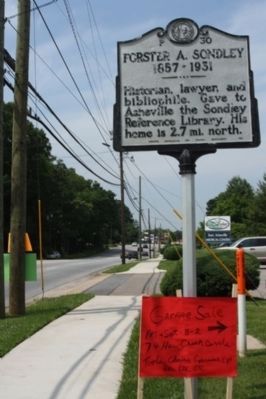
Photographed by Mike Stroud, May 19, 2012
2. Forster A. Sondley Marker, traveling west on Tunnel Road.
After graduation in 1876, Sondley returned to Asheville to practice law. Admitted to the bar, he received his law license from the North Carolina Supreme Court in 1879. Sondley’s knowledge and abilities, coupled with his charismatic courtroom presence, garnered him a reputation as one of the most capable civil attorneys in the state. However, at the peak of his career in 1905, Sondley retired to pursue other interests, specifically his study of North Carolina history.
Widely read and expert in state history, Sondley served on the first North Carolina Historical Commission in 1903, and fostered the development of the Buncombe County Historical Society. In 1911, Sondley moved to Finis Viae, a massive home built along Haw Creek near Asheville. At his new residence Sondley collected every document and artifact he could locate concerning North Carolina history.
By the time of his death on April 17, 1931, Sondley had amassed a library of nearly 30,000 volumes including many rare works pertaining to North Carolina history. An avid writer, Sondley produced Asheville and Buncombe County in 1922 and A History of Buncombe County in 1930.
A lifelong bachelor, Sondley held an estate which was broken up at his death and distributed among his nieces and nephews. However, Sondley left his library to the city of Asheville, and it formed the nucleus of the Sondley Reference Library at Asheville’s Pack Memorial Library.(North Carolina Dept. of Cultural Resources)
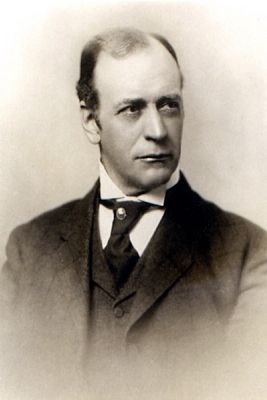
Photographed by Old Buncombe County Genealogy
3. Forester A. Sondley
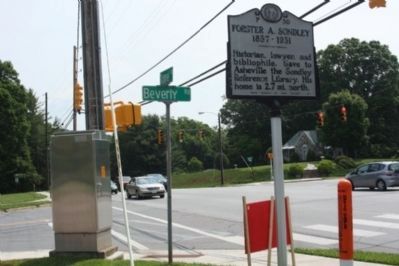
Photographed by Mike Stroud, May 19, 2012
4. Forster A. Sondley Marker, at the intersection of Tunnel Road (U.S. 70) and Beverly Road
Credits. This page was last revised on June 1, 2025. It was originally submitted on June 12, 2012, by Mike Stroud of Bluffton, South Carolina. This page has been viewed 1,187 times since then and 32 times this year. Photos: 1, 2, 3, 4. submitted on June 12, 2012, by Mike Stroud of Bluffton, South Carolina.
