Enka Village in Buncombe County, North Carolina — The American South (South Atlantic)
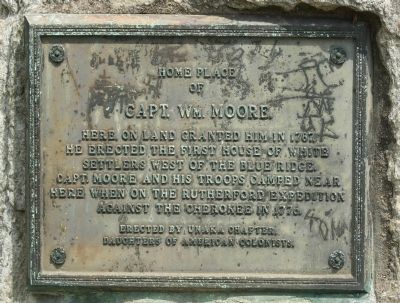
Home Place of Capt. Wm. Moore
Photographed by Mike Stroud, May 19, 2012
1. Home Place of Capt. Wm. Moore Marker
He erected the first house of white
settlers west of the Blue Ridge.
Capt. Moore and his troops camped near
here when on the Rutherford Expedition
against the Cherokee in 1776.
Erected by Unaka Chapter
Daughters of American Colonists.
Topics. This historical marker is listed in this topic list: Settlements & Settlers. A significant historical year for this entry is 1787.
Location. 35° 32.839′ N, 82° 38.008′ W. Marker is in Enka Village, North Carolina, in Buncombe County. It is on Sand Hill Road (State Highway 3412), on the right when traveling north. Touch for map. Marker is in this post office area: Asheville NC 28806, United States of America. Touch for directions.

Regionally, this marker is in the Mountains and in Greater Asheville. It is also in the American South, specifically in the Upper South, in Appalachia, and specifically in Southern Appalachia. Globally, it is in North America, the Western Hemisphere, the Western World, and the Anglosphere. Historically, it finds itself in what was once the original Cherokee Nation, the territory of the Mississippian Culture,
this page online
Other nearby markers. At least 8 other markers are within 4 miles of this marker, measured as the crow flies: William Moore (about 300 feet away, measured in a direct line); Sulphur Springs (approx. 1.8 miles away); Rutherford Trace (approx. 2 miles away); a different marker also named Rutherford Trace (approx. 2 miles away); Olive Tilford Dargan (approx. 2.9 miles away); "End of Car Line" (approx. 3.1 miles away); Dr. L.B. McBrayer (approx. 3.4 miles away); The Quilt Garden (approx. 3.7 miles away).
Regarding Home Place of Capt. Wm. Moore. Moore returned to western North Carolina after Rutherford’s expedition and settled on land along Hominy Creek. Moore and second wife, Margaret Patton, raised his six children from his first marriage to Ann Cathey as well as their six children. Moore served during the Revolution and then returned to Buncombe to serve in municipal and civic roles the remainder of his life. It is said that Moore first constructed a block fort on his property near Hominy Creek for protection from Native
Photographed by Mike Stroud, May 19, 2012
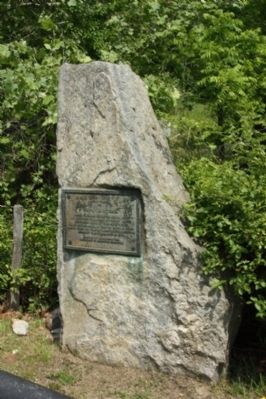
2. Home Place of Capt. Wm. Moore Marker
Also see . . . William Moore Homesite and Grave: A Patriot Builds Where He Camped. American Revolution Tour of North Carolina website entry (Submitted on November 23, 2024, by Larry Gertner of New York, New York.)
Additional commentary.
1. Home Place
The structure cannot be seen through the trees from the roadway.
— Submitted June 16, 2012, by Mike Stroud of Bluffton, South Carolina.

Photographed by Mike Stroud, May 19, 2012
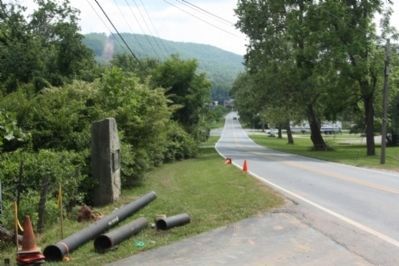
3. Home Place of Capt. Wm. Moore Marker along northbound Sand Hill Road
Photographed by Mike Stroud, May 19, 2012
4. Home Place of Capt. Wm. Moore Marker, seen looking south
via North Carolina History Project, unknown
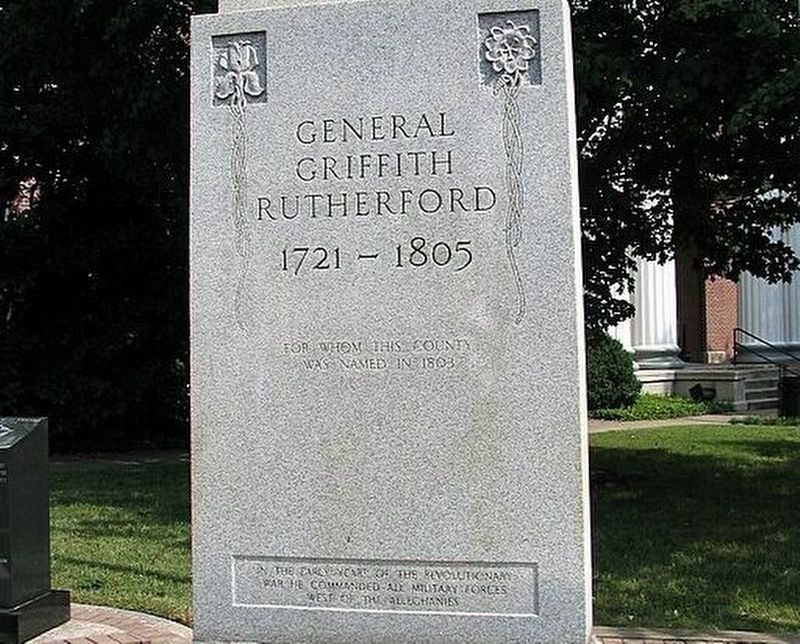
5. Rutherford's Campaign
North Carolina History Project website entry
Click for more information.
Click for more information.
Credits. This page was last revised on June 12, 2025. It was originally submitted on June 15, 2012, by Mike Stroud of Bluffton, South Carolina. This page has been viewed 1,172 times since then and 103 times this year. Photos: 1, 2, 3, 4. submitted on June 16, 2012, by Mike Stroud of Bluffton, South Carolina. 5. submitted on June 12, 2025, by Larry Gertner of New York, New York.
