Boston Theater District in Suffolk County, Massachusetts — The American Northeast (New England)
John Quincy Adams
Photographed by J. Makali Bruton, June 14, 2021
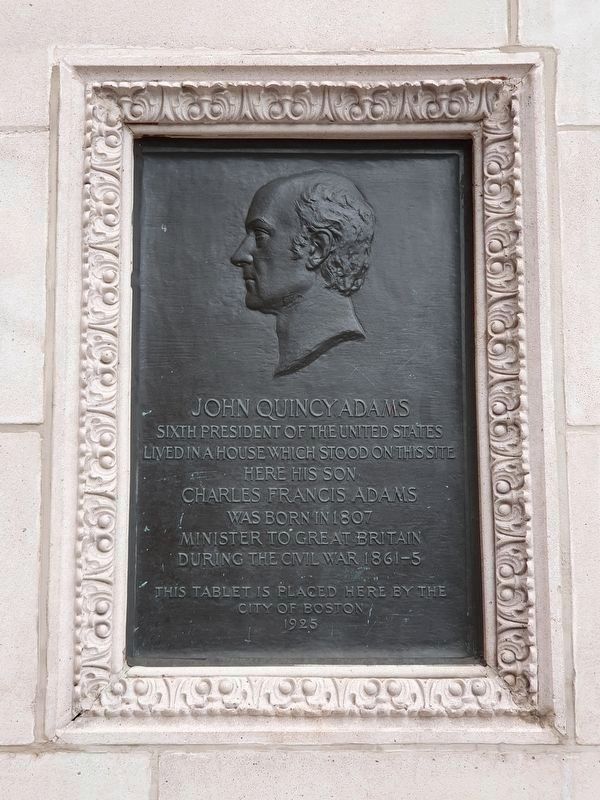
1. John Quincy Adams Marker
Sixth president of the United States
Lived in a house which stood on this site
Here his son
Charles Francis Adams
Was born in 1807
Minister to Great Britain
During the Civil War 1861-5
Erected 1925 by The City of Boston.
Topics and series. This historical marker is listed in these topic lists: Patriots & Patriotism • Settlements & Settlers • War, US Civil. In addition, it is included in the Former U.S. Presidents: #06 John Quincy Adams series list. A significant historical year for this entry is 1807.
Location. 42° 21.138′ N, 71° 3.864′ W. Marker is in Boston, Massachusetts, in Suffolk County. It is in the Boston Theater District. It is on Boylston Street, on the right when traveling east. Touch for map. Marker is at or near this postal address: 62 Boylston Street, Boston MA 02116, United States of America. Touch for directions.

Regionally, this marker is in Massachusetts’ Historic Boston. It is also in the American Northeast, in New England, and on the Eastern Seaboard. Globally, it is in the North Atlantic Region, North America, the Western Hemisphere, the Western
this page online
Other nearby markers. At least 8 other markers are within walking distance of this marker: The Union (within shouting distance of this marker); Boston Young Men's Christian Union (within shouting distance of this marker); Colonial Theatre (about 300 feet away, measured in a direct line); Emerson Majestic Theatre (about 300 feet away); William Billings (about 400 feet away); Liberty Tree Plaza (about 400 feet away); Liberty Tree Block (about 500 feet away); Theater in Boston (about 600 feet away). Touch for a list and map of all markers in Boston.
Also see . . . John Quincy Adams (Wikipedia). (Submitted on June 21, 2012, by Bryan Simmons of Attleboro, Massachusetts.)
Photographed by Bryan Simmons, June 2012
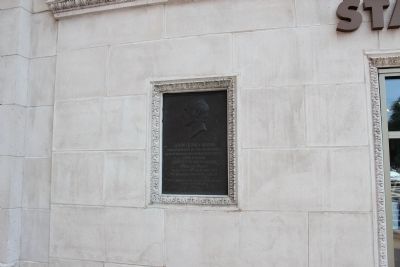
2. John Quincy Adams Marker
Photographed by Bryan Simmons, June 2012
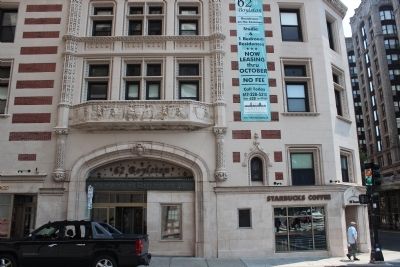
3. John Quincy Adams Marker
Photographed by Allen C. Browne, February 16, 2015
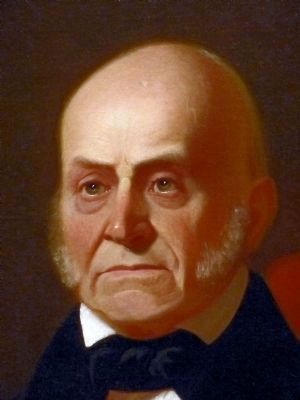
4. John Quincy Adams
Sixth President, 1825–29
Sixth President, 1825–29
This 1850 portrait of John Quincy Adams by George Caleb Bingham (after an 1844 original) hangs in the National Portrait Gallery in Washington, DC.
“John Quincy Adams's tenure as James Monroe's secretary of state ranks among the most productive In the history of that office. But Adams's often tactless ways were ill-suited for the presidency, and when his vision for such items as a comprehensive national transportation system met with hostility in Congress, he would not compromise. As a result, his administration's accomplishments were meager. But Adams was not through with political life. Elected to the House of Representatives in 1830, he served there until his death. In his prolonged and successful struggle defending the antislavery movement's right to petition Congress, ‘Old Man Eloquent‘ had gained a circle of admirers that extended well beyond his Massachusetts constituency.
When Adams sat for this portrait, he doubted that artist George Caleb Bingham could produce ‘a strong likeness.’ But Bingham did just that, and the portrait's vitality seems to echo Ralph Waldo Emerson's comment that the aging Adams was ‘like one of those old cardinals, who as quick as he is chosen Pope, throws away his crutches and his crookedness, and is as straight as a boy.’” — National Portrait Gallery
“John Quincy Adams's tenure as James Monroe's secretary of state ranks among the most productive In the history of that office. But Adams's often tactless ways were ill-suited for the presidency, and when his vision for such items as a comprehensive national transportation system met with hostility in Congress, he would not compromise. As a result, his administration's accomplishments were meager. But Adams was not through with political life. Elected to the House of Representatives in 1830, he served there until his death. In his prolonged and successful struggle defending the antislavery movement's right to petition Congress, ‘Old Man Eloquent‘ had gained a circle of admirers that extended well beyond his Massachusetts constituency.
When Adams sat for this portrait, he doubted that artist George Caleb Bingham could produce ‘a strong likeness.’ But Bingham did just that, and the portrait's vitality seems to echo Ralph Waldo Emerson's comment that the aging Adams was ‘like one of those old cardinals, who as quick as he is chosen Pope, throws away his crutches and his crookedness, and is as straight as a boy.’” — National Portrait Gallery
Credits. This page was last revised on January 30, 2023. It was originally submitted on June 21, 2012, by Bryan Simmons of Attleboro, Massachusetts. This page has been viewed 1,261 times since then and 54 times this year. Photos: 1. submitted on June 14, 2021, by J. Makali Bruton of Washington, District of Columbia. 2, 3. submitted on June 21, 2012, by Bryan Simmons of Attleboro, Massachusetts. 4. submitted on April 14, 2015, by Allen C. Browne of Silver Spring, Maryland. • Bill Pfingsten was the editor who published this page.
