Federal Triangle in Northwest Washington in Washington, District of Columbia — The American Northeast (Mid-Atlantic)
Grandeur for the People
Make No Little Plans
| — | Federal Triangle Heritage Trail | — |
Photographed by Craig Swain, June 9, 2012
1. Grandeur for the People Marker
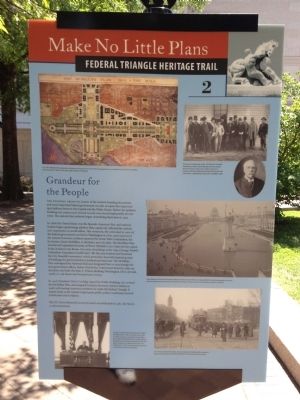
The National Archives, keeper of the nation's founding documents and most important federal government records, occupies this important spot halfway between the Capitol and the White House. Before the Archives building was constructed, federal records were stored haphazardly all over town. The nation's first archivist began centralizing them here in 1935.
In 1898 the United States won the Spanish-American War, and national leaders began questioning whether their capital city reflected the nation's new importance in world affairs. This viewpoint, the centennial in 1900 of the federal government's arrival in Washington in 1800, and concerns of the nation's foremost architects spurred the Senate Park Commission, led by Senator James McMillan, to develop a new city plan. The McMillan Plan revived and expanded elements of Pierre L'Enfant's 1791 vision for the capital. It also looked to the Beaux-Arts style of buildings at the 1893 Chicago World's Columbian Exposition (world's fair). The fair awed visitors and launched the City Beautiful movement, which promoted classically inspired groups of buildings for governmental or institutional
this page online
In 1926 President Calvin Coolidge signed the Public Buildings Act, revived the McMillan Plan, and assigned Treasury Secretary Andrew Mellon to work with leading American architects to create the Federal Triangle. It stands today as the nation's largest great public project combining classical architecture and sculpture.
The U.S. Navy Memorial across the street was dedicated in 1987, the Navy's 212th anniversary.
Erected 2012 by Cultural Tourism DC. (Marker Number 2.)
Topics and series. This historical marker is listed in these topic lists: Architecture • Government & Politics • War, Spanish-American. In addition, it is included in the Federal Triangle Heritage Trail, and the Former U.S. Presidents: #30 Calvin Coolidge series lists. A significant historical year for this entry is 1935.
Location. 38° 53.6′ N, 77° 1.4′ W. Marker is in


Regionally, this marker is in the Washington Metropolitan Area. It is also in the American Northeast, in the Upper South, in the Mid-Atlantic, in the Tidewater, and in the Chesapeake Bay Region. Globally, it is in North America, the Western Hemisphere, the Western World, and the Anglosphere.
Other nearby markers. At least 8 other markers are within walking distance of this marker: In Memory of Franklin Delano Roosevelt (within shouting distance of this marker); The United States Navy Memorial (within shouting distance of this marker); Welcome Aboard! (within shouting distance of this marker); America's Main Street (within shouting distance of this marker); General Winfield Scott Hancock (about 400 feet away, measured in a direct
Photographed by Craig Swain, June 9, 2012
3. Grandeur for the People Marker
Other markers no longer nearby. Welcome Aboard! (was within shouting distance of this marker but has been replaced with another marker now near it); The Navy Memorial - from Bow to Stern (was about 400 feet away but has been replaced with another marker now near it).
Photographed by J. Makali Bruton, September 13, 2016
4. Grandeur for the People Marker
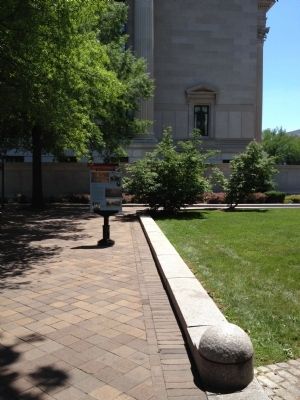
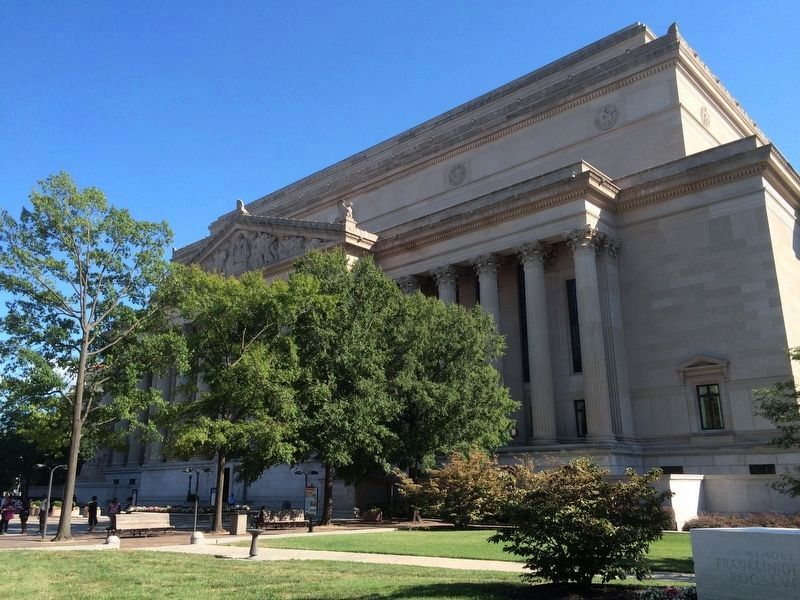
The marker can be seen in front of the National Archives Building (underneath the tree).
Credits. This page was last revised on March 19, 2026. It was originally submitted on July 6, 2012, by Craig Swain of Leesburg, Virginia. This page has been viewed 1,181 times since then and 18 times this year. Photos: 1. submitted on July 6, 2012, by Craig Swain of Leesburg, Virginia. 2. submitted on September 28, 2024, by Devry Becker Jones of Washington, District of Columbia. 3. submitted on August 25, 2012, by Craig Swain of Leesburg, Virginia. 4. submitted on September 13, 2016, by J. Makali Bruton of Washington, District of Columbia.
