Berliner Innenstadt in Mitte, Germany — Northeast German Plain (The European Plain)
Baudenkmal Berliner Mauer
⎯⎯⎯
Berlin Wall Monument
![<i>Baudenkmal Berliner Mauer</i> [Berlin Wall Mounment] Marker image. Click for full size.](Photos2/211/Photo211568.jpg?7112012101500AM "<i>Baudenkmal Berliner Mauer</i> [Berlin Wall Mounment] Marker. Click for full size.")
Photographed by Richard E. Miller, May 26, 2012
1. Baudenkmal Berliner Mauer [Berlin Wall Mounment] Marker

German Text: …
Der Bau der Mauer begann am 13. August 1961. Mit dieser über 150 km langen Grenzsperranlage riegelte die Regierung der Deutschen Demokratischen Republik (DDR) Ost-Berlin und das übrige Gebiet der DDR hermetisch ab. Zwischen Oktober 1949 und August 1961 waren mehr als 2,7 Millionen Menschen aus der DDR geflohen, mehrheitlich über die Sektorengrenzen zwischen Ost- und West-Berlin. Die Mauer sollte diesen Flüchtlingsstrom unterbinden und jeden unkontrollierten Grenzübergang unmöglich machen.
Die Sperranlage bestand aus mehreren Abschnitten: einer „Vorderlandmauer“ und einer „Hinterlandmauer“, einem Grenzstreifen mit Kolonnenweg, Wachtürmen und Sperrbefestigungen. Bis 1989 kamen an der Berliner Mauer mindestens 136 Menschen zu Tode, 98 von ihnen waren Flüchtlinge. Die meisten fielen den Schüssen der DDR-Grenztruppen zum Opfer.
Die Reformpolitik der Sowjetunion, die rasch anwachsende Protestbewegung der DDR-Bevölkerung, aber auch
this page online
Das 200 m lange Reststück der Mauer an der Niederkirchnerstraße – die hier die Grenze zwischen den Bezirken Mitte (Ost-Berlin) und Kreuzberg (West-Berlin) markierte – wurde auf Wunsch der „Topographie des Terrors“ mit allen Spuren der Zerstörung aus der Zeit des Mauerfalls erhalten und 1990 unter Denkmalschutz gestellt. Das Mauerfragment ist heute Bestandteil des Dokumentationszentrums Topographie des Terrors. Als eines der wenigen noch erhaltenen Mauerreste in der Stadt ist es auch eine der zentralen Stationen innerhalb des vom Berliner Senat entwickelten „Gesamtkonzepts Berliner Mauer“.
English Text:
The Berlin Wall became an international symbol of the division of Germany after the Second World War and also of the Cold War between East and West.
The construction of the Berlin Wall began on August
Photographed by Richard E. Miller, May 26, 2012
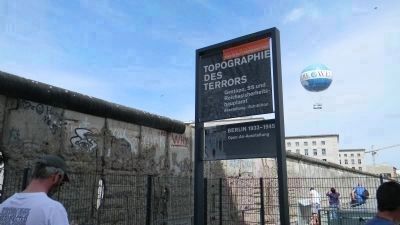
2. "Topographie Des Terrors": Gestapo, SS und Reichssicherheitshauptamt
entrance sign for the adjacent Topography of Terrors Museum, a documentary of the Nazi era in Berlin.
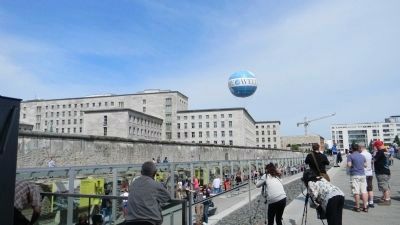
The installation consisted of several sections: a “front wall” and a “hinterland wall,” an inner track with a patrol path, watchtowers, and barrier fortifications. By 1989, at least 136 people had lost their lives at the Wall, 98 of them while trying to flee. Most of them were shot down by GDR border guards.
Reforms in the Soviet Union and the rapidly growing protest movement in the GDR population, but also the flight of thousands of GDR citizens via Eastern European countries, led to the peaceful “fall” of the Wall on November 9, 1989. Soon afterwards, the first sections of the barrier were torn down. Even before the reunification of Germany on October 3, 1990, the Wall had largely disappeared
Photographed by Richard E. Miller, May 26, 2012
3. Baudenkmal Berliner Mauer
At the request of the Topography of Terror, the remaining 200 meters of the Wall at Niederkirchnerstrase, which marked the border between the districts of Mitte (East Berlin) and Kreuzberg (West Berlin) have been preserved with all the traces of destruction that occurred during the transitional period. This fragment of the Wall, designated a historical monument in 1990, now forms part of the Topography of Terror Documentation Center. As one of the few surviving sections of the Wall in the city, it is also one of the central sites in the “Overall Concept for the Berlin Wall” developed by the Berlin Senate.
Erected by Topography of Terror Documentation Center.
Topics and series. This historical marker and monument is listed in these topic lists: Government & Politics • Notable Places • War, Cold. In addition, it is included in the Berlin Wall series list. A significant historical year for this entry is 1961.
Location. 52° 30.422′ N, 13° 22.958′ E. Marker is in Berlin, in Mitte. It is in Berliner Innenstadt. It is on Niederkirchnerstraße east of Stresemannstraße, on the right when traveling east.
Photographed by Richard E. Miller, May 26, 2012
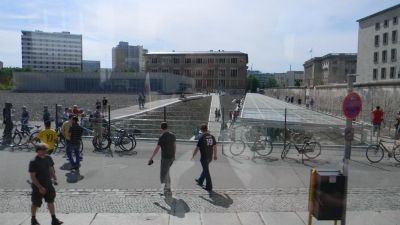
4. The "Topographie Des Terrors" museum complex

Regionally, it is in Europe, the European Union, Atlantic Europe, Central Europe, the Schengen Area, Western Europe, and the Western World. Historically, it finds itself in what was once the Holy Roman Empire, the former West Germany, and at the Berlin Wall.
Other nearby markers. At least 8 other markers are within walking distance of this marker: Remains of the Berlin Wall (a few steps from this marker); a different marker also named Baudenkmal Berliner Mauer / Berlin Wall Monument (a few steps from this marker); Gestapo-Zentrale / Gestapo Headquarters (within shouting distance of this marker); Das Hausgefängnis des Geheimen Staatspolizeiamts (within shouting distance of this marker); Topography of Terror (within shouting distance of this marker); Topographie des Terrors / Topography of Terror (within shouting distance of this marker); Das „Hausgefängnis“ der Gestapo-Zentrale / The “House Prison” at Gestapo Headquarters (about 90 meters away, measured in a direct line); Haupteinfahrt der Gestapo-Zentrale / Main Driveway to Gestapo Headquarters
Photographed by James Hulse, March 6, 2026
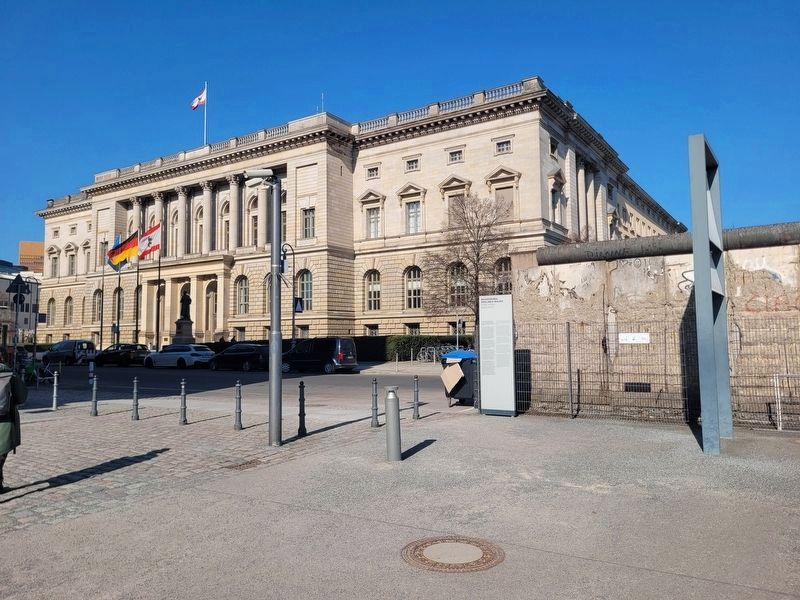
5. Baudenkmal Berliner Mauer Marker
The marker next to a section of the Berlin Wall.
Also see . . . Topography of Terror. (Submitted on July 20, 2012, by Richard E. Miller of Oxon Hill, Maryland.)
Additional keywords. Topographie des Terrors
Credits. This page was last revised on September 8, 2026. It was originally submitted on July 10, 2012, by Richard E. Miller of Oxon Hill, Maryland. This page has been viewed 1,502 times since then and 83 times this year. Last updated on July 24, 2012, by Richard E. Miller of Oxon Hill, Maryland. Photos: 1, 2. submitted on July 10, 2012, by Richard E. Miller of Oxon Hill, Maryland. 3, 4. submitted on July 20, 2012, by Richard E. Miller of Oxon Hill, Maryland. 5. submitted on September 8, 2026, by James Hulse of Medina, Texas. • Bill Pfingsten was the editor who published this page.
