
Fort Smith in Sebastian County, Arkansas — The American South (West South Central)
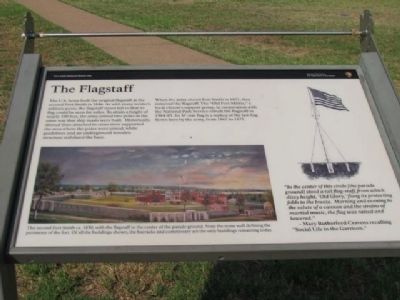
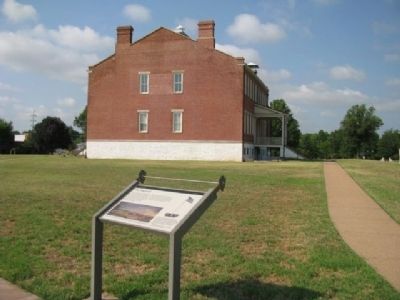
The Flagstaff
Fort Smith National Historic Site
| — | National Park Service, U.S. Department of the Interior | — |
Photographed by Denise Boose, July 13, 2012
1. The Flagstaff Marker
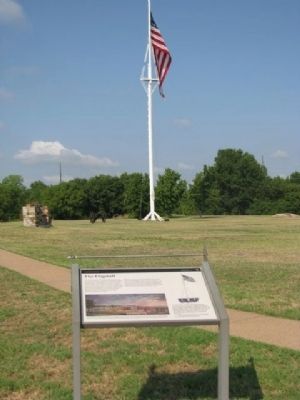
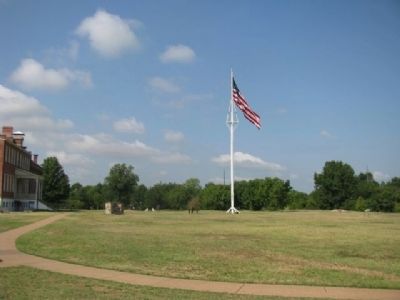
When the army closed Fort Smith in 1871, they removed the flagstaff. The “Old Fort Militia,” a local citizen support group, in cooperation with the National Park Service rebuilt the flagstaff in 1984-85. Its 37-star flag is a replica of the last flag flown here by the army, from 1867-1871.
Erected by National Park Service, U.S. Department of the Interior.
Topics. This historical marker is listed in this topic list: Military. A significant historical year for this entry is 1846.
Location. 35° 23.329′ N, 94° 25.764′ W. Marker is in Fort Smith, Arkansas, in Sebastian County. It is on Parker Avenue, on the left when traveling north. Located in Fort Smith
this page online

Regionally, this marker is in the Arkansas River Valley, in the Cherokee Heritage Region, and in Osage Territory. It is also in the American South and specifically in the Upper South. Globally, it is in North America, the Western Hemisphere, the Western World, and the Anglosphere. Historically, it finds itself in what was once the territory of the Mississippian Culture, the Louisiana Purchase, one of the Confederate States of America, and the Antebellum South.
Other nearby markers. At least 8 other markers are within walking distance of this marker: The Women’s Jail, 1872-1888 (a few steps from this marker); The Guardhouse, 1849-1871 (within shouting distance of this marker); The Parade Grounds (within shouting distance of this marker); Old Federal Building (within shouting distance of this marker); Explorando Fort Smith / Exploring Fort Smith (within shouting distance of this marker); The Bastion That Never Was (within shouting distance
Photographed by Denise Boose, July 13, 2012
2. The Flagstaff Marker
Photographed by Denise Boose, July 13, 2012
3. The Flagstaff Marker
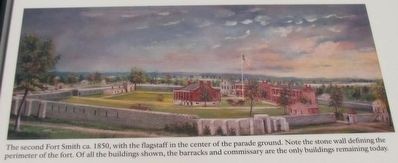
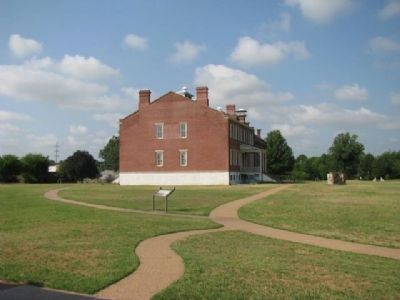
The second Fort Smith ca. 1850, with the flagstaff in the center of the parade ground. Note the stone wall defining the perimeter of the fort. Of all the buildings shown, the barracks and commissary are the only buildings remaining today.
Photographed by Denise Boose, July 13, 2012
4. The Flagstaff Marker
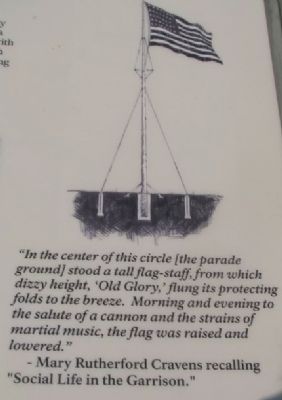
“In the center of this circle [the parade ground] stood a tall flag-staff, from which dizzy height, ‘Old Glory,’ flung its protecting folds to the breeze. Morning and evening to the salute of a cannon and the strains of martial music, the flag was raised and lowered.” -Mary Rutherford Cravens recalling “Social Life in the Garrison.”
Photographed by Denise Boose, July 13, 2012
5. The Flagstaff & Marker
Photographed by Denise Boose, July 13, 2012
6. The Flagstaff Marker
Photographed by Denise Boose, July 13, 2012
7. The Flagstaff Marker
Credits. This page was last revised on June 12, 2020. It was originally submitted on August 14, 2012, by Denise Boose of Tehachapi, California. This page has been viewed 1,145 times since then and 12 times this year. Photos: 1, 2, 3, 4, 5, 6, 7. submitted on August 14, 2012, by Denise Boose of Tehachapi, California. • Craig Swain was the editor who published this page.
