Fort Smith in Sebastian County, Arkansas — The American South (West South Central)
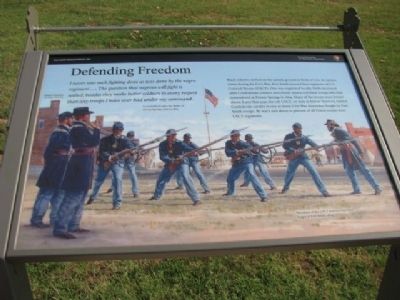
Defending Freedom
Fort Smith National Historic Site
| — | National Park Service, U.S. Department of the Interior | — |
Photographed by Denise Boose, July 13, 2012
1. Defending Freedom Marker
Black infantry drilled on the parade ground in front of you. At various times during the Civil War, Fort Smith housed four regiments of U.S. Colored Troops (USCT). One was organized locally. Drills increased after Confederate soldiers mercilessly massacred black troops who had surrendered at Poison Springs in 1864. Many of the troops were former slaves. Later that year, the 11th USCT, on duty in Indian Territory, battled Confederate cavalry in one of many skirmishes fought by Fort Smith troops. By war’s end about 10 percent of all Union troops were USCT regiments.
Erected by National Park Service, U.S. Department of the Interior.
Topics. This historical marker is listed in these topic lists: African Americans • Military. A significant historical date for this entry is July 17, 1863.
Location. 35° 23.275′ N, 94° 25.83′ W. Marker is in Fort
this page online

Regionally, this marker is in the Arkansas River Valley, in the Cherokee Heritage Region, and in Osage Territory. It is also in the American South and specifically in the Upper South. Globally, it is in North America, the Western Hemisphere, the Western World, and the Anglosphere. Historically, it finds itself in what was once the territory of the Mississippian Culture, the Louisiana Purchase, one of the Confederate States of America, and the Antebellum South.
Other nearby markers. At least 8 other markers are within walking distance of this marker: The War Begins (here, next to this marker); Fort Wall (within shouting distance of this marker); Executions at Fort Smith (within shouting distance of this marker); The Gallows (within shouting distance of this marker); The Officer’s Quarters (within shouting distance of this marker); Boom! (within shouting distance of this marker);
Photographed by Denise Boose, July 13, 2012
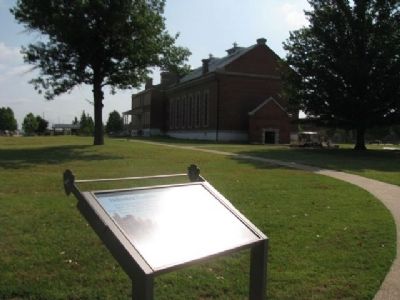
2. Defending Freedom Marker
Photographed by Denise Boose, July 13, 2012
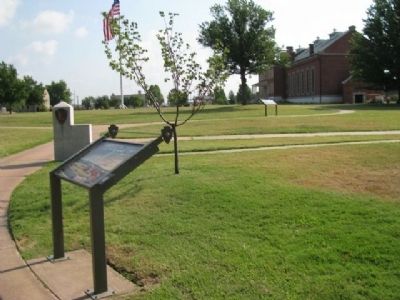
3. Defending Freedom Marker in the distance
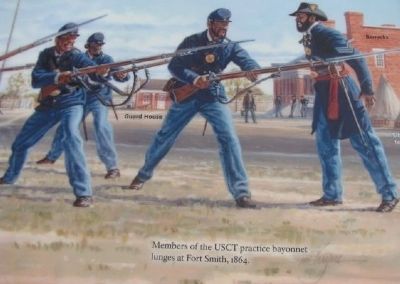
4. Defending Freedom Marker
Members of the USCT practice bayonet lunges at Fort Smith, 1864.
Credits. This page was last revised on July 11, 2020. It was originally submitted on September 2, 2012, by Denise Boose of Tehachapi, California. This page has been viewed 930 times since then and 24 times this year. Photos: 1, 2, 3, 4. submitted on September 2, 2012, by Denise Boose of Tehachapi, California. • Craig Swain was the editor who published this page.
