Near Hamilton in Martin County, North Carolina — The American South (South Atlantic)
Fort Branch
A Mighty Fortress
Photographed by Craig Swain, July 28, 2012
1. Fort Branch Marker
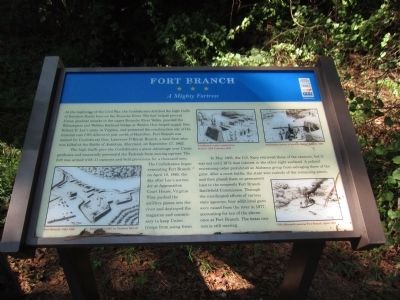
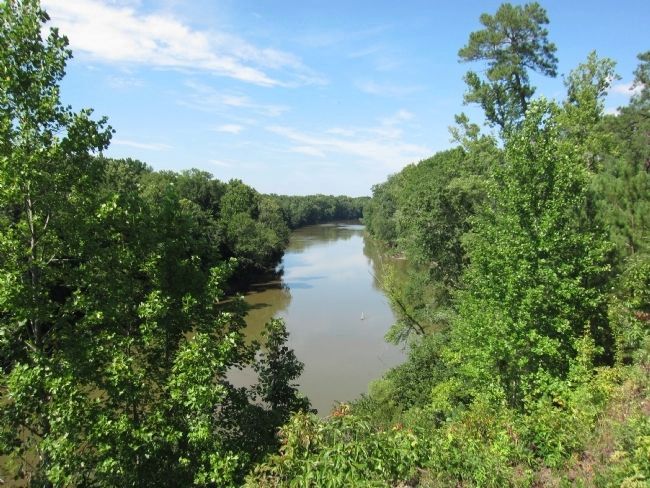
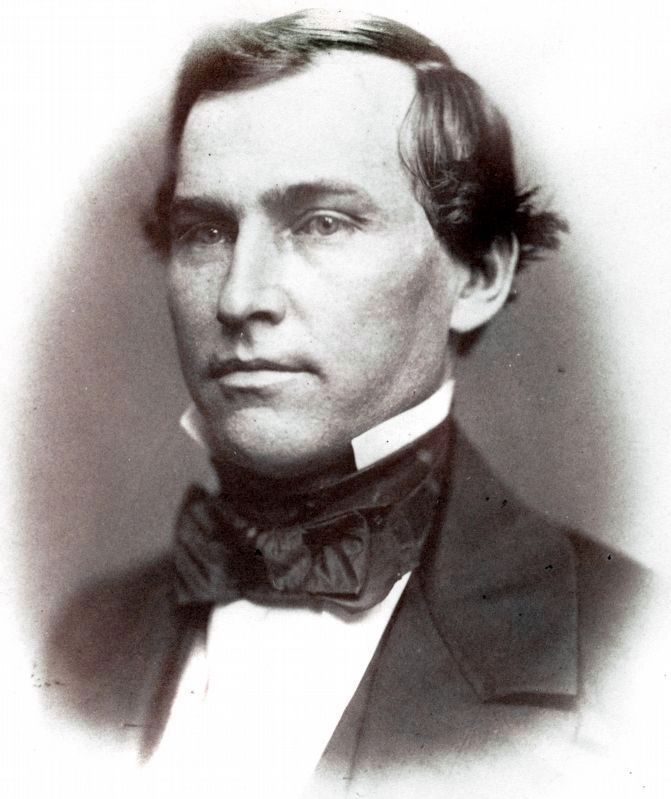
At the beginning of the Civil War, the Confederates fortified the high bluffs of Rainbow Banks here on the Roanoke River. The fort helped prevent Union gunboat attacks in the upper Roanoke River Valley, guarded the Wilmington and Weldon Railroad bridge at Weldon that helped supply Gen. Robert E. Lee's army in Virginia, and protected the construction site of the ironclad ram CSS Albemarle just north of Hamilton. Fort Branch was named for Confederate Gen. Lawrence O'Bryan Branch, a local hero who was killed at the Battle of Antietam, Maryland, on September 17, 1862.
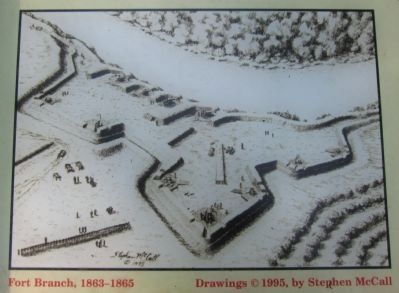
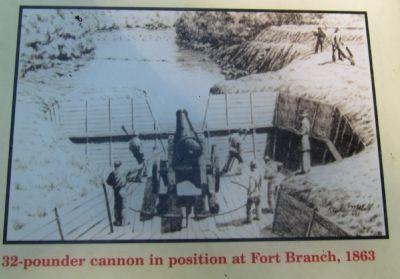
The high bluffs gave the Confederates a great advantage over Union gunboats and essentially prevented the Federals from moving upriver. The fort was armed with 11 cannons and held provisions for a thousand men. The Confederates began evacuating Fort Branch on April 10, 1865, the day after Lee's surrender at Appomattox Court House, Virginia. They pushed the artillery pieces into the river and destroyed the magazine and commissary to keep Union troops from using them.
In May 1865, the U.S. Navy retrieved three of the cannons, but it was not until 1972 that interest
this page online
Erected by North Carolina Civil War Trails.
Topics and series. This historical marker is listed in these topic lists: Forts and Castles • War, US Civil. In addition, it is included in the North Carolina Civil War Trails series list. A significant historical date for this entry is April 10, 1865.
Location. 35° 55.626′ N, 77° 10.282′ W. Marker is near Hamilton, North Carolina, in Martin County. It is on Fort Branch Road (County Route 1416), on the right when traveling east. Located at the entrance of Fort Branch Historical Site. Touch for map. Marker is in this post office area: Oak City NC 27857, United States of America. Touch for directions.

Regionally, this
Photographed by Craig Swain, July 28, 2012
2. Fort Branch, 1863-1865
Other nearby markers. At least 8 other markers are within 8 miles of this marker, measured as the crow flies: A different marker also named Fort Branch (approx. 1.8 miles away); St. Martin's Episcopal Church (approx. 2.2 miles away); a different marker also named St. Martin's Episcopal Church (approx. 2.2 miles away); Spring Green Primitive Baptist Church (approx. 2.6 miles away); a different marker also named Spring Green Primitive Baptist Church (approx. 2.6 miles away); Everetts Christian Church (approx. 6½ miles away); a different marker also named Everetts Christian Church (approx. 6½ miles away); West Martin School (approx. 7½ miles away). Touch for a list and map of all markers in Hamilton.
Another marker is no longer
Photographed by Craig Swain, July 28, 2012
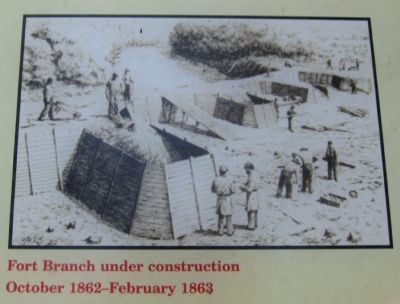
3. Fort Branch under construction, October 1862-February 1863
Also see . . . Fort Branch Civil War Site. The site is operated by the Fort Branch Battlefield Commission. (Submitted on September 3, 2012, by Craig Swain of Leesburg, Virginia.)
Photographed by Craig Swain, July 28, 2012
4. 32-pdr cannon in position at Fort Branch, 1863
Photographed by Craig Swain, July 28, 2012
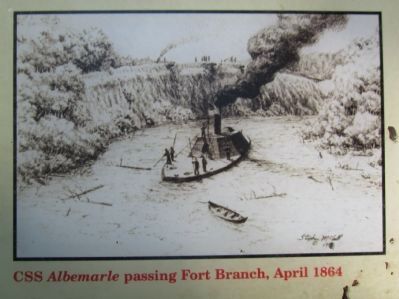
5. CSS Albemarle passing Fort Branch, April 1864
Photographed by Craig Swain, July 28, 2012
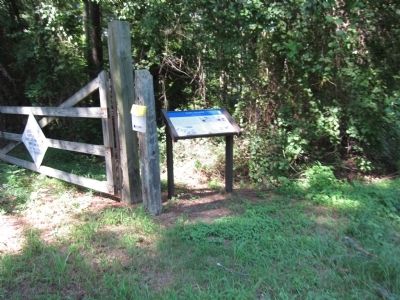
6. Fort Branch Marker
Photographed by Craig Swain, July 28, 2012
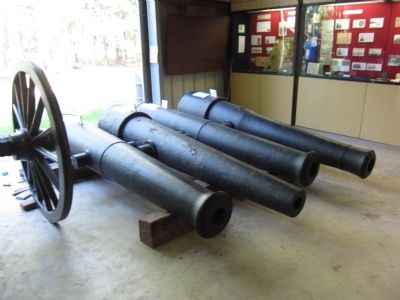
7. Recovered Cannons
Four of the recovered cannons on display at Fort Branch. The guns are, left to right, a 24-pdr siege gun, a 4.62-inch Gibbon & Andrews siege rifle, another 24-pdr siege gun, and a 32-pdr banded and rifled navy gun.
Photographed by Craig Swain, July 28, 2012
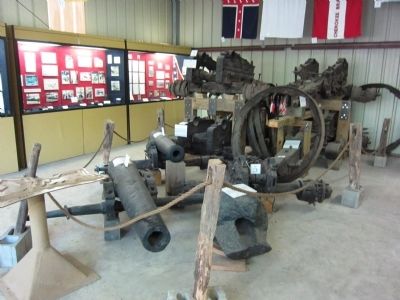
8. Recovered Cannons and other Artifacts
Other items recovered from the river include a rare 4-inch Blakely Rifle imported from England during the war, an iron 6-pdr field gun, a fragment of a 32-pdr navy gun, and field and siege carriages for the guns. Surprisingly much of the wood work remains intact.
Photographed by Craig Swain, July 28, 2012
9. Rainbow Bend at Fort Branch
Library of Congress
10. Lawrence O'Bryan Branch
Lawrence O'B. Branch was a Congressman from North Carolina in 1859 when Julian Vannerson took this photo. Branch joined the Confederate forces on May 1, 1861 as a private soldier and died a Brigadier General on September 17, 1862.
Credits. This page was last revised on November 8, 2024. It was originally submitted on September 3, 2012, by Craig Swain of Leesburg, Virginia. This page has been viewed 1,601 times since then and 50 times this year. Photos: 1, 2, 3, 4, 5, 6, 7, 8, 9. submitted on September 3, 2012, by Craig Swain of Leesburg, Virginia. 10. submitted on September 14, 2020, by Allen C. Browne of Silver Spring, Maryland.
