Beaufort in Beaufort County, South Carolina — The American South (South Atlantic)
Beaufort County, South Carolina
Colonial And Revolutionary Period
| — | 1711-1860 | — |
Photographed by Mike Stroud, February 2008
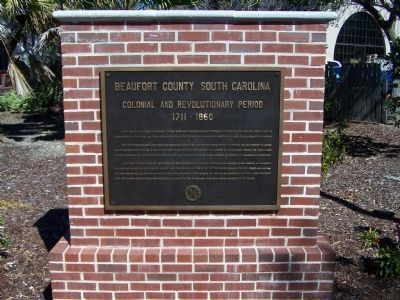
1. Beaufort County, South Carolina Colonial And Revolutionary Period Marker
Until 1779 Beaufort played little part in the Revolution. Early in that year the first British attempt to take the town was repulsed by General William Moultrie's Militia at the Battle of Port Royal Island. The same year Beaufort was occupied by British forces. Patriots and Tories fought bitterly throughout the area to the end of 1782. Beaufort's most prominent patriot was Thomas Heyward Jr., signer of the Declaration of Independence.
After slow recovery from the war's depletion, the introduction of sea island cotton in 1799 brought a rapid increase in plantations and slaves. New wealth provided Beaufort's elegant homes, fine libraries and some of the best preparatory schools in the south between 1800 and 1860, including Beaufort College. So many men of the state and national prominence were produces that ante-bellum Beaufort was described
this page online
Erected 2007 by Beaufort County.
Topics. This historical marker is listed in these topic lists: Colonial Era • Horticulture & Forestry • Patriots & Patriotism • War, US Revolutionary. A significant historical year for this entry is 1779.
Location. 32° 25.828′ N, 80° 40.384′ W. Marker is in Beaufort, South Carolina, in Beaufort County. It can be reached from Bay Street. Marker is in Henry C. Chambers Waterfront Park, along the Beaufort River. Touch for map. Marker is in this post office area: Beaufort SC 29902, United States of America. Touch for directions.

Regionally, this marker is in the Lowcountry and on the Sea Islands. It is also in the American South, specifically in the Deep South, and on the Eastern Seaboard. Globally, it is in the North Atlantic Region, North America, the Western Hemisphere, the Western World, and the Anglosphere. Historically, it finds itself in what was once New Spain, the territory of the Mississippian Culture, one of the original
Photographed by Mike Stroud, February 2008
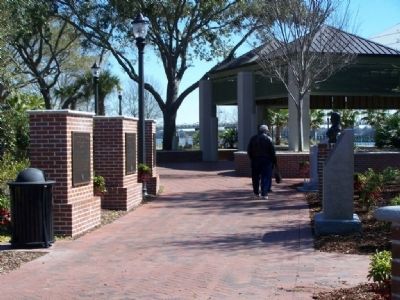
2. Beaufort County, South Carolina Markers in Waterfront Park
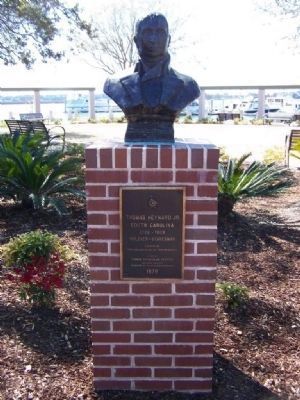
Other nearby markers. At least 8 other markers are within walking distance of this marker: A different marker also named Beaufort County, South Carolina (here, next to this marker); Thomas Heyward, Jr. (here, next to this marker); Beaufort County South Carolina (here, next to this marker); Freedmen's Bank Building (about 400 feet away, measured in a direct line); The William Levin Building (about 500 feet away); The Scheper-Keyserling Building (about 600 feet away); Verdier House (about 600 feet away); Lafayette's Tour (about 700 feet away). Touch for a list and map of all markers in Beaufort.
Regarding Beaufort County, South Carolina. "in·di·go "
a. Any of various shrubs or herbs of the genus Indigofera in the pea family, having odd-pinnate leaves and usually red or purple flowers in axillary racemes.
b. A blue dye obtained from these plants
Also see . . . Wikipedia entry for Thomas Heyward, Jr. ...was a signer of the United States Declaration of Independence as a representative of South Carolina. (Submitted on March 3, 2008, by Mike Stroud of Bluffton, South Carolina.)
Photographed by Mike Stroud, February 2008
3. Nearby Thomas Heyward, Jr. Marker
Credits. This page was last revised on January 17, 2025. It was originally submitted on March 3, 2008, by Mike Stroud of Bluffton, South Carolina. This page has been viewed 1,882 times since then and 37 times this year. Photos: 1, 2, 3. submitted on March 3, 2008, by Mike Stroud of Bluffton, South Carolina. • Kevin W. was the editor who published this page.
