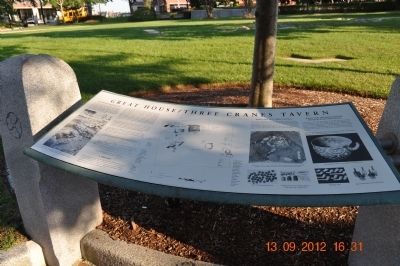
Great House
Three Cranes Tavern
History and Archaeology
In the 1900s, as part of the major highway reconstruction project that built the tunnels beneath this park, a team of archaeologists studied City Square and its history.The investigators researched historic documents and conducted an archaeological dig to determine what happened in City Square's past. This research was supported by the Federal Highway Administration and the Massachusetts Department.---
The archaeology uncovered a very important aspect of Charlestown's history beneath City Square, the Great House, which was first public building erected by the Massachusetts Bay Colony. the Great House was built as part of the Charlestown settlement in 1629 for Governor John Winthrop. As the Governor's residence and a meeting place for his Court of Assistants, the Great House was the Company's seat of government for several months during the summer of 1930. Governor Winthrop and the operations of the Massachusetts Bay company moved across the river to Boston (then called Shawmut) in October 1630. The company sold the Great House to the town in 1633.---
The Great House was then uses as a meeting
this page online
The building in City Square were razed by fire during the Battle of Bunker Hill on June 17, 1775. The square was left as an open marketplace after the battle and the remains of the Great House/Three Cranes Tavern site were preserved beneath the ashes.---
A Time line
The archaeologist carefully removed about four feet of fill from the surface of City Square before they hit a layer of demolition and ash. This burned layer was from 1775 when most of Charlestown was destroyed during the battle of Bunker Hill. An excellent time market, the archaeologists knew that what lay beneath and among this rubble was older than 1775.---
What are these stones?
The stones in the lawn in front of you are the actual foundation stones of the Three Cranes Tavern that were uncovered during the archaeological dig. Post holes marking the location of the original wooden

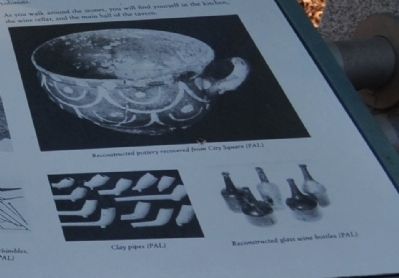
What the Archaeological investigation revealed In addition to the tavern foundation, several privies were also uncovered. Privies were used as both outhouses and trash pits. The artifacts found in these privies allowed archaeologist to date the site and tell us how people lived or used the site. The privies in City Square contained important pottery, fine wine glasses, and butchered animal bones, which tell us that the occupants were wealthy colonists. As you walk around the stones, you will find yourself in the kitchen, the wine cellar, and the main hall of the tavern.
Topics. This historical marker is listed in this topic list: Colonial Era. A significant historical month for this entry is June 1775.
Location. 42° 22.308′ N, 71° 3.707′ W. Marker is in Boston, Massachusetts, in Suffolk County. It is in Charlestown. It is on City Square. City Square Park. Touch for map. Marker is at or near this postal address: 73 City Square, Charlestown MA 02129,

Regionally, this marker is in Massachusetts’ Historic Boston. It is also in the American Northeast, in New England, and on the Eastern Seaboard. Globally, it is in the North Atlantic Region, North America, the Western Hemisphere, the Western World, and the Anglosphere. Historically, it finds itself in what was once one of the original Thirteen Colonies.
Other nearby markers. At least 8 other markers are within walking distance of this marker: Charlestown Training Field / Winthrop Square (here, next to this marker); Paul Revere (within shouting distance of this marker); Court of the Assistants (within shouting distance of this marker); City Square: Continuity and Change (within shouting distance of this marker); Charlestown World War II Memorial (within shouting distance of this marker); Vietnam/Korean Conflict Memorial (within shouting distance of this marker); The Leonard P. Zakim Bunker Hill Bridge (about 400 feet away, measured in a direct line); The Old North Church (about 400 feet away). Touch for a list and map of all markers in Boston.
Credits. This page was last revised on January 30, 2023. It was originally submitted on October 11, 2012, by Sandra Hughes Tidwell of Killen, Alabama, USA. This page has been viewed 3,335 times since then and 230 times this year. Photos: 1, 2, 3. submitted on October 11, 2012, by Sandra Hughes Tidwell of Killen, Alabama, USA. • Bill Pfingsten was the editor who published this page.
