
La Dordogne et la navigation
[The Dordogne and navigation]
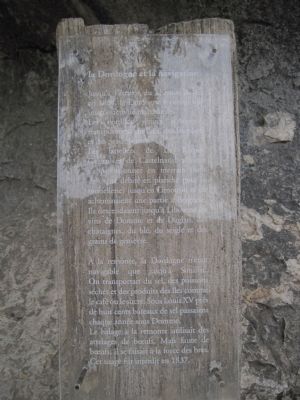

This marker is composed of four panels.
le courau
Le courau était un bateau à fond plat de 10 à 50 tonneaux. Il était équipé de deux à trois paires d’avirons, d’une corde de halage, d’une mâture mobile et d’une voile
this page online
le gabare
Avec sa coque ventrue, la gabàre était adaptée aux conditions fluviomaritimes de l’estuaire de la Gironde.
l’auberge des garbaries
Il y avait à Saint-Julien de Cénac un bureau de navigation où les bateaux devaient faire viser leur feuille de route.
La maison juste au-dessus de la chapelle était un auberge. Les gabariers s’arrêtaient pour échanger des nouvelles, faire et défaire de réputations commerciales ou tout simplement y jouer, y manger ou y passer la nuit.
the courau
the barge
the garbaries’ inn
The Dordogne and navigation
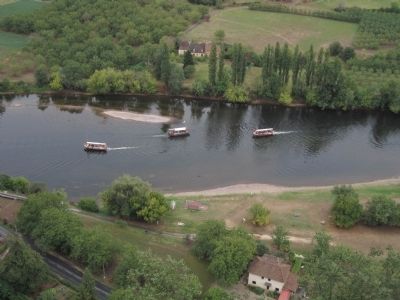
Until the arrival of the railway in 1884, the Dordogne has experienced intense commercial activity.
Fleets came, from Argentat carrying wood, cheese and raw hides.
The boatmen of Rogue-Gageac and Castlenaud brought staves (wood cut into boards chéne for cooperage) until Limousin and [acheminaient?] part in Bergerac. They descended to Libourne with wine from Domme and Daglan, chestnuts, wheat, rye and juniper berries.
Returning upstream, the Dordogne was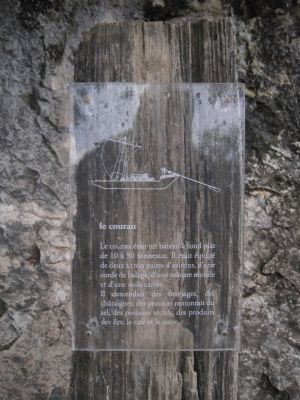
The courau was a flat-bottomed boat 10 to 50 tons. It was equipped with two to three pairs of oars, rope tow, a mobile mast and a square sail.
It descended carrying cheese, chestnuts, skins and acended with salt, dried fish, products of the islands; coffee and sugar.
With its bulbous hull, the barge was adapted to the conditions of the sea-river Gironde estuary.
There was at Saint-Julien de Cénac a shipping office where the boats had planned there route.
The house just above the chapel was a hostel. The boatmen stopped to exchange news, make and unmake business reputations or just play, eat or spend the night.]
Erected by le jardins de Marqueyssac.
Topics. This historical marker is listed in this topic list: Waterways & Vessels. A significant historical year for this entry is 1884.
Location. 44° 49.517′ N,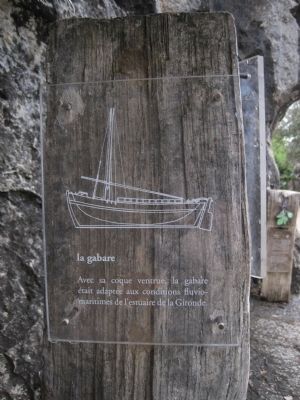

Regionally, it is in the North Atlantic Region, on the Atlantic Arc, in Europe, in the European Union, in Atlantic Europe, in the Schengen Area, in Western Europe, in a coastal Mediterranean country, and in the Western World. Historically, it finds itself in what was once a French colony and also the Roman Empire.
Other nearby markers. At least 8 other markers are within 8 kilometers of this marker, measured as the crow flies: Géologie, écologie et histoire de La Malartrie (approx. 0.7 kilometers away); Les Gabares (approx. 1.2 kilometers away); Chateau Feodal de Beynac (approx. 2.5 kilometers away); Jacques de Maleville (approx. 4.3 kilometers away); Jacquou le Croquant (approx. 4.5 kilometers away); Perigord Noir (approx. 7.4 kilometers away); Hôtel de Cervalè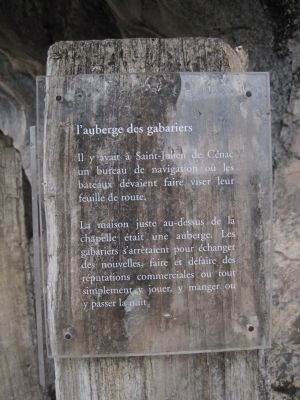
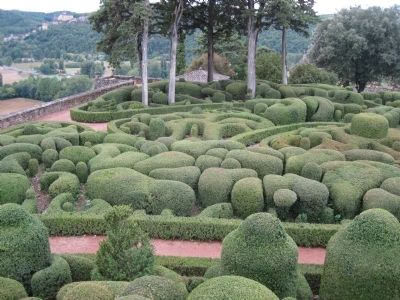
Also see . . . Château de Marqueyssac. "In the 1860s, the new owner, Julien de Cervel, began to plant thousands of boxwood trees - today there are over 150,000 - and had them carved in fantastic shapes, many in groups of rounded shapes like flocks of sheep." (Submitted on October 23, 2012, by Barry Swackhamer of Brentwood, California.)
Credits. This page was last revised on September 12, 2018. It was originally submitted on October 23, 2012, by Barry Swackhamer of Brentwood, California. This page has been viewed 497 times since then and 17 times this year. Photos: 1, 2, 3, 4, 5, 6, 7. submitted on October 23, 2012, by Barry Swackhamer of Brentwood, California. • Bill Pfingsten was the editor who published this page.
