Windsor in Bertie County, North Carolina — The American South (South Atlantic)
The Battle of Windsor
January 30, 1864
Photographed by Bernard Fisher, October 27, 2012
1. The Battle of Windsor Marker
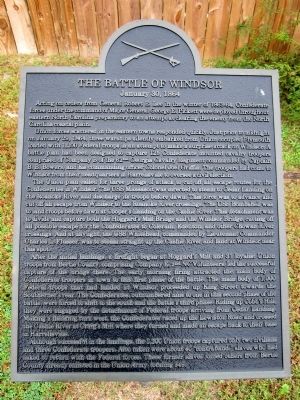
Union forces scattered in the eastern towns responded quickly. Just prior to midnight on January 29, 1864, three warships silently embarked from Union occupied Plymouth loaded with 1,200 Federal troops in an attempt to make a surprise attack on Windsor. A battle plan had been designed to capture 125 Confederate mounted cavalry troopers comprised of Company B of the 62nd Georgia Cavalry Regiment commanded by Captain B.B. Bowers, and his commanding officer Colonel Joel Griffin. The troopers had come to Windsor from their headquarters in Harrellsville to oversee a civil election.
The Union plan called for three prongs of attack to cut off all escape routes for the Confederates in Windsor. The USS Massasoit was directed to steam to Cedar Landing on the Roanoke River and discharge its troops before dawn. This force was to advance and cut off all
this page online
After the initial landing, a firefight began at Hoggard’s Mill and 31 loyalist Union troops from Bertie County comprising Company E, 2nd NC Volunteers, led the successful capture of the bridge there. The early morning firing attracted the main body of Confederate troopers in town to this first phase of the battle. The main body of 1,000 Federal troops that had landed at Windsor proceeded up King Street towards the Southerner’s rear. The Confederates, outnumbered nine to one in this second phase of the battle, were forced to shift to the south and the battle’s third phase. Riding up Cobb’s Hill, they were engaged by the detachment
Photographed by Bernard Fisher, October 27, 2012
2. The Battle of Windsor Marker
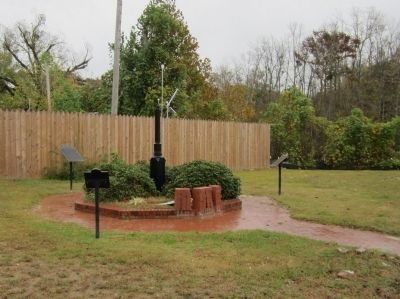
Although successful in the landings, 1,200 Union troops captured only two civilians and three Confederate troopers. Also taken were about 40 “contraband,” slaves who had asked to return with the Federal forces. These former slaves joined others from Bertie County already enlisted in the union Army, totaling 349.
Topics. This historical marker is listed in this topic list: War, US Civil. A significant historical month for this entry is January 1862.
Location. 35° 59.64′ N, 76° 56.557′ W. Marker is in Windsor, North Carolina, in Bertie County. It is at the intersection of South King Street (State Highway 308) and East Water Street (U.S. 17), on the right when traveling north on South King Street. Touch for map. Marker is in this post office area: Windsor NC 27983, United States of America. Touch for directions.

Regionally, this marker is in the Coastal Plain. It is also in the American South, specifically in the Upper South, in the Tidewater, and on the Eastern Seaboard. Globally, it is in the North Atlantic Region, North America, the Western Hemisphere, the Western World, and the Anglosphere. Historically, it finds itself in what was once the territory of the Mississippian Culture, one of the original Thirteen Colonies, one of the Confederate States of America, and the Antebellum South.
Other nearby markers. At least 8 other markers are within walking distance of this marker: Gray’s Landing (here, next to this marker); Historic Windsor (here, next to this marker); Engagement at Windsor (about 700 feet away, measured in a direct line); Railroad Depot Vault (about 800 feet away); Roanoke/Cashie River Center Grave Site (approx. 0.2 miles away); Eden House Root Cellar (approx. 0.2 miles away); WWII POW Camp (approx. 0.2 miles away); William Blount (approx. 0.2 miles away). Touch for a list and map of all markers in Windsor.
Other markers no longer nearby. Engagement at Windsor (was about 700 feet away but has been replaced with another marker now near it); Wellington and Powell Railroad (was approx. 0.2 miles away but has been replaced with another marker now near it).
Also see . . . Skirmish at Windsor - January 30, 1864. (Submitted on July 14, 2025, by Brandon D Cross of Flagler Beach, Florida.)
Credits. This page was last revised on August 7, 2025. It was originally submitted on October 29, 2012, by Bernard Fisher of Richmond, Virginia. This page has been viewed 1,752 times since then and 90 times this year. Photos: 1, 2. submitted on October 29, 2012, by Bernard Fisher of Richmond, Virginia.
