
Montmartre in Paris in Département de Paris, Île-de-France, France — Western Europe
Eglise Saint-Jean-l’Evangéliste
[Church of St. John the Evangelist]
| — | Histoire de Paris | — |
April 10, 2025
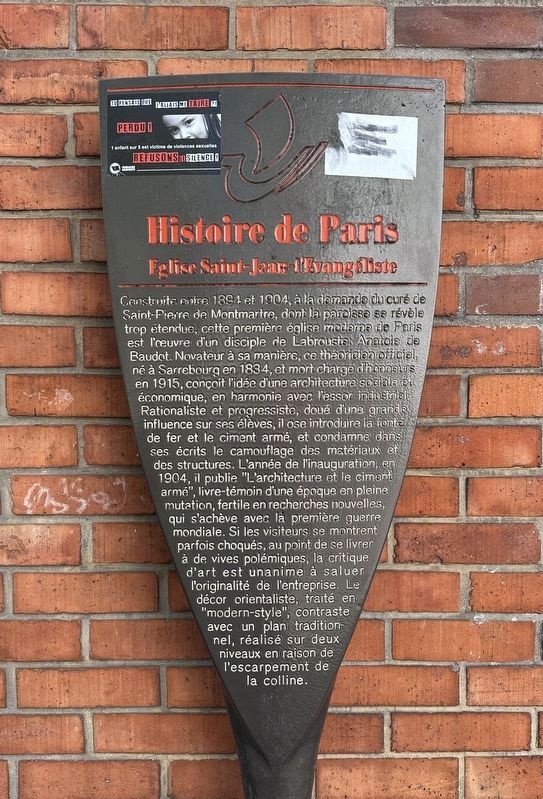
1. Eglise Saint-Jean-l’Evangéliste Marker
[Translated by Google Translate with modifications:
Church of St. John the Evangelist
Built between 1894 and 1904, at the request of the parish priest of Saint-Pierre de Montmartre, which proved too large parish, the first modern church in Paris is the work of a disciple of Labrouste: Anatole de Baudot. Innovative in its own way, this official theorist, born in Sarrebourg in 1834, died loaded with honors in 1915, conceived the idea of a social and economic architecture in harmony with the industrial. Rationalist and progressive, endowed with a great influence on his students, he dared to introduce cast iron and reinforced concrete, and condemned in his writings camouflaging materials
this page online
Topics and series. This historical marker is listed in this topic list: Religion & Religious Structures. In addition, it is included in the Histoire de Paris series list. A significant historical year for this entry is 1894.
Location. 48° 53.064′ N, 2° 20.284′ E. Marker is in Paris, Île-de-France, in Département de Paris. It is in Montmartre. It is on Rue des Abbesses. This marker is located in the Montmartre District of Paris. Touch for map. Marker is at or near this postal address: 15-17 Rue des Abbesses, Paris, Île-de-France 75018, France. Touch for directions.

Regionally, it is in the North Atlantic Region, Europe, the European Union, Atlantic Europe,
Photographed by Barry Swackhamer, September 29, 2012
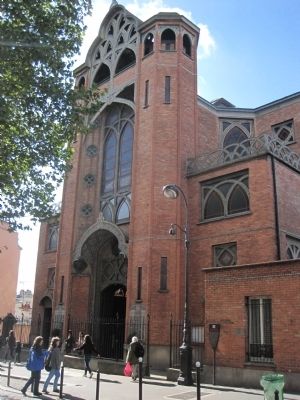
2. Eglise Saint-Jean-l’Evangéliste Marker
Other nearby markers. At least 8 other markers are within walking distance of this marker: David Kutner (about 120 meters away, measured in a direct line); Le Bateau-Lavoir (about 180 meters away); Picasso (about 210 meters away); Georges Clemenceau (about 210 meters away); Le dispensaire de Clemenceau / Clemenceau’s Dispensary (about 210 meters away); École de Orsel Deported Jewish Students Memorial (about 210 meters away); La Grande Crue de 1910 / The Great Flood of 1910 (about 240 meters away); Jean-Baptiste Clément (approx. 0.3 kilometers away). Touch for a list and map of all markers in Paris.
Additional keywords. panneau
April 10, 2025
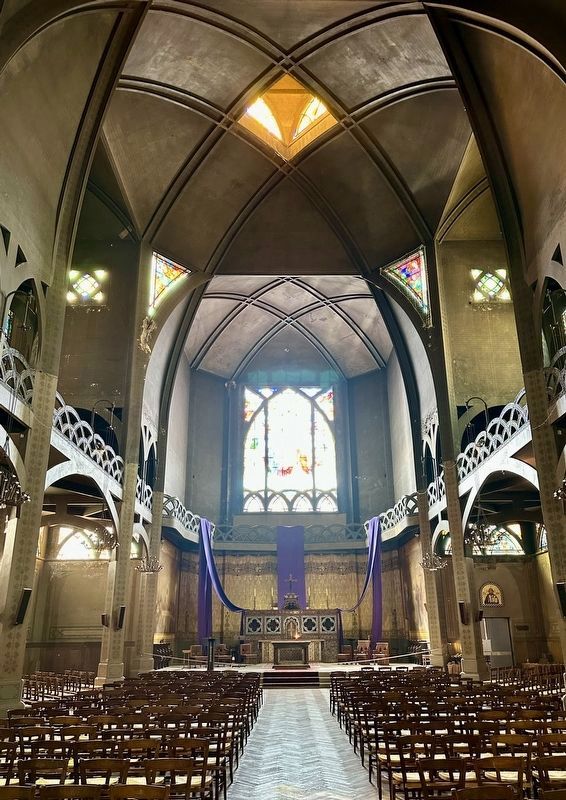
3. Eglise Saint-Jean-l’Evangéliste - interior
Photographed by Barry Swackhamer, September 30, 2012
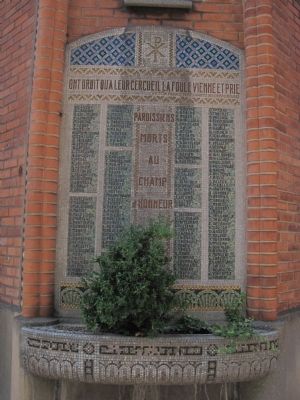
4. Memorial to the Dead of WWI on the wall of Eglise Saint-Jean-l’Evangéliste
Photographed by Barry Swackhamer, September 29, 2012
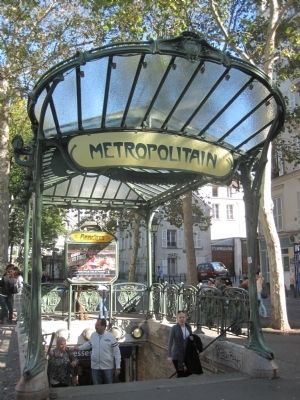
5. Entrance to the Abesses Metro Station
The station is across the street from the Eglise Saint-Jean-l’Evangéliste.
Photographed by Barry Swackhamer, September 29, 2012
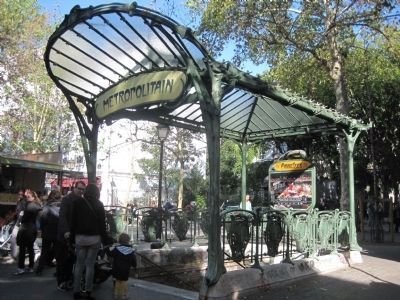
6. Entrance to the Abesses Metro Station
One of the only two remaining original Hector Guimard metro entrances in Paris.
Credits. This page was last revised on May 1, 2025. It was originally submitted on November 2, 2012, by Barry Swackhamer of Brentwood, California. This page has been viewed 883 times since then and 26 times this year. Photos: 1. submitted on May 1, 2025. 2. submitted on November 2, 2012, by Barry Swackhamer of Brentwood, California. 3. submitted on May 1, 2025. 4, 5, 6. submitted on November 2, 2012, by Barry Swackhamer of Brentwood, California. • Bill Pfingsten was the editor who published this page.
