Champs-Élysées in Paris in Département de Paris, Île-de-France, France — Western Europe
The Students of France
Photographed by Barry Swackhamer, October 1, 2012
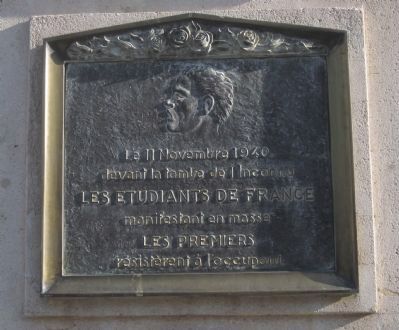
1. The Students of France Marker

devant la tombe de l’Inconnu
Les Etudiants de France
manifestant en masse
Les Premiers
résistèrent à l’occupant
On November 11, 1940, before the Tomb of the Unknown Soldier, the students of France demonstrated the first mass resistance against the occupier.
Topics. This historical marker is listed in this topic list: War, World II. A significant historical date for this entry is November 11, 1940.
Location. 48° 52.413′ N, 2° 17.813′ E. Marker is in Paris, Île-de-France, in Département de Paris. It is in Champs-Élysées. It is at the intersection of Champs-Élysées and Avenue de Friedland, on the right when traveling west on Champs-Élysées. Touch for map. Marker is at or near this postal address: 156 Champs-Élysées, Paris, Île-de-France 75003, France. Touch for directions.

Regionally, it is in the North Atlantic Region, Europe, the European Union, Atlantic Europe, the Schengen Area, Western Europe, a coastal Mediterranean country, and the Western World. Historically, it finds itself in what was once a French colony and also the Roman Empire.
Other nearby markers. At least
this page online
Regarding The Students of France. In German-Occupied France, the Nazi authorities were fearful that any formal observance of Armistice Day (November 11) would incite a demonstration. They prohibited ceremonies of any kind, even church services or commemorations at war memorials. When the time came to make a stand, it was the young people — rather than the veterans — who defied the ban. French students staged a massive protest against the Occupation and paraded along the Champs-Élysées — which, since the fall of France, had become
Photographed by Barry Swackhamer, October 1, 2012
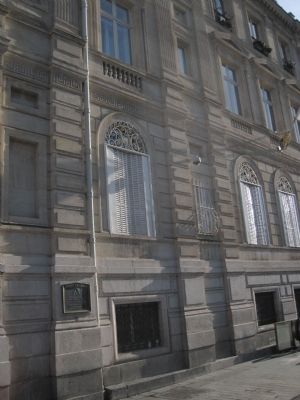
2. The Students of France Marker
Photographed by Barry Swackhamer, October 1, 2012
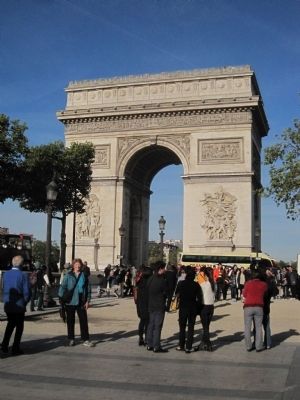
3. The Arc d'Triomphe in Place de Charles de Gaulle
Credits. This page was last revised on June 16, 2024. It was originally submitted on November 7, 2012, by Barry Swackhamer of Brentwood, California. This page has been viewed 649 times since then and 51 times this year. Photos: 1, 2, 3. submitted on November 7, 2012, by Barry Swackhamer of Brentwood, California. • Bill Pfingsten was the editor who published this page.
