Inner Harbor in Baltimore, Maryland — The American Northeast (Mid-Atlantic)
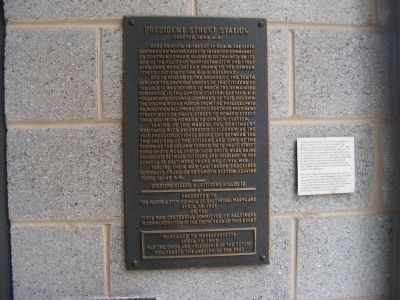
President Street Station
Erected 1842 A.D.

Here on April 19, 1861 at 11 A.M. the Sixth Regiment of Massachusetts Infantry commanded by Colonel Edward F. Jones, detrained on its way to the relief of Washington City. The first nine cars were safely drawn to the Camden Street Station of the B&O Railroad.
Due to failure of the brakes of the tenth car; and the growing unrest of the citizens of the area, it was decided to march the remaining companies to the Camden Station. Captain A. S. Follansbee assumed command of this column. The column would march from the Philadelphia, Wilmington and Baltimore Depot, north on President Street, west on Pratt Street to Howard Street then south on Howard to Camden Station.
Taking up the march, the contingent was faced with an aroused citizenry, as the unit proceeded, fights broke out between the two factions of the citizens and some of the troops, as the column turned on to Pratt Street some shots were fired. Soon shots were being exchanged between citizens and soldiers in the streets of Baltimore, there was a civil war.
Forcing their way the troops proceeded out Pratt St. and on to Camden Station, leaving there 12-45 P.M.
Solders
this page online
Presented to the Mayor and City Council of Baltimore, Maryland, April 19, 1961 by the Civil War Centennial Committee of Baltimore in commemoration of the 100th year of this event.
Maryland to Massachusetts April 19, 1865 May the Union and friendship of the future obliterate the anguish of the past
Topics and series. This historical marker is listed in these topic lists: Railroads & Streetcars • War, US Civil. In addition, it is included in the Baltimore and Ohio Railroad (B&O) series list. A significant historical date for this entry is April 19, 1833.
Location. This marker has been replaced by another marker nearby. 39° 17.041′ N, 76° 36.144′ W. Marker is in Baltimore, Maryland. It is in the Inner Harbor. It is at the intersection of President Street and Fleet Street on President Street. The marker has been moved inside of the station. Per museum staff, it was originally displayed outdoors. Touch for map. Marker is at or near this postal address: 801 Fleet St, Baltimore MD 21202, United States of America. Touch for directions.

Regionally, this marker is in Central Maryland. It is also in the American
Photographed by Don Morfe, April 10, 2011
2. President Street Station Marker
Other nearby markers. At least 8 other markers are within walking distance of this location: A different marker also named President Street Station (a few steps from this marker); a different marker also named Baltimore Riot Trail (a few steps from this marker); On to Yorktown (a few steps from this marker); Mr. Trash Wheel (about 400 feet away); The National Katyń Memorial (about 400 feet away); Baltimore Public Works Museum (about 400 feet away); The Katyń Massacre, 1940 (about 400 feet away); Discover Little Italy: A Taste of the Past (about 500 feet away). Touch for a list and map of all markers in Baltimore.
Other markers no longer nearby. Baltimore Riot Trail (was here, next to this marker but has been replaced with another marker now near it); The Inner Harbor Water Wheel (was about 300 feet

Photographed by Devry Becker Jones (CC0), May 24, 2024
3. President Street Station Marker
This marker is displayed just inside the museum.
More about this marker. The small marker next to above marker states in part "One result of the Centennial was that the events of April 19, 1861 were more thoroughly researched and subsequently some of the facts contained on this plaque have been found incorrect. These minor inaccuracies however do no diminish its value as a tangible connection to the Centennial and the preservation of this important building.
Related marker. Click here for another marker that is related to this marker. This marker has been replaced by the linked marker.
Photographed by Don Morfe, April 10, 2011
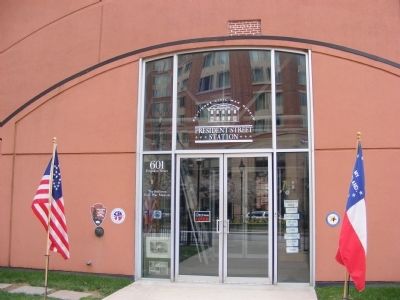
4. President Street Station
Photographed by Don Morfe, April 10, 2011
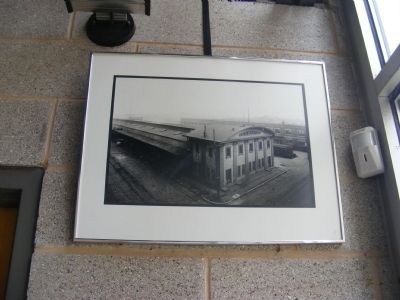
5. Image of President Street Station on display inside of the museum
Photographed by Don Morfe, April 10, 2011
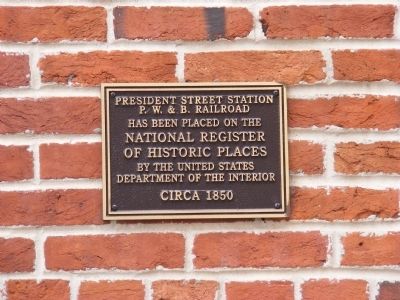
6. President Street Station Marker

Photographed by Devry Becker Jones (CC0), May 24, 2024
7. Interpretive sign to the right of the marker
Created by the Baltimore Civil War Roundtable in 1961 to observe the Civil War Centennial, this plaque was placed here on September 7, 1997 - the 40th anniversary of the creation of the National Civil War Centennial Commission by President Dwight D. Eisenhower. One of three, this plaque was never mounted after the first was stolen from its place near the Inner Harbor. Roundtable member Edward Turner preserved the plaques for President Street and Camden Stations. His son, Louis, presented this plaque to the Museum.
One result of the Centennial was that the events of April 19, 1861 were more thoroughly researched and subsequently some of the facts contained on this plaque have been found incorrect. These minor inaccuracies however do not diminish its value as a tangible connection to the Centennial and the preservation of this important building.
One result of the Centennial was that the events of April 19, 1861 were more thoroughly researched and subsequently some of the facts contained on this plaque have been found incorrect. These minor inaccuracies however do not diminish its value as a tangible connection to the Centennial and the preservation of this important building.
Credits. This page was last revised on May 24, 2024. It was originally submitted on November 8, 2012, by Don Morfe of Baltimore, Maryland. This page has been viewed 988 times since then and 101 times this year. Photos: 1. submitted on May 24, 2024, by Devry Becker Jones of Washington, District of Columbia. 2. submitted on November 8, 2012, by Don Morfe of Baltimore, Maryland. 3. submitted on May 24, 2024, by Devry Becker Jones of Washington, District of Columbia. 4, 5, 6. submitted on November 8, 2012, by Don Morfe of Baltimore, Maryland. 7. submitted on May 24, 2024, by Devry Becker Jones of Washington, District of Columbia. • Bill Pfingsten was the editor who published this page.
