Union Springs in Bullock County, Alabama — The American South (East South Central)
Trinity Episcopal Church
⎯⎯⎯
Red Door Theater
Photographed by David J Gaines, October 20, 2012
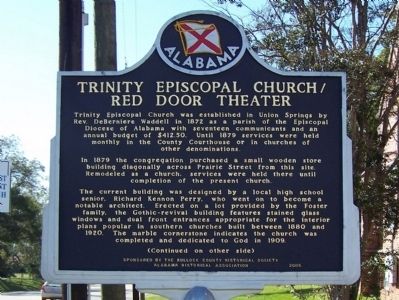
1. Trinity Episcopal Church/Red Door Theater Marker, front
In 1879 the congregation purchased a small wooden store building diagonally across Prairie Street from this site. Remodeled as a church, services were held there until completion of the present church.
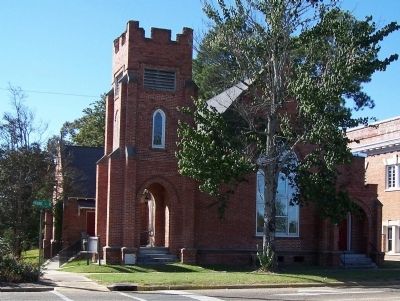
The current building was designed by a local high school senior, Richard Kennon Perry, who went on to become a notable architect. Erected on a lot provided by the Foster family, the Gothic-revival building features stained glass windows and dual front entrances appropriate for the interior plans popular in southern churches built between 1880 and 1920. The marble cornerstone indicates the church was completed and dedicated to God in 1909.
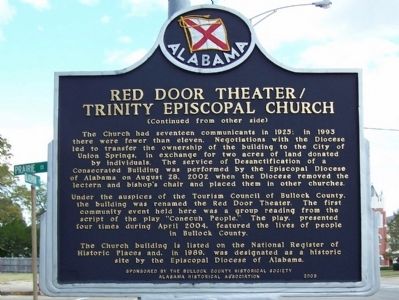
The Church had seventeen communicants in 1925; in 1993 there were fewer than eleven. Negotiations with the Diocese led to transfer of ownership of the building to the City of Union Springs,
this page online
Under the auspices of the Tourism Council of Bullock County, the building was renamed the Red Door Theater. The first community event held here was a group reading from the script of the play “Conecuh People.” The play, presented four times during April 2004, featured the lives of people in Bullock County.
The church building is listed on the National Register of Historic Places and, in 1989, was designated as a historic site by the Episcopal Diocese of Alabama.
Erected 2005 by The Bullock County Historical Society and the Alabama Historical Association.
Topics and series. This historical marker is listed in this topic list: Religion & Religious Structures. In addition, it is included in the Alabama Historical Association series list. A significant historical year for this entry is 1872.
Location. 32° 8.608′ N, 85° 42.977′ W. Marker is in Union Springs, Alabama,
Photographed by David J Gaines, October 20, 2012
2. Trinity Episcopal Church/Red Door Theater Marker, back

Regionally, this marker is in the American South, specifically in the Deep South, and in the Black Belt. Globally, it is in North America, a Gulf of Mexico state, the Western Hemisphere, the Western World, and the Anglosphere. Historically, it finds itself in what was once the territory of the Mississippian Culture, one of the Confederate States of America, and the Antebellum South.
Other nearby markers. At least 8 other markers are within one mile of this marker, measured as the crow flies: Log Cabin Museum / Old City Cemetery (about 300 feet away, measured in a direct line); Hank Williams (about 400 feet away); Bullock County Courthouse Historic District (about 700 feet away); Union Springs, Alabama (about 700 feet away); Depot & Coal Shute (approx. 0.2 miles away); Eddie Kendricks (approx. 0.2 miles away); Indian Treaty Boundary Line (approx. 0.7 miles
Photographed by David J Gaines, October 20, 2012
3. Trinity Episcopal Church
Credits. This page was last revised on December 9, 2024. It was originally submitted on November 9, 2012, by David J Gaines of Pinson, Alabama. This page has been viewed 1,395 times since then and 46 times this year. Photos: 1, 2, 3. submitted on November 9, 2012, by David J Gaines of Pinson, Alabama. • Bill Pfingsten was the editor who published this page.
