Midway in Bullock County, Alabama — The American South (East South Central)
Town of Midway
Photographed by David J Gaines, October 20, 2012
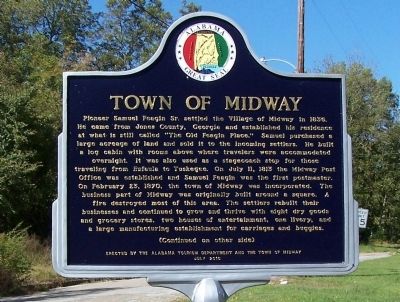
1. Town of Midway Marker, front
Inscription.
Pioneer Samuel Feagin Sr. settled the Village of Midway in 1836. He came from Jones County, Georgia and established his residence at what is still called “The Old Feagin Place.” Samuel purchased a large acreage of land and sold it to incoming settlers. He built a log cabin with rooms above where travelers were accommodated overnight. It was also used as a stagecoach stop for those traveling from Eufaula to Tuskegee. On July 11, 1813 the Midway Post Office was established and Samuel Feagin was the first postmaster. On February 23, 1870, the town of Midway was incorporated. The business part of Midway was originally built around a square. A fire destroyed most of this area. The settlers rebuilt their businesses and continued to grow and thrive with eight dry goods and grocery stores, two houses of entertainment, one livery, and a large manufacturing establishment for carriages and buggies. The lower section of Midway, at the Central of Georgia Railroad, was once called James, Alabama. On March 18, 1903, the Union Springs Herald stated the Town of Midway and James had grown not only in population but businesses
Click or scan to see this page online
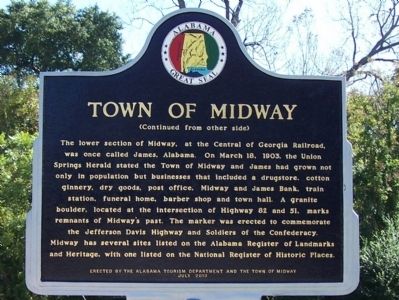
that included a drugstore, cotton ginnery, dry goods, post office, Midway and James Bank, train station, funeral home, barber shop and town hall. A granite boulder, located at the intersection of Highway 82 and 51, marks the remnants of Midway's past. The marker was erected to commemorate the Jefferson Davis Highway and Soldiers of the Confederacy. Midway has several sites listed on the Alabama Register of Landmarks and Heritage, with one listed on the National Register of Historic Places.
Erected 2010 by Alabama Tourism Department and the Town of Midway.
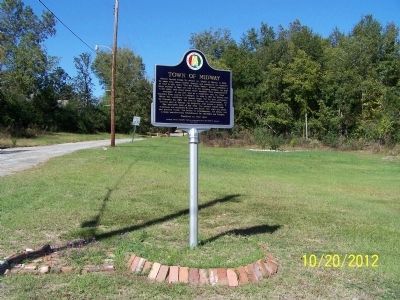
Location. 32° 4.237′ N, 85° 31.341′ W. Marker is in Midway, Alabama, in Bullock County. It is at the intersection of Railroad Street and Depot Street, on the right when traveling west on Railroad Street. Touch for map. Marker is in this post office area: Midway AL 36053, United States of America. Touch for directions.
Regionally,
Photographed by David J Gaines, October 20, 2012
2. Town of Midway Marker, back
this marker is in the American South, specifically in the Deep South, and in the Black Belt. Globally, it is in North America, a Gulf of Mexico state, the Western Hemisphere, the Western World, and the Anglosphere. Historically, it finds itself in what was once the territory of the Mississippian Culture, one of the Confederate States of America, and the Antebellum South.
Credits. This page was last revised on June 16, 2016. It was originally submitted on November 6, 2012, by David J Gaines of Pinson, Alabama. This page has been viewed 2,197 times since then and 112 times this year. Last updated on December 15, 2012. Photos:1, 2, 3. submitted on November 6, 2012, by David J Gaines of Pinson, Alabama. • Bill Pfingsten was the editor who published this page.