Southgate in Campbell County, Kentucky — The American South (East South Central)
William H. Horsfall
Photographed by J. J. Prats, July 19, 2025
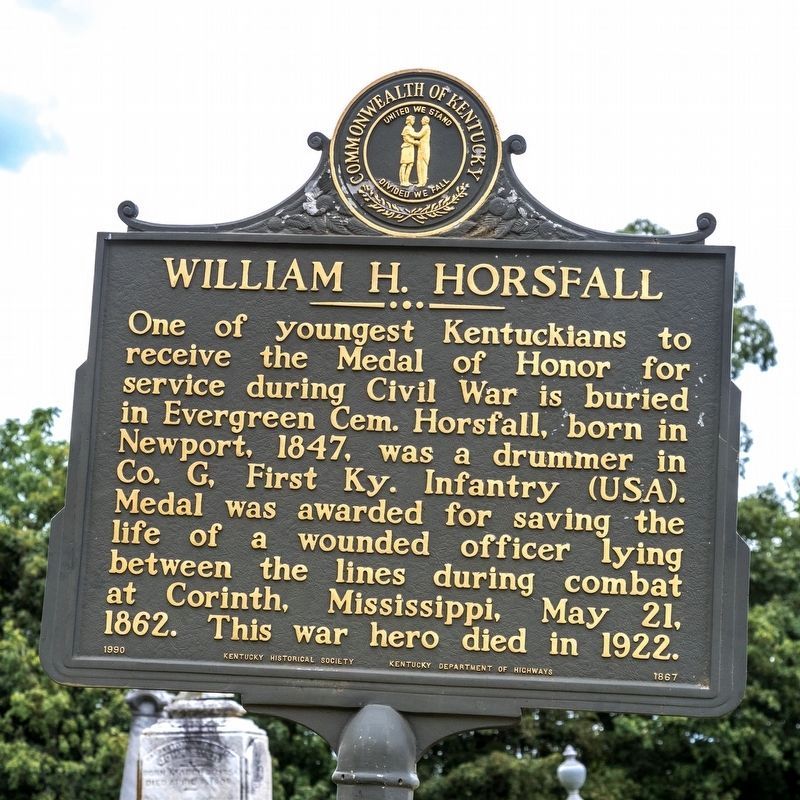
1. William H. Horsfall Marker
Erected 1990 by Kentucky Historical Society, Kentucky Department of Highways. (Marker Number 1867.)
Topics and series. This historical marker is listed in this topic list: War, US Civil. In addition, it is included in the Kentucky Historical Society, and the Medal of Honor Recipients series lists. A significant historical date for this entry is May 21, 1847.
Location. 39° 4.113′ N, 84° 28.083′ W. Marker is in Southgate, Kentucky, in Campbell County. It is at the intersection of Alexandria Pike (U.S. 27) and the Evergreen Cemetery entrance, on the right when traveling south on Alexandria Pike. Marker is located in Evergreen Cemetery. Touch for map. Marker is at or near this postal address: 25 Alexandria Pike, Newport KY 41071, United States of America. Touch for directions.

Regionally,
this page online
Other nearby markers. At least 8 other markers are within walking distance of this marker: William Horsfall (here, next to this marker); In Memory of the Civil War Veterans Buried in Soldiers Lot (a few steps from this marker); James Taylor Jr. (within shouting distance of this marker); Brigadier General George Baird Hodge (within shouting distance of this marker); Brent Spence (within shouting distance of this marker); Major David Leitch (within shouting distance of this marker); Major David Leitch Monument (about 300 feet away, measured in a direct line); Samuel Bigstaff (about 300 feet away). Touch for a list and map of all markers in Southgate.
More about this marker. William H. Horsfall is buried in Evergreen Cemetery, Section 15-GAR, Grave 72
Regarding William H. Horsfall.
Photographed by J. J. Prats, July 19, 2025
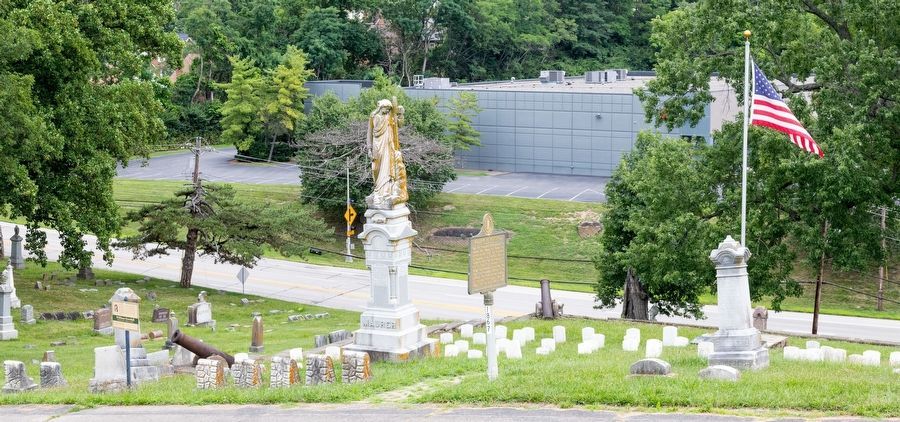
2. View of the Civil War Soldier’s Section of Evergreen Cemetery, Southgate, Kentucky
Both of William Horsfall historical markers are shown.
Additional commentary.
1. A Youngster’s Heroism
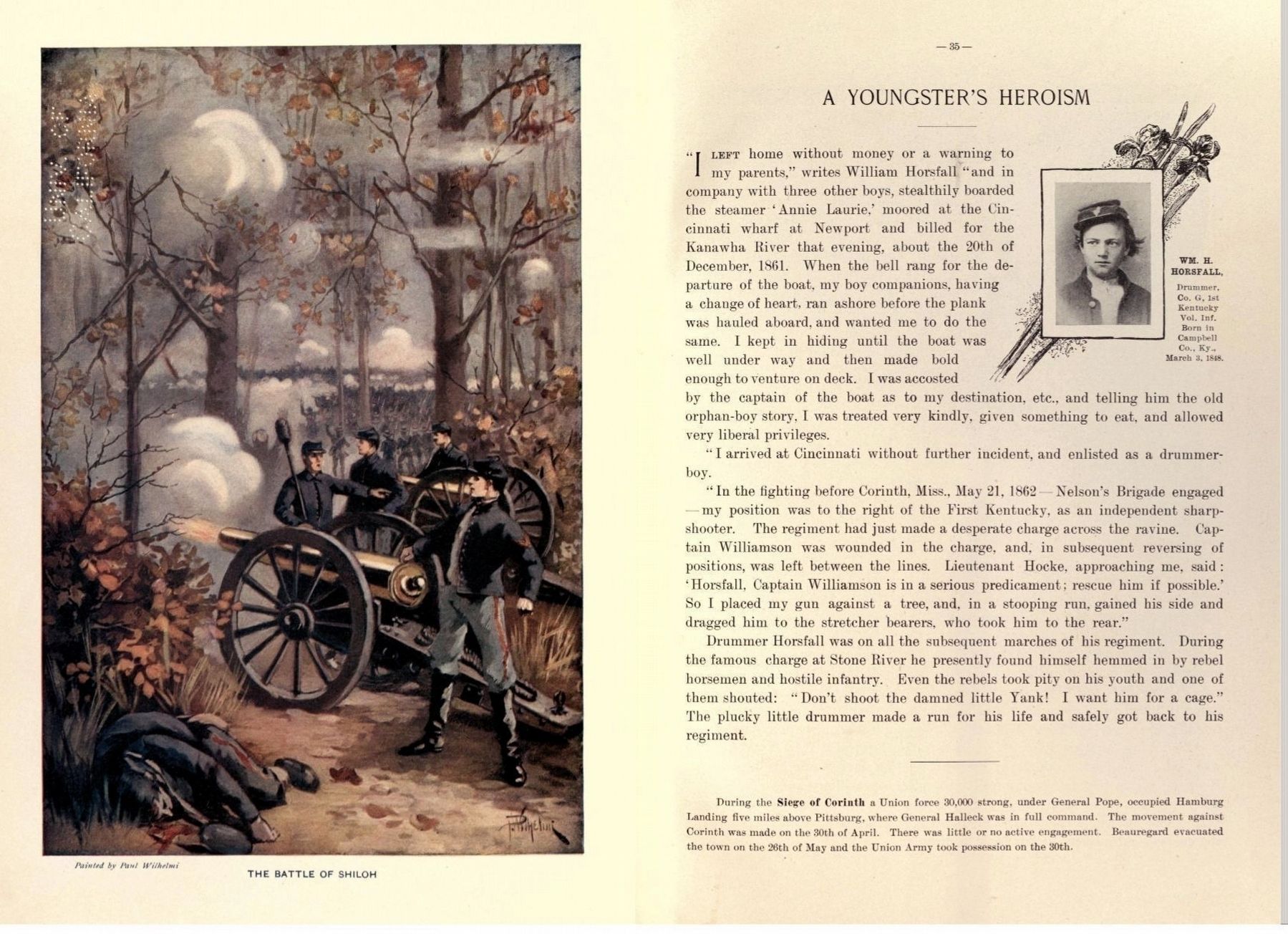
Personal reminiscence in the 1901 book Deeds of Valor: How America’s heroes won the Medal of Honor compiled by Walter F. Beyer and Oscar F. Keydel, from William H. Horsfall, Drummer, Company G, First Kentucky Volunteers Infantry. He was born in Campbell County, Kentudky, March 3, 1848.
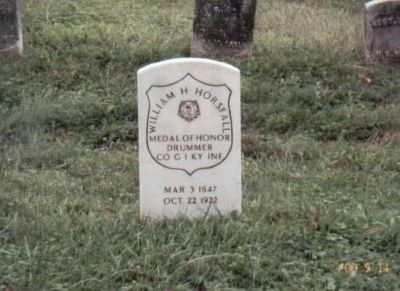
“I left home without money or a warning to my parents,” writes William Horsfall, “and in company with three other boys, stealthily boarded the steamer Annie Laurie, moored at the Cincinnati wharf at Newport and billed for the Kanawha River that evening, about the 20th of December, 1861. When the bell rang for the departure of the boat, my boy companions, having a change of heart, ran ashore before the plank was hauled aboard, and wanted me to do the same. I kept in hiding until the boat was wellDuring the Siege of Corinth a Union force 30,000 strong under General John Pope occupied Hamburg Landing five miles above Pittsburg, Mississippi, where General Henry Halleck was in full command. The movement against Corinth was made on the 30th of April. There was little or no active engagement. Confederate General P.G.T. Beauregard evacuated the town on the 26th of May, 1862, and the Union Army took possession on the 30th.under way and then made bold enough to venture on deck. I was accosted by the captain of the boat as to my destination, etc., and telling him the old orphan-boy story, I was treated very kindly, given something to eat, and allowed very liberal privileges.Photographed by Don Morfe, September 14, 20003. William H. Horsfall GravestoneMedal of Honor
Drummer
Company G, First Kentucky Infantry
Mar 3 1847 – Oct 22 1922
“I arrived at Cincinnati without further incident, and enlisted as a drummer-boy.
“In the fighting before Corinth, Miss., May 21, 1862 — Nelson’s Brigade engaged — my position was to the right of the First Kentucky, as an independent sharpshooter. The regiment had just made a desperate charge across the ravine. Captain Williamson was wounded in the charge, and, in subsequent reversing of positions, was left between the lines. Lieutenant Hocke, approaching me, said `Horsfall, Captain Williamson is in a serious predicament; rescue him if possible.’ So I placed my gun against a tree, and, in a stooping run, gained his side and dragged him to the stretcher bearers, who took him to the rear.”
Drummer Horsfall was on all the subsequent marches of his regiment. During the famous charge at Stone River he presently found himself hemmed in by rebel horsemen and hostile infantry. Even therebels took pity on his youth and one of them shouted: “Don’t shoot the damned little Yank! I want him for a cage.” The plucky little drummer made a run for his life and safely got back to his regiment.Pages 34-35 in Deeds of Valor (Public Domain)4. A Youngster’s HeroismPages 34 and 35 from Deeds of Valor: How America’s heroes won the Medal of Honor compiled by Walter F. Beyer and Oscar F. Keydel, published in 1901 in Detroit by the Perrien-Keydel Company. The text of this article has been transcribed elsewhere on this page.
— Submitted August 2, 2025, by J. J. Prats of Powell, Ohio.
Credits. This page was last revised on August 4, 2025. It was originally submitted on December 20, 2012, by Don Morfe of Baltimore, Maryland. This page has been viewed 1,340 times since then and 29 times this year. Photos: 1, 2. submitted on August 2, 2025, by J. J. Prats of Powell, Ohio. 3. submitted on December 20, 2012, by Don Morfe of Baltimore, Maryland. 4. submitted on August 2, 2025, by J. J. Prats of Powell, Ohio. • Craig Swain was the editor who published this page.
