Harrison in Sioux County, Nebraska — The American Midwest (Upper Plains)
Fossil Hills Trail
Agate Fossil Beds National Monument
| — | National Park Service, U.S. Department of the Interior | — |

Photographed by Don Morfe, June 30, 1997
1. Fossil Hills Trail Marker
The hills held ancient secrets for paleontologists.
The two hills in the distance don’t look like anything special. Even up close the untrained eye will see nothing astounding. But a sandstone layer near the bases of the hills has yielded one of the richest concentrations of fossilized mammal remains ever discovered.
Since 1904, paleontologists have been uncovering fossil bones here which greatly contribute to our knowledge of prehistoric mammals. Today many of these fossils are studied and displayed at leading museums and universities. Although thousands of bones have been removed, a great many more lie undisturbed within the fossil hills.
This trail leads to the main fossil quarry sites at University and Carnegie Hills. The 2-mile round-trip hike takes about an hour. At each hill a small section of the fossil layer is displayed just as it was found.
Topics. This historical marker is listed in this topic list: Paleontology. A significant historical year for this entry is 1904.
Location. 42° 25.158′ N, 103° 44.466′ W. Marker is in Harrison, Nebraska, in Sioux County. It is on River Road. Touch for map. Marker is in this
this page online

Regionally, this marker is in the Nebraska Panhandle. It is also in the American Midwest, in the Corn Belt, on the prairies, on the Great Plains, on the Northern Plains, and specifically on the High Plains. Globally, it is in North America, the Western Hemisphere, the Western World, and the Anglosphere. Historically, it finds itself in what was once the Louisiana Purchase.
Other nearby markers. At least 8 other markers are within walking distance of this marker: Bone Cabin (approx. 0.4 miles away); The Gift of Friendship (approx. 0.6 miles away); a different marker also named Fossil Hills Trail (approx. 0.6 miles away); Combatting Invader Plants (approx. 0.6 miles away); Historic Excavations (approx. 0.7 miles away); Chalicotheres (approx. 0.7 miles away); Menoceras (approx. 0.7 miles away); Quarry A (approx. 0.7 miles away).
Regarding Fossil Hills Trail. Agate Fossil Beds National Monument is nestled in the Niobrara River Valley in Nebraska 65 miles [110 km] east-southeast of its headwaters in the Hat Creek Breaks of Wyoming. The
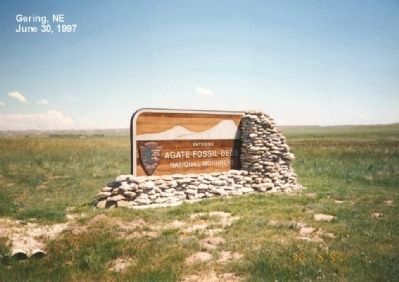
Photographed by Don Morfe, June 30, 1997
2. Agate Fossil Beds National Monument entrance sign.
During the Miocene the land now known as Agate was a grass savanna comparable to today’s Serengeti Plains in Africa. Twenty million years ago animals such as the Dinohyus (giant pig-like animal), Stenomylus (small gazelle-camel), and Menoceras (short rhinoceros) roamed the plains. There were also carnivorous beardogs wandering around, and the land beaver Paleocastor dug spiral burrows that remain as today’s trace fossils (Daemonelix) into the ancient riverbanks. There are remnants of the ancient grasses and hoofprints of prehistoric animals in Miocene sediments preserved in the park, as well as layers of fossilized bones.
The park was created to preserve the rich fossil deposits and their geological contexts amidst today’s natural ecosystem. Numerous mammals, fish, amphibians, reptiles, and birds inhabit or pass through the park, undisturbed and protected. Many species of
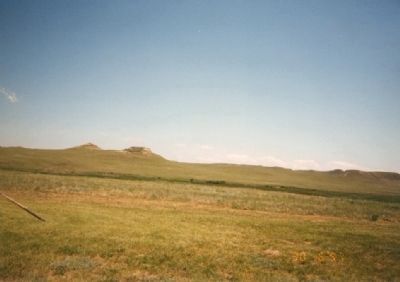
Photographed by Don Morfe, June 30, 1997
3. Fossil Hills Trail
Text by Kimberly Howard, Biological Technician, Agate Fossil Beds National Monument. Information from Agate Fossil Beds Park Handbook, U. S. Department of the Interior, Washington, DC, 1980.
Related marker. Click here for another marker that is related to this marker.
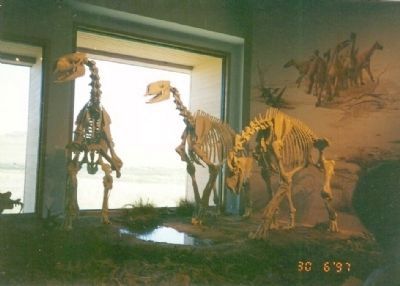
Photographed by Don Morfe, June 30, 1997
4. Inside the Agate Fossil Beds Visitor Center
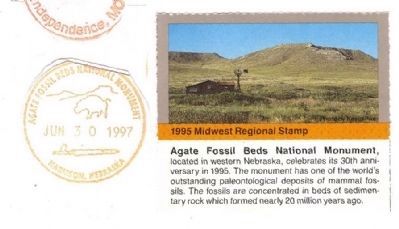
Photographed by Don Morfe, June 30, 1997
5. National Park Cancellation Stamp
National Park Cancellation Stamp.
Agate Fossil Beds National Monument located in western Nebraska, celebrates its 30th anniversary in 1995. The monument has one of the world’s outstanding paleontological deposits of mammal fossils. The fossils are concentrated in beds of sedimentary rock which formed nearly 20 million years ago.
Credits. This page was last revised on April 27, 2024. It was originally submitted on December 22, 2012, by Don Morfe of Baltimore, Maryland. This page has been viewed 842 times since then and 96 times this year. Photos: 1, 2, 3, 4, 5. submitted on December 22, 2012, by Don Morfe of Baltimore, Maryland. • Bill Pfingsten was the editor who published this page.
Editor’s want-list for this marker. A clear shot of whole marker & wide shot of the marker and its surroundings. • Can you help?
