Bellefontaine Cemetery in St. Louis, Missouri — The American Midwest (Upper Plains)
Thomas Hart Benton
Statesman
| — | Elizabeth Benton | — |
Photographed by William Fischer, Jr., January 21, 2012
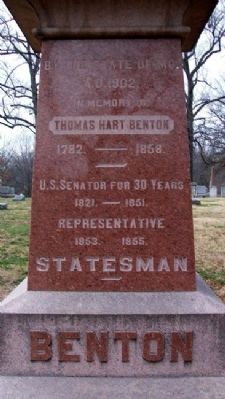
1. Thomas Hart Benton Marker
A.D. 1902
In memory of
Thomas Hart Benton
1782 - 1858
U.S. Senator for 30 Years
1821 - 1851
Representative
1853 - 1855
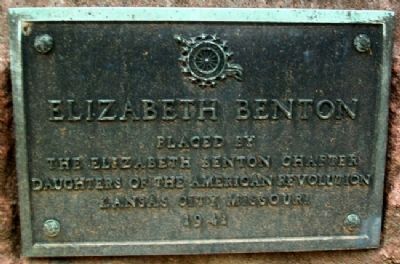
Elizabeth Benton
[namesake of the D.A.R. chapter]
Erected 1902 by State of Missouri and Elizabeth Benton Chapter, NSDAR.
Topics and series. This historical marker is listed in these topic lists: Cemeteries & Burial Sites • Government & Politics. In addition, it is included in the Daughters of the American Revolution (DAR) series list. A significant historical year for this entry is 1902.
Location. 38° 41.499′ N, 90° 13.952′ W. Marker is in St. Louis, Missouri. It is in Bellefontaine Cemetery. It can be reached from West Florissant Avenue. Monument is in Block 40, Lot 173, of Bellefontaine Cemetery. Touch for map. Marker is at or near this postal address: 4947 West Florissant Avenue, Saint Louis MO 63115, United States of America. Touch for directions.

Regionally, this marker is in the American Midwest, in the Lewis & Clark Corridor, in the Corn Belt, and in the Great River Road Region. Globally, it is in North America, the Western Hemisphere, the Western World, and the Anglosphere. Historically, it finds itself in what was once the territory of the Mississippian Culture, the Louisiana Purchase, and the Antebellum South.
Other nearby markers. At least 8 other markers are within walking distance of this marker: James M Riley (about 500 feet away, measured in a direct line); Presley and Amelia Cordell (about 700 feet away); James MacCash (about 700 feet away); Charlotte Taylor Blow Charless (about 800 feet away); Samuel Hawken (approx. 0.2 miles away); Charles Galloway (approx. 0.2 miles away); Robert A. Barnes (approx. ¼ mile away); Kit Bond Chestnut Grove (approx. 0.3 miles away). Touch for a list and map of all markers in St. Louis.
Another
this page online
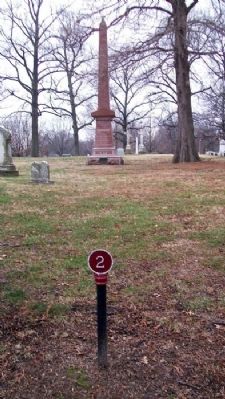
Regarding Thomas Hart Benton. Monument location is designated by the Red #2 marker along the cemetery drive.
Also see . . .
1. Thomas Hart Benton. Biographical Directory of the U.S. Congress website entry (Submitted on December 25, 2012, by William Fischer, Jr. of Reynoldsburg, Ohio.)
2. Thomas Hart Benton. NNDB website entry (Submitted on December 25, 2012, by William Fischer, Jr. of Reynoldsburg, Ohio.)
3. Bellfontaine Cemetery, St. Louis MO. Website homepage (Submitted on December 25, 2012, by William Fischer, Jr. of Reynoldsburg, Ohio.)
Photographed by William Fischer, Jr., January 21, 2012
2. Elizabeth Benton Marker
Photographed by William Fischer, Jr., January 21, 2012
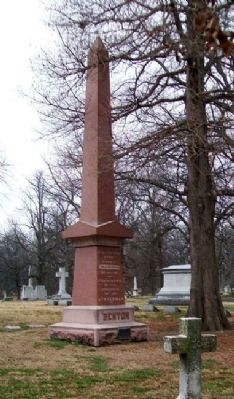
3. Thomas Hart Benton Monument
Photographed by William Fischer, Jr., January 21, 2012
4. Thomas Hart Benton Monument
Photographed by William Fischer, Jr., January 21, 2012
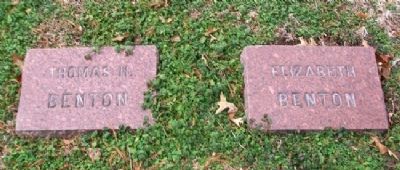
5. Thomas Hart and Elizabeth Benton Markers
Photographed by Allen C. Browne, February 16, 2015
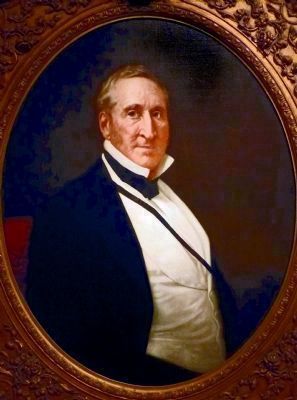
6. Thomas Hart Benton
This 1861 portrait by Ferdinand Thomas Lee Boyle hangs in the National Portrait Gallery in Washington DC.
“Thomas Hart Benton was a major political figure in the period, serving as a Democratic senator from from Missouri for thirty years. Politically, Benton helped implement ‘manifest destiny’ with his wholehearted support of national expansion. He wrote in 1818: ‘In a few years the Rocky Mountains will be passed and the “children of Adam” will have [marched] west to … the Pacific.’ To fulfill this vision of America as a new Eden, Benton promoted homesteading, the western railroad, the Pony Express. annexation, and other measures. But his career foundered on the issue of slavery. A believer in the Union and an opponent of slavery, he voted against the Compromise of 1850, which deferred conflict on the slavery issue. Benton's intransigence outraged the Missouri legislature, and they replaced him with a proslavery Whig in 1850.” — National Portrait Gallery
“Thomas Hart Benton was a major political figure in the period, serving as a Democratic senator from from Missouri for thirty years. Politically, Benton helped implement ‘manifest destiny’ with his wholehearted support of national expansion. He wrote in 1818: ‘In a few years the Rocky Mountains will be passed and the “children of Adam” will have [marched] west to … the Pacific.’ To fulfill this vision of America as a new Eden, Benton promoted homesteading, the western railroad, the Pony Express. annexation, and other measures. But his career foundered on the issue of slavery. A believer in the Union and an opponent of slavery, he voted against the Compromise of 1850, which deferred conflict on the slavery issue. Benton's intransigence outraged the Missouri legislature, and they replaced him with a proslavery Whig in 1850.” — National Portrait Gallery
Credits. This page was last revised on November 25, 2023. It was originally submitted on December 25, 2012, by William Fischer, Jr. of Reynoldsburg, Ohio. This page has been viewed 841 times since then and 46 times this year. Photos: 1, 2, 3, 4, 5. submitted on December 25, 2012, by William Fischer, Jr. of Reynoldsburg, Ohio. 6. submitted on April 23, 2015, by Allen C. Browne of Silver Spring, Maryland.
