Dunbar in Fayette County, Pennsylvania — The American Northeast (Mid-Atlantic)
Kentuck Knob
I. N. and Bernardine Hagan House
Photographed by Bill Pfingsten, October 22, 2012
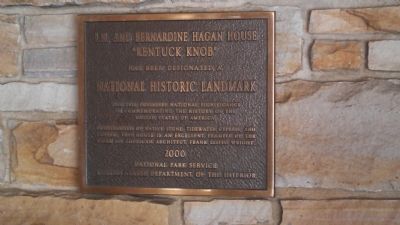
1. Kentuck Knob Marker
"Kentuck Knob"
has been designated a
National Historic Landmark
This site possesses National significance in commemorating the history of the United States of America
Constructed of native stone, tidewater cypress, and copper, this house is an excellent example of the work of American architect Frank Lloyd Wright
2000
National Park Service
United States Department of the Interior
Erected by National Park Service.
Topics and series. This historical marker is listed in this topic list: Landmarks. In addition, it is included in the Frank Lloyd Wright, and the National Historic Landmarks series lists. A significant historical year for this entry is 2000.
Location. 39° 52.101′ N, 79° 31.284′ W. Marker is in Dunbar, Pennsylvania, in Fayette County. It can be reached from Kentuck Road. Touch for map. Marker is at or near this postal address: 723 Kentuck Road, Dunbar PA 15431, United States of America. Touch for directions.

Regionally, this marker is in Pennsylvania’s Laurel Highlands. It is also in the American Northeast, in the Mid-Atlantic, in Appalachia, and specifically in Northern
this page online
Other nearby markers. At least 8 other markers are within 2 miles of this marker, measured as the crow flies: K6 Telephone Kiosk 1935 (approx. ¼ mile away); Finial from One, Poultry, London EC4, 1870 (approx. ¼ mile away); A "Most Enchanting" Resort (approx. 1.4 miles away); Veterans Memorial (approx. 1½ miles away); Ohiopyle (approx. 1½ miles away); Railroading (approx. 1½ miles away); a different marker also named Ohiopyle (approx. 1.6 miles away); a different marker also named Ohiopyle (approx. 1.6 miles away). Touch for a list and map of all markers in Dunbar.
More about this marker. There is an entrance fee to visit the house and grounds. This is an example of Frank Lloyd Wright's Unisonian concept for a compact house with a base cost of $5,500. The Hagan's then had the base plans revised to meet their personal preferences. The completed house ended
Photographed by Bill Pfingsten, October 22, 2012
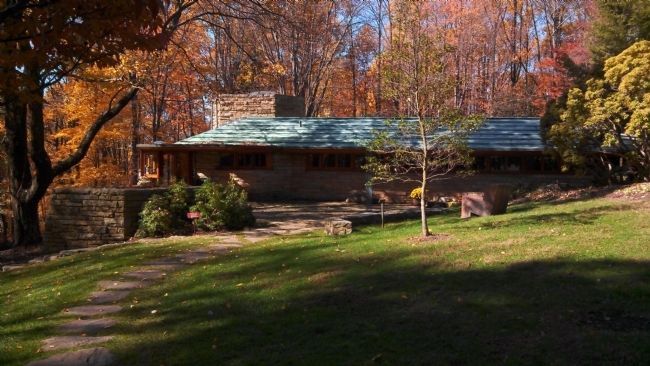
2. Kentuck Knob
The house was built on top of a treeless rock covered mountain with an open view of the surrounding area. The owners then planted 10,000 trees for privacy. As the trees matured, their view disappeared.
Also see . . . Kentuck Knob website. (Submitted on December 26, 2012, by Bill Pfingsten of Bel Air, Maryland.)
Photographed by Bill Pfingsten, October 22, 2012
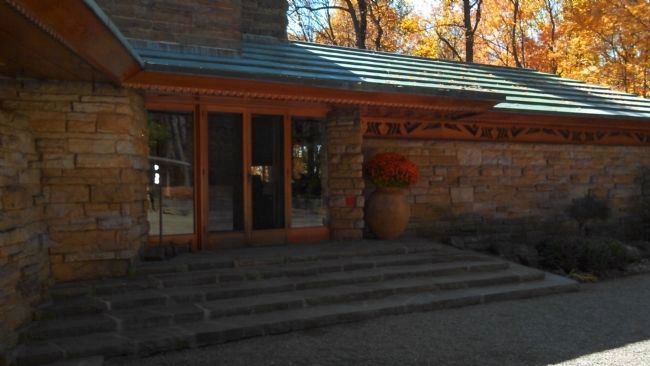
3. Kentuck Knob
Wright designed the house using topographic maps and surveys of the area.
Photographed by Bill Pfingsten, October 22, 2012
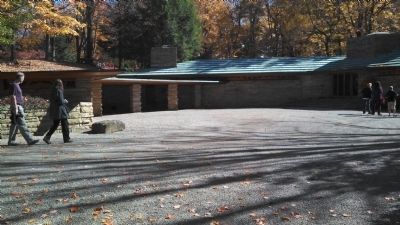
4. Kentuck Knob Carport
Wright disliked, garages, basements and attics because they attracted clutter. He developed the concept of a carport where clutter could not accumulate.
Photographed by Bill Pfingsten, October 22, 2012
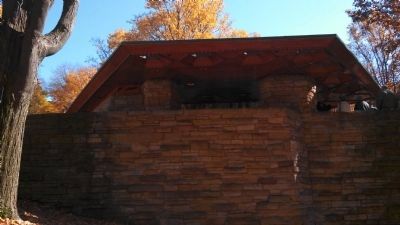
5. Kentuck Knob
Overhangs were planned to allow warming sunlight in winter and shade in the summer. There was no need for air conditioning.
Credits. This page was last revised on June 16, 2016. It was originally submitted on December 26, 2012, by Bill Pfingsten of Bel Air, Maryland. This page has been viewed 709 times since then and 21 times this year. Photos: 1, 2, 3, 4, 5. submitted on December 26, 2012, by Bill Pfingsten of Bel Air, Maryland.
