Plymouth Notch in Windsor County, Vermont — The American Northeast (New England)
Calvin Coolidge Homestead
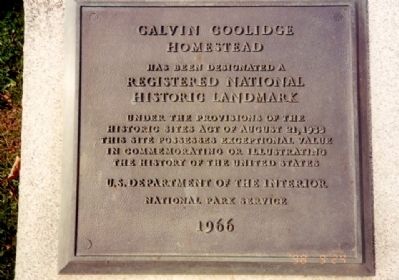
Photographed by Don Morfe, September 24, 1998
1. Calvin Coolidge Homestead Marker
Erected by National Park Service.
Topics and series. This historical marker is listed in this topic list: Notable Places. In addition, it is included in the Former U.S. Presidents: #30 Calvin Coolidge, and the National Historic Landmarks series lists. A significant historical year for this entry is 1933.
Location. 43° 32.118′ N, 72° 43.248′ W. Marker is in Plymouth, Vermont, in Windsor County. It is in Plymouth Notch. It is on Calvin Coolidge Memorial Road. Touch for map. Marker is in this post office area: Plymouth VT 05056, United States of America. Touch for directions.

Regionally, this marker is in Vermont’s Connecticut River Valley and in the Green Mountains. It is also in the American Northeast and in New England. Globally, it is in North America, the Western Hemisphere, the Western
this page online
Other nearby markers. At least 8 other markers are within 6 miles of this marker, measured as the crow flies: Calvin Coolidge (within shouting distance of this marker); Plymouth WW1 Memorial (about 300 feet away, measured in a direct line); Capt. John Coolidge Flagpole (approx. 0.2 miles away); Achsa W. Sprague (1827-1862) (approx. ¼ mile away); World War II Veterans Honor Roll (approx. 1.1 miles away); Vermont Gold Rush (approx. 4.2 miles away); Revolutionary War Campground on the Crown Point Road (approx. 4.3 miles away); Bridgewater World War I Monument (approx. 6 miles away). Touch for a list and map of all markers in Plymouth.
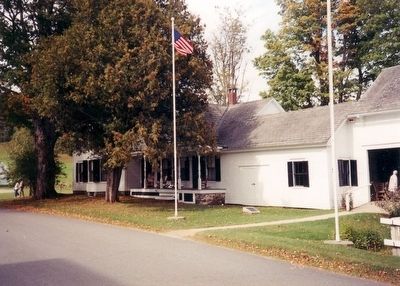
Photographed by Don Morfe, September 24, 1998
2. Calvin Coolidge Homestead Marker
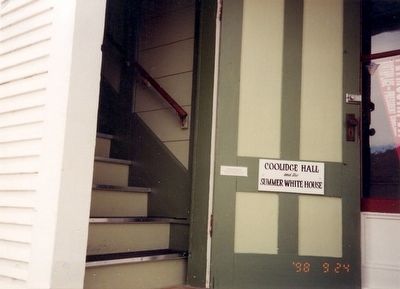
Photographed by Don Morfe, September 24, 1998
3. Calvin Coolidge Homestead Marker
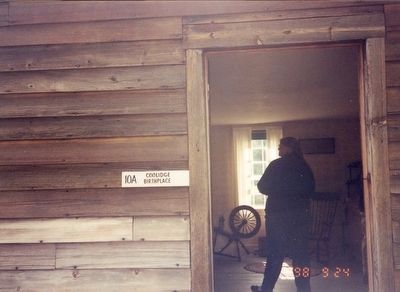
Photographed by Don Morfe, September 24, 1998
4. Calvin Coolidge Homestead Marker
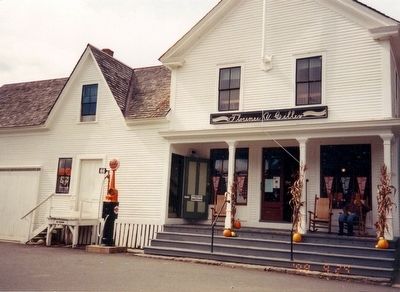
Photographed by Don Morfe, September 24, 1998
5. The Coolidge Store
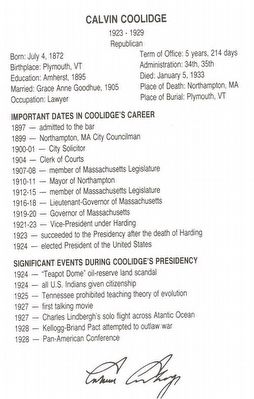
Photographed by Don Morfe, September 24, 1998
6. Short Biography of Calvin Coolidge
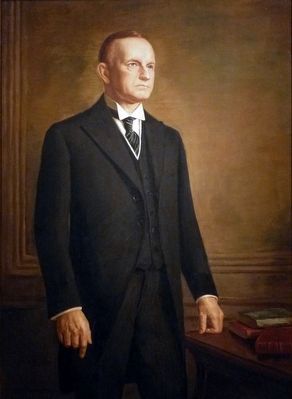
Photographed by Allen C. Browne, August 9, 2015
7. Calvin Coolidge
This 1956 portrait of Calvin Coolidge by Joseph E. Burgess (after Ercole Cartotto) hangs in the National Portrait Gallery in Washington, DC.
“Americans expect their presidents to be active, which explains why Calvin Coolidge has been labeled by historians as the ‘quiet president’ and an ‘American enigma.’ Coolidge was propelled to national prominence, and the vice presidency, by his decision, while governor of Massachusetts, to fire striking officers in Boston's police strike of 1919, proclaiming, ’there is no right to strike against the public safety by anybody, anywhere, any time.’ Assuming the presidency after Warren Harding's death in 1923, Coolidge determined not to do anything to upset American prosperity. Upon election to the presidency, Coolidge, in his 1925 inaugural address the first on radio expressed his belief that ‘the people of America [should] … work less for the government and more for themselves.… That is the chief meaning of freedom.’ When Coolidge left office, political commentator Walter Lippmann wrote, ‘Surely no one will write of those years … that an aggressive president altered the destiny of the Republic. Yet … no one will write … that the Republic wished its destiny to be altered.’” — National Portrait Gallery
“Americans expect their presidents to be active, which explains why Calvin Coolidge has been labeled by historians as the ‘quiet president’ and an ‘American enigma.’ Coolidge was propelled to national prominence, and the vice presidency, by his decision, while governor of Massachusetts, to fire striking officers in Boston's police strike of 1919, proclaiming, ’there is no right to strike against the public safety by anybody, anywhere, any time.’ Assuming the presidency after Warren Harding's death in 1923, Coolidge determined not to do anything to upset American prosperity. Upon election to the presidency, Coolidge, in his 1925 inaugural address the first on radio expressed his belief that ‘the people of America [should] … work less for the government and more for themselves.… That is the chief meaning of freedom.’ When Coolidge left office, political commentator Walter Lippmann wrote, ‘Surely no one will write of those years … that an aggressive president altered the destiny of the Republic. Yet … no one will write … that the Republic wished its destiny to be altered.’” — National Portrait Gallery
Credits. This page was last revised on November 4, 2020. It was originally submitted on December 26, 2012, by Don Morfe of Baltimore, Maryland. This page has been viewed 906 times since then and 39 times this year. Photos: 1, 2, 3, 4, 5, 6. submitted on December 26, 2012, by Don Morfe of Baltimore, Maryland. 7. submitted on October 17, 2015, by Allen C. Browne of Silver Spring, Maryland. • Bill Pfingsten was the editor who published this page.
