Charles Town in Jefferson County, West Virginia — The American South (Appalachia)
Site of the Execution of John Brown
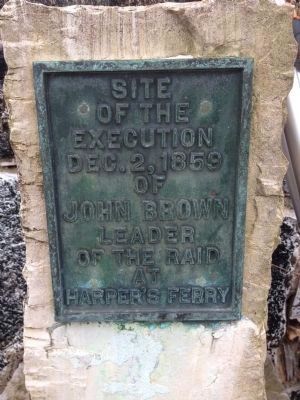
Photographed by Chris Able, December 31, 2012
1. Site of the Execution Marker
Topics. This historical marker is listed in this topic list: War, US Civil. A significant historical month for this entry is December 1800.
Location. 39° 17.143′ N, 77° 51.368′ W. Marker is in Charles Town, West Virginia, in Jefferson County. It can be reached from South Samuel Street just south of Hunter Street, on the left when traveling south. Marker is on private property. Touch for map. Marker is at or near this postal address: 515 S Samuel St, Charles Town WV 25414, United States of America. Touch for directions.

Regionally, this marker is in the Washington Metropolitan Area and in the Eastern Panhandle. It is also in the American South, specifically in the Upper South, in Appalachia, and specifically in Northern Appalachia. Globally, it is in North America, the Western Hemisphere, the Western World, and the Anglosphere. Historically,
this page online
Other nearby markers. At least 8 other markers are within walking distance of this marker: John Brown Scaffold (within shouting distance of this marker); John Brown Hanging Site (within shouting distance of this marker); Green And Copeland Jr. (within shouting distance of this marker); George Upshur Manning (approx. 0.2 miles away); George Washington Turner (approx. 0.2 miles away); Samuel Washington House (approx. 0.2 miles away); Sergeant Littleton Tazewell Cordell (approx. ¼ mile away); A Cemetery Disturbed (approx. ¼ mile away). Touch for a list and map of all markers in Charles Town.
More about this marker. Marker is on private property. Be sure you do trespass onto the property.
Also see . . . The Hanging. American Experience website. “Admittance to John Brown’s execution was severely restricted. Virginia
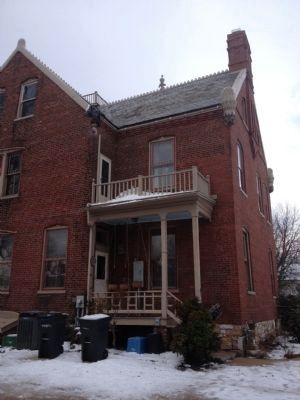
Photographed by Chris Able, December 31, 2012
2. Site of the Execution of John Brown
This view it east-southeast. The marker is in the lower right of the photo, up against the foundation, facing right.
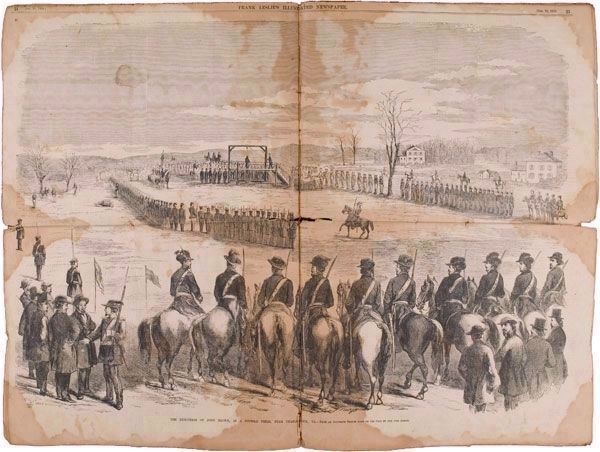
Virginia Historical Society Archive
3. The Execution of John Brown, In a Stubble Field, Near Charlestown, Va.
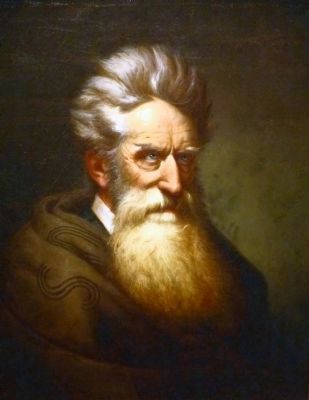
Photographed by Allen C. Browne, February 16, 2015
4. John Brown
This 1872 portrait of John Brown by Ole Peter Hansen Balling hangs in the National Portrait Gallery in Washingotn DC.
“There were those who noted a touch of insanity in abolitionist John Brown; he believed he had been called by God to embark on a personal crusade to end slavery. Brown and five of his sons were actively engaged in the bloody guerrilla war being waged in Kansas in 1855-56, between proslavery and anti-slavery factions. But in 1857, Brown began making plans for the 1859 raid on the federal arsenal at Harper's Ferry, an event that would make him both infamous and immortal. The scheme to commandeer firearms with which to arm a slave rebellion failed, and Brown was captured, tried, and hanged. His insurrection found favor among many northern abolitionists. In response, southerners viewed Brown as a sign that they must either break their allegiance to the Union or be destroyed by an increasingly fanatical North. ” — National Portrait Gallery
“There were those who noted a touch of insanity in abolitionist John Brown; he believed he had been called by God to embark on a personal crusade to end slavery. Brown and five of his sons were actively engaged in the bloody guerrilla war being waged in Kansas in 1855-56, between proslavery and anti-slavery factions. But in 1857, Brown began making plans for the 1859 raid on the federal arsenal at Harper's Ferry, an event that would make him both infamous and immortal. The scheme to commandeer firearms with which to arm a slave rebellion failed, and Brown was captured, tried, and hanged. His insurrection found favor among many northern abolitionists. In response, southerners viewed Brown as a sign that they must either break their allegiance to the Union or be destroyed by an increasingly fanatical North. ” — National Portrait Gallery
Credits. This page was last revised on June 16, 2016. It was originally submitted on December 31, 2012, by J. J. Prats of Powell, Ohio. This page has been viewed 4,018 times since then and 174 times this year. Photos: 1, 2. submitted on December 31, 2012, by J. J. Prats of Powell, Ohio. 3. submitted on December 31, 2012. 4. submitted on May 2, 2015, by Allen C. Browne of Silver Spring, Maryland.
