Mandarin in Duval County, Florida — The American South (South Atlantic)
Harriet Beecher Stowe Home
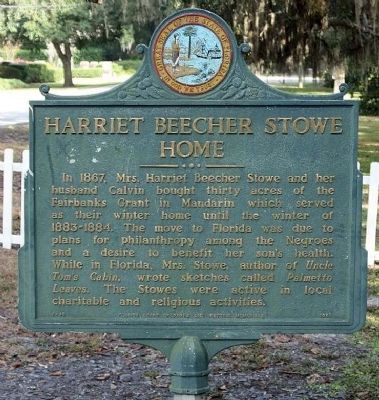
Photographed by Mike Stroud, December 2, 2012
1. Harriet Beecher Stowe Home Marker
Erected 1961 by Florida Board of Parks and Historic Memorials. (Marker Number F-40.)
Topics. This historical marker is listed in this topic list: Notable Places. A significant historical year for this entry is 1867.
Location. 30° 9.683′ N, 81° 39.518′ W. Marker is in Mandarin, Florida, in Duval County. It is on Mandarin Road near Brady Road, on the right when traveling west. Touch for map. Marker is in this post office area: Jacksonville FL 32223, United States of America. Touch for directions.

Regionally, this marker is in First Coast and in Greater Jacksonville. It is also in the American South and on the Eastern Seaboard. Globally, it is in the North Atlantic
this page online
Other nearby markers. At least 8 other markers are within walking distance of this marker: Mandarin Store and Post Office (about 300 feet away, measured in a direct line); James Hall (1760–1837) (about 300 feet away); Mandarin Veterans Monument (about 500 feet away); Church of Our Savior (approx. 0.4 miles away); The Maple Leaf (approx. ¾ mile away); The St. Johns River (approx. ¾ mile away); Losco Winery (approx. ¾ mile away); The Major William Webb / Walter Jones Farmhouse (approx. ¾ mile away).
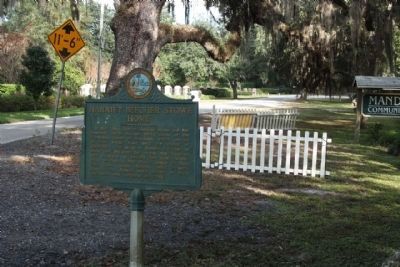
Photographed by Mike Stroud, December 2, 2012
2. Harriet Beecher Stowe Home Marker, looking west along Mandarin Road
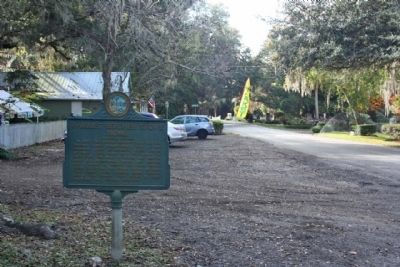
Photographed by Mike Stroud, December 2, 2012
3. Harriet Beecher Stowe Home Marker, looking east
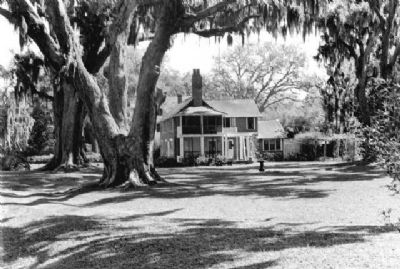
State Archives of Florida, circa 1960
4. Harriet Beecher Stowe Home
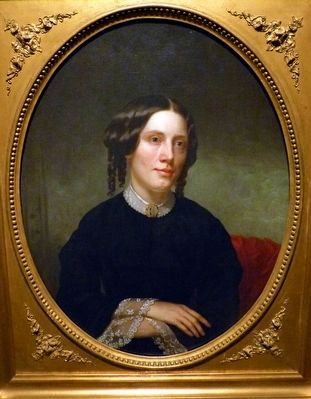
Photographed by Allen C. Browne, August 9, 2015
5. Harriet Beecher Stowe
This 1853 portrait by Alanson Fisher hangs in the National Portrait Gallery in Washington,
DC.
“Excluded from public professions, cultivated women sought other avenues for their talents. From discussing the issues of the day in informal salon gatherings, it was a short step for women to become writers, especially since the antebellum period saw a burgeoning number of magazines catering to women. So Harriet Beecher Stowe started a career that made her one of the most popular novelists of the nineteenth century. Stowe's place in American history was sealed with her novel Uncle Tom's Cabin (1851-52), which sold 300,000 copies in its first year. Uncle Tom's Cabin was a reform novel; Stowe was motivated to write it by the Fugitive Slave Law and the effect that slavery had in destroying the African American family. No more effective charge could be made in a nation that, both North and South, revered the family as the foundation of society.” — National Portrait Gallery
“Excluded from public professions, cultivated women sought other avenues for their talents. From discussing the issues of the day in informal salon gatherings, it was a short step for women to become writers, especially since the antebellum period saw a burgeoning number of magazines catering to women. So Harriet Beecher Stowe started a career that made her one of the most popular novelists of the nineteenth century. Stowe's place in American history was sealed with her novel Uncle Tom's Cabin (1851-52), which sold 300,000 copies in its first year. Uncle Tom's Cabin was a reform novel; Stowe was motivated to write it by the Fugitive Slave Law and the effect that slavery had in destroying the African American family. No more effective charge could be made in a nation that, both North and South, revered the family as the foundation of society.” — National Portrait Gallery
Credits. This page was last revised on March 21, 2023. It was originally submitted on January 10, 2013, by Mike Stroud of Bluffton, South Carolina. This page has been viewed 2,233 times since then and 112 times this year. Photos: 1, 2, 3. submitted on January 10, 2013, by Mike Stroud of Bluffton, South Carolina. 4. submitted on January 11, 2013, by Mike Stroud of Bluffton, South Carolina. 5. submitted on August 10, 2015, by Allen C. Browne of Silver Spring, Maryland.
