Chalmette in St. Bernard Parish, Louisiana — The American South (West South Central)
The Battle Ends
Photographed by Bryan Olson, May 2007
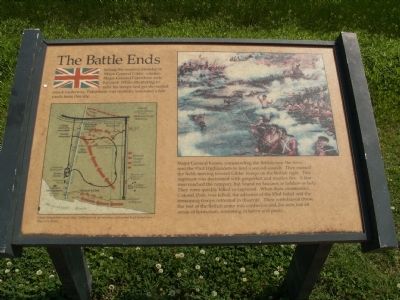
1. The Battle Ends Marker
Major General Keane, commanding the British near the river; sent the 93rd Highlanders to lead a second assault. They crossed the field, moving towards Gibbs’ troops on the British right.This regiment was decimated with grapeshot and musket fire. A few men reached the rampart, but found no fascines or ladders or help. They were quickly killed or captured. When their commander, Colonel Dale, was killed, the advance of the 93rd failed and the remaining troops retreated in disarray. Their withdrawal threw the rest of the British army into confusion and the men lost all sense of formation, retreating in terror and panic.
Erected by National Park Service.
Topics. This historical marker is listed in this topic list: War of 1812.
Location. Marker has been reported missing. It was located near 29° 56.651′ N, 89° 59.355′ W. Marker was in Chalmette,
this page online

Regionally, this marker was in Bayou Country and in Greater New Orleans. It was also in the American South, specifically in the Deep South, and on the Gulf Coast. Globally, it was in North America, a Gulf of Mexico state, the Western Hemisphere, the Western World, and the Anglosphere. Historically, it found itself in what was once New Spain, the Viceroyalty of New France, the territory of the Mississippian Culture, the Louisiana Purchase, one of the Confederate States of America, and the Antebellum South.
Other nearby markers. At least 8 other markers are within walking distance of this location: Pakenham's Fall (a few steps from this marker); The Main Attack (a few steps from this marker); Roads and Ditches (approx. 0.2 miles away); Here We Honor Veterans Who Served Their Country (approx. 0.2 miles away); Chalmette National Cemetery (approx. 0.2 miles
Photographed by Bryan Olson, May 2007
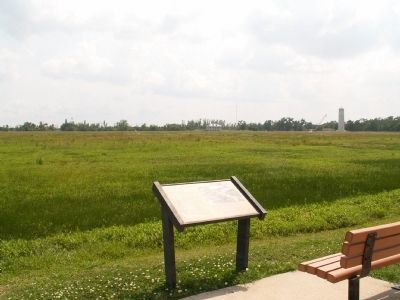
2. The Battle Ends Marker
Pakenham’s arrival at the front line showed how desperate the British army’s situation was. As he tried to rally his men for another attack, an American rifleman shot him in the spine, mortally wounding him. (NPS)
Another marker is no longer nearby. “Where Has Our Equipment Gone?” (was approx. 0.2 miles away but has been confirmed missing).
More about this marker. On the right side of the marker is an illustration of the fighting showing some of the Highland regiments in action. On the left is a map showing the British movements on the battlefield, captioned Great Britain lost more than 2,000 men in an infantry action that lasted less than two hours.
Additional keywords. Battle of New Orleans, Chalmette Battlefield
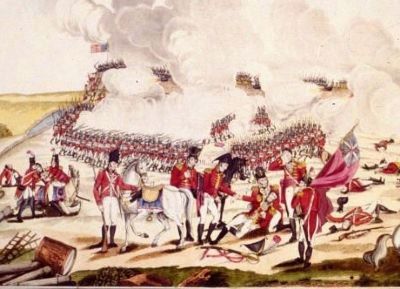
3. The death of Major General Pakenham
This engraving depicts the death of General Pakenham
Credits. This page was last revised on January 14, 2023. It was originally submitted on March 15, 2008, by Bryan Olson of Syracuse, New York. This page has been viewed 1,917 times since then and 17 times this year. Photos: 1, 2, 3. submitted on March 15, 2008, by Bryan Olson of Syracuse, New York. • Craig Swain was the editor who published this page.
