Chalmette in St. Bernard Parish, Louisiana — The American South (West South Central)
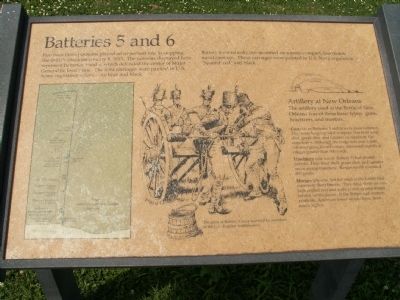
Batteries 5 and 6
Photographed by Bryan Olson, May 2007
1. Batteries 5 and 6 Marker
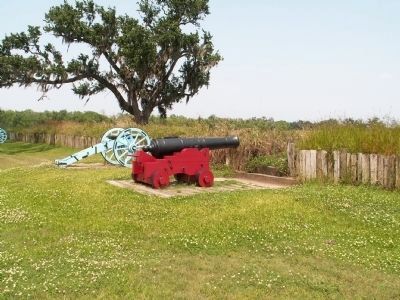
Battery 6 contained guns mounted on a more compact mobile naval carriage. These carriages were painted in U.S Navy regulation “Spanish red” and black.
Artillery at New Orleans
The artillery used at the Battle of New Orleans was of three basic types: guns, howitzers, and mortars.
Guns (As in Batteries 5 and 6) were most common. They were long-barreled weapons that fired solid shot, grape shot, and canister on relatively flat trajectories. Although the range was over a mile for most guns, their accuracy decreased rapidly at ranges greater than 500 yards.
Howitzers (one was in battery 1) had shorter barrels. They fired shell, grape shot, and canister on an arcing trajectory. Ranges rarely exceeded 800 yards.
Mortars (present, but not used in the battle) had extremely short barrels. They fired shells on very high angled arcs
this page online
Erected by National Park Service.
Topics. This historical marker is listed in this topic list: War of 1812. A significant historical date for this entry is January 8, 1815.
Location. Marker has been reported missing. It was located near 29° 56.7′ N, 89° 59.549′ W. Marker was in Chalmette, Louisiana, in St. Bernard Parish. It was on Battlefield Road, on the left when traveling south. Touch for map. Marker was in this post office area: Chalmette LA 70043, United States of America. Touch for directions.

Regionally, this marker was in Bayou Country and in Greater New Orleans. It was also in the American South, specifically in the Deep South, and on the Gulf Coast. Globally, it was in North America, a Gulf of Mexico state, the Western Hemisphere, the Western World, and the Anglosphere. Historically, it found itself in what was once New Spain, the Viceroyalty of New France, the territory of the Mississippian Culture, the Louisiana Purchase, one of the Confederate States of America, and the
Photographed by Bryan Olson, May 2007
2. The American Rampart
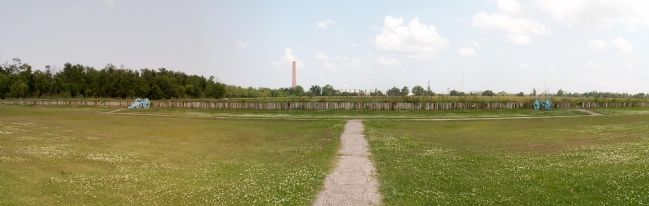
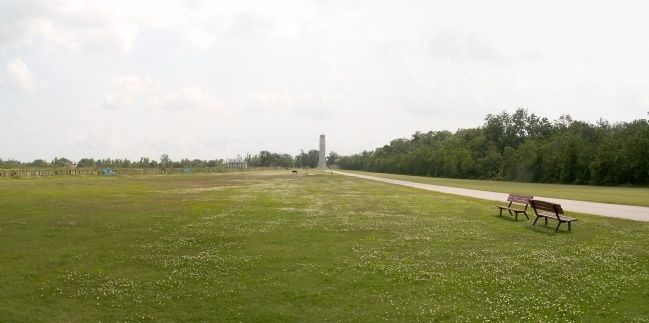
Batteries 5 and 6, along with Batteries 7 and 8 to the northeast anchoring the left flank of Jackson’s line, helped to stop Gibbs’s advancing column on January 8. The cannon in battery 5 are reproductions of the two six ponders used here the day of the battle.(NPS)
Other nearby markers. At least 8 other markers are within walking distance of this location: Batteries Five and Six (within shouting distance of this marker); Batteries Seven and Eight (within shouting distance of this marker); Chalmette Battlefield And National Cemetery (about 600 feet away, measured in a direct line); Battle Of New Orleans 200th Anniversary (about 800 feet away); Battery Four (approx. 0.2 miles away); The Kentucky Rifle (approx. 0.2 miles away); Chalmette Battlefield (approx. 0.2 miles away); Fazendeville (approx. 0.2 miles away). Touch for a list and map of all markers in Chalmette.
Another marker is no longer nearby. Battery 4 (was approx. 0.2 miles away but has been confirmed missing).
More about this marker. The center illustration on the marker shows The guns at Battery 5 were manned by U.S. Regular artillerymen. A map on the left details the disposition of U.S. troops and batteries. On the right a drawing illustrates the differences of the three weapon classes described.
Additional keywords. Battle of New Orleans, Chalmette Battlefield

Photographed by Bryan Olson, May 2007
3. An American Gun
Guns were most common. They were long-barreled weapons that fired solid shot, grape shot, and canister on relatively flat trajectories. Although the range was over a mile for most guns, their accuracy decreased rapidly at ranges greater than 500 yards.
Photographed by Bryan Olson, May 2007
4. An American Gun mounted on a mobile naval carriage
These carriages were painted in U.S Navy regulation “Spanish red” and black.
Photographed by Bryan Olson, May 2007
5. The American Rampart, looking South
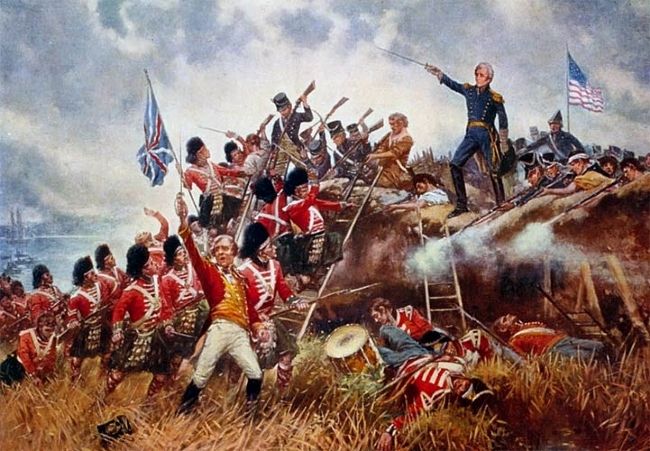
6. The Battle of New Orleans
Painting by E. Percy Moran, "The Battle of New Orleans," on January 9, 1815, the climactic battle in the War of 1812 and the early career of General Andrew Jackson.
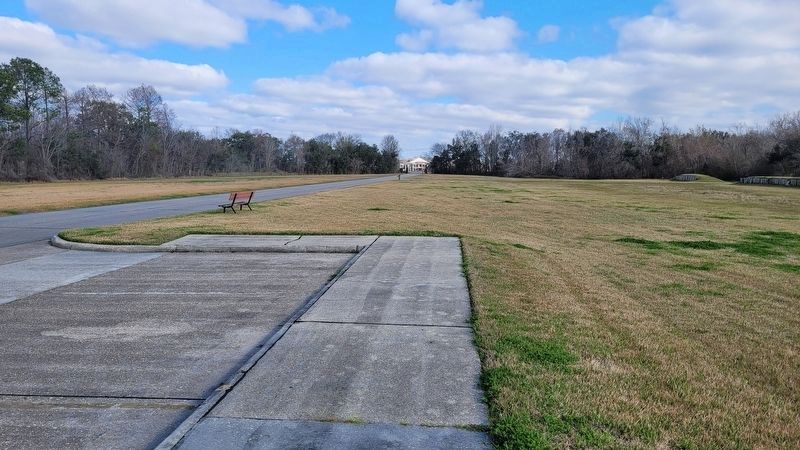
Photographed by James Hulse, January 13, 2023
7. The Batteries 5 and 6 Marker has been removed and replaced with another marker
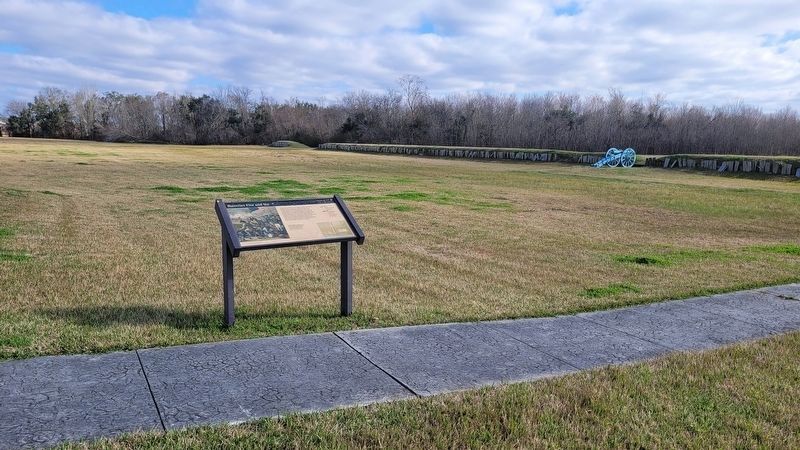
Photographed by James Hulse, January 13, 2023
8. The new Batteries 5 and 6 Marker called Batteries Five and Six
Credits. This page was last revised on January 14, 2023. It was originally submitted on March 16, 2008, by Bryan Olson of Syracuse, New York. This page has been viewed 2,885 times since then and 96 times this year. Photos: 1, 2, 3, 4, 5, 6. submitted on March 16, 2008, by Bryan Olson of Syracuse, New York. 7, 8. submitted on January 13, 2023, by James Hulse of Medina, Texas. • Craig Swain was the editor who published this page.
