Bagdad in Santa Rosa County, Florida — The American South (South Atlantic)
The Thompson House ⎯⎯⎯ Skirmish on the Blackwater
Photographed by Mark Hilton, November 17, 2016
1. The Thompson House Marker
Inscription.
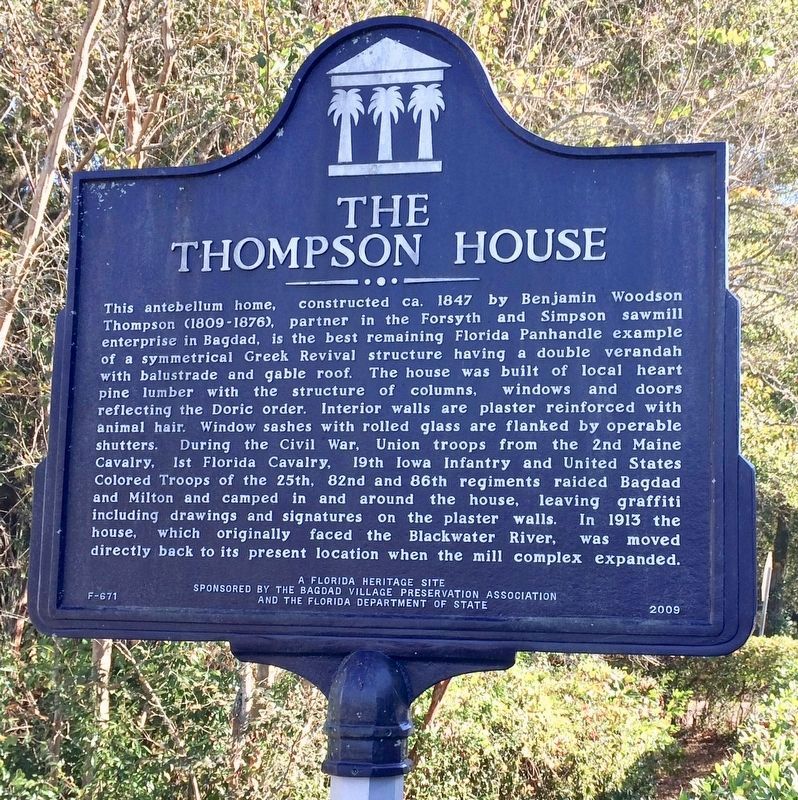
The Thompson House
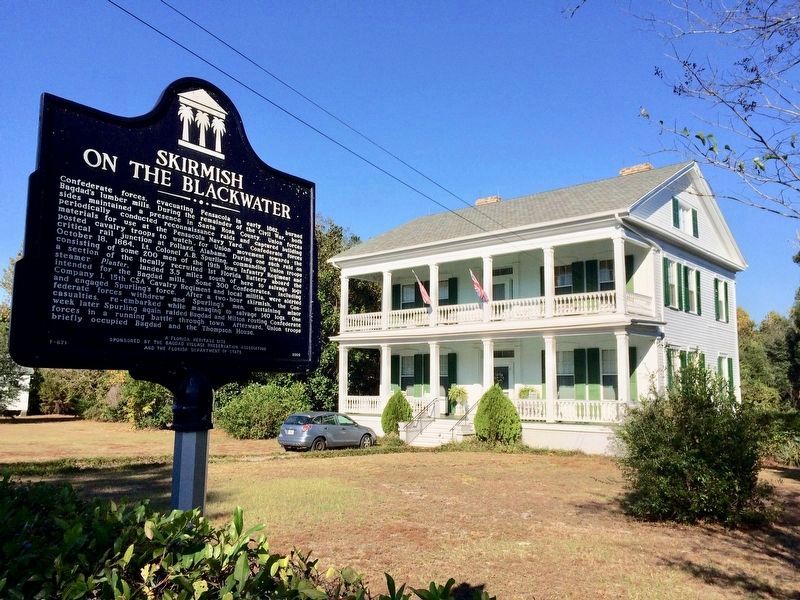
This antebellum home, constructed ca. 1847 by Benjamin Woodson Thompson (1809 - 1876), partner in the Forsyth and Simpson sawmill enterprise in Bagdad, is the best remaining Florida Panhandle example of a symmetrical Greek Revival structure having a double verandah with balustrade and cantilevered gable roof. The house was built of local heart pine lumber with the structure of columns, windows and doors reflecting the Doric order. Interior walls are plaster reinforced with animal hair. Widow sashes with rolled glass are flanked by operable shutters. During the Civil War, Union troops from the 2nd Maine Cavalry, 1st Florida Cavalry, 19th Iowa Infantry and United States Colored Troops of the 25th, 82nd and 86th regiments raided Bagdad and Milton and camped in and around the house, leaving graffiti including drawings and signatures on the plaster walls. In 1913 the house, which originally faced the Blackwater River, was moved directly back to its present location when the Mill complex expanded.
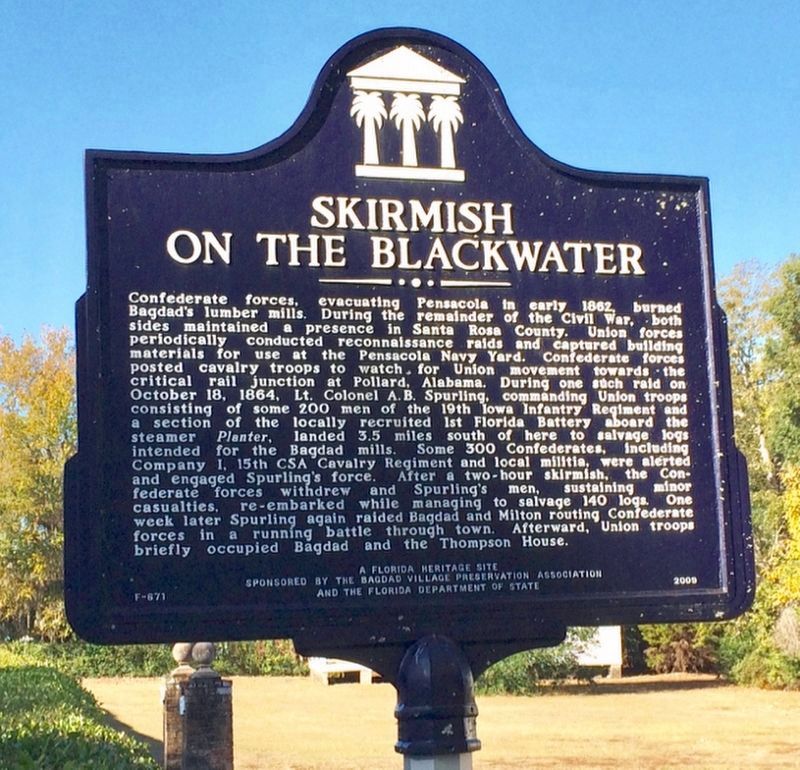
Skirmish on the Blackwater
Confederates, evacuating Pensacola in the spring of 1862, burned the lumber mills
Click or scan to see this page online
of Bagdad. During the remainder of the war, both sides maintained a presence in Santa Rosa County. Union forces periodically conducted reconnaissance raids and captured building materials for use at the Pensacola Navy Yard. Confederates posted locally recruited cavalry troops to lookout for any Union movement towards the critical rail junction at Pollard, Alabama. During one such raid on October 18, 1864, Lt. Colonel A. B. Spurling commanding Union troops consisting of some 200 men of the 19th Iowa Infantry Regiment and a section of the locally recruited 1st Florida Battery aboard the steamer Planter landed 3.5 miles south of here to salvage logs intended for the Bagdad mills. Some 300 Confederates including Company I, 15th CSA Cavalry Regiment and local militia were alerted and engaged Spurling’s force. After a two-hour skirmish, the Confederates withdrew and Spurling’s men sustaining minor casualties re-embarked while managing to salvage 140 logs. One week later Spurling again raided Bagdad and Milton routing Confederates in a running battle through town. Afterward, Union troops briefly occupied Bagdad and the Thompson House.
Erected 2009
Photographed by Mark Hilton, November 17, 2016
2. Skirmish on the Blackwater Marker
by the Bagdad Village Preservation Association and the Florida Department of State. (Marker Number F-671.)
Location. 30° 36.15′ N, 87° 2.001′ W. Marker is in Bagdad, Florida, in Santa Rosa County. It is at the intersection of Forsyth Street and Thompson Street, on the right when traveling north on Forsyth Street. Touch for map. Marker is at or near this postal address: 4620 Forsyth St, Bagdad FL 32530, United States of America. Touch for directions.
Regionally, this marker is in Greater Pensacola and on the Florida Panhandle. It is also in the American South, specifically in the Deep South, and on the Gulf Coast. Globally, it is in the North Atlantic Region, North America, a Gulf of Mexico state, the Western Hemisphere, the Western World, and the Anglosphere. Historically, it finds itself in what was once New Spain, the territory of the Mississippian Culture, one of the Confederate States of America, and the Antebellum South.
Credits. This page was last revised on September 22, 2024. It was originally submitted on August 16, 2010. This page has been viewed 4,771 times since then and 269 times this year. Last updated on February 9, 2013. Photos:1, 2, 3. submitted on November 21, 2016, by Mark Hilton of Montgomery, Alabama. 4. submitted on August 16, 2010. • Bill Pfingsten was the editor who published this page.