Eastham in Barnstable County, Massachusetts — The American Northeast (New England)
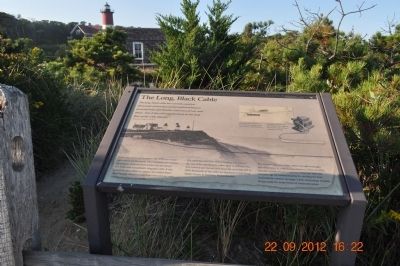
The Long, Black Cable
Photographed by Sandra Hughes, September 22, 2012
1. The Long, Black Cable Marker
Now it lies cold and dormant on the deep floor of the wide Atlantic.
If you stood here on November 16, 1879. you would have joined the thousands who cheered as the steamer CS Faraday delivered from France the last thread of a 3,000-mile transatlantic telegraph cable. It was one of the first cables to connect the United States with Europe. America could now communicate with Europe in minutes not weeks.
The small French Cable Hut in front of you housed the end of the transatlantic cable. Built in 1893 the hut was restored and moved back from the receding cliff in 2004. Remnants of the cable are displayed at Salt Pond Visitor Center in Eastham, Massachusetts.
For 24 years this and other cables brought messages and daily news to cities across America. Then, in 1903, six miles north of here Guglielmo Marconi ushered in a new age of communication by sending the first transatlantic wireless message. Cable technology remains in use today for some forms of communication.
Topics.
this page online
Location. 41° 51.582′ N, 69° 57.155′ W. Marker is in Eastham, Massachusetts, in Barnstable County. It is at the intersection of Cable Road and Nauset Light Beach Rd on Cable Road. Touch for map. Marker is in this post office area: Eastham MA 02642, United States of America. Touch for directions.

Regionally, this marker is on Cape Cod. It is also in the American Northeast, in New England, and on the Eastern Seaboard. Globally, it is in the North Atlantic Region, North America, the Western Hemisphere, the Western World, and the Anglosphere. Historically, it finds itself in what was once one of the original Thirteen Colonies.
Other nearby markers. At least 8 other markers are within 2 miles of this marker, measured as the crow flies: Pushed Back by the Sea (a few steps from this marker); The Nauset Lights (within shouting distance of this marker); Nauset Beach Light Station, a Shifting Landmark (within shouting distance of this marker); Keeping the Light for 114 Years (within shouting distance of this marker);
Photographed by Sandra Hughes, September 22, 2012
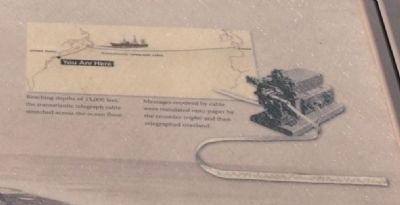
2. The Long, Black Cable Marker
You are here
Reaching depths of 15,000 feet, the transatlantic telegraph cable stretched across the ocean floor.
Messages received by cable were translated onto paper by the recorder (right) and then telegraphed overland.
Photographed by Sandra Hughes, September 22, 2012
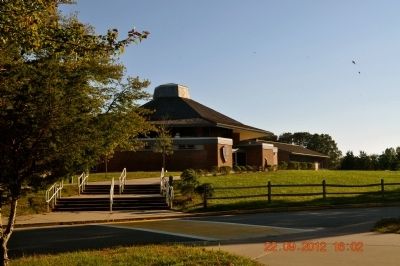
3. Salt Pond Visitor Center in Cape Cod
50 Doane Rd Eastham, MA 02642
Photographed by Sandra Hughes, September 22, 2012
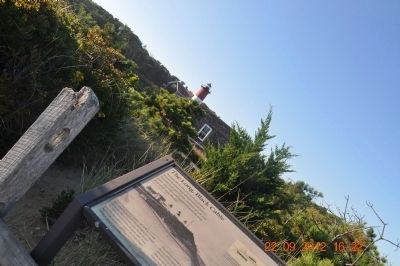
4. The Long, Black Cable Marker
Credits. This page was last revised on August 3, 2026. It was originally submitted on February 17, 2013, by Sandra Hughes Tidwell of Killen, Alabama, USA. This page has been viewed 1,660 times since then and 84 times this year. Photos: 1, 2. submitted on February 17, 2013, by Sandra Hughes Tidwell of Killen, Alabama, USA. 3, 4. submitted on February 18, 2013, by Sandra Hughes Tidwell of Killen, Alabama, USA. • Bill Pfingsten was the editor who published this page.
