Jerusalem, Jerusalem District, Israel — The Middle East (West Asia)
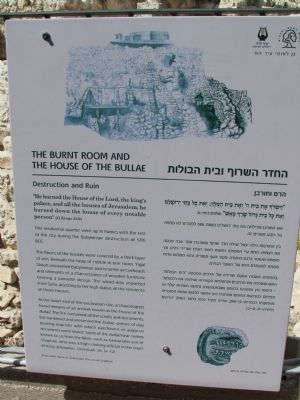
The Burnt Room and the House of the Bullae
Destruction and Ruin
Photographed by Dale K. Benington, March 12, 2013
1. The Burnt Room and the House of the Bullae Marker
"He burned the House of the Lord, the king's palace, and all the houses of Jerusalem; he burned down the house of every notable person."
(II Kings 25: 9)
This residential quarter went up in flames with the rest of the city during the Babylonian during the Babylonian destruction of 586 BCE.
The floors of the houses were covered by a thick layer of ash. Beneath the heap of rubble in one room, Yigal Shiloh uncovered Babylonian and Israelite arrowheads and remnants of a charred piece of wooden furniture bearing a palmette design. The wood was imported from Syria, attesting to the high status of the residents of these houses.
At the lower end of the excavation site, archaeologists found remains of an archive known as the House of the Bullaé. The fire consumed all the scrolls and documents, but hardened and preserved the bullae-pieces of clay bearing imprints with which parchment or papyrus documents were sealed. Some of the bullae bear names known to us from the Bible, such as Gemariahu son of Shaphan, who was a high-ranking official in the court of King Jehoiakim. (Jeremiah 36: 9-12)
Topics and series. This historical
this page online
Location. 31° 46.427′ N, 35° 14.168′ E. Marker is in Jerusalem, Jerusalem District. It can be reached from Ma'alot Ir David Street just east of Ma'ale HaShalom, on the left when traveling south. This historical marker is located just off of the roadway, inside the "City of David - Ancient Jerusalem" facility, which offers visitors a tour of both historic and archaeological sites that are part of the Ancient City of David. It is situated at Stop Three "C" of the City of David historic tour route, which is in front of the enormous Stepped Stone Structure. Touch for map. Touch for directions.

Regionally, it is in Asia, specifically in West Asia, in the Middle East, in The Levant, on the Red Sea, in a coastal Mediterranean country, and in the Western World. Historically, it finds itself in what was once the Byzantine Empire, the Ottoman Empire, a British Mandate, and the Roman Empire.
Other nearby markers. At least 8 other markers are
Photographed by Dale K. Benington, March 12, 2013
2. The Burnt Room and the House of the Bullae Marker
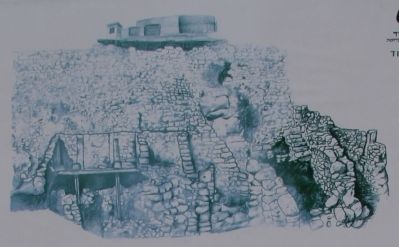
Close-up view of the illustration on the historical marker.
Regarding The Burnt Room and the House of the Bullae. The "City of David - Ancient Jerusalem" handout/brochure has this to say about the Burnt Room stop on the historic tour:
"On the seventh day of the fifth month - that was the nineteenth year of King Nebuchadnezzar of Babylon - Nebuzaradan, the chief of the guards, an officer of the King of Babylon, came to Jerusalem. He burned the House of the Lord, the king's palace, and all the houses of Jerusalem; he burned down the house of every notable person." (2 Kings 25: 8-9)
"The fire that consumed Jerusalem in 586 BCE did not spare the
Photographed by Dale K. Benington, March 12, 2013
3. The Burnt Room and the House of the Bullae Marker
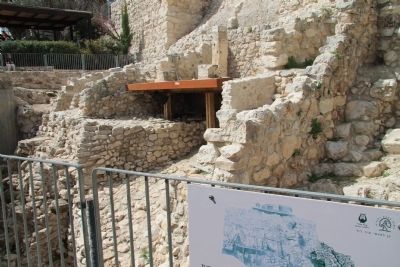
View of the historical marker in the lower right foreground and the "Ahiel House" (where the wooden platform is located) in center of the picture. Located in the lower terrace, 16 feet below the "House of Ahiel," was a narrow building where 51 bullae were found.
The "City of David - Ancient Jerusalem" handout/brochure has this to say about the House of the Bullae stop on the historic tour:
"Thus said the Lord of Hosts, the God of Israel: Take these documents, this deed of purchase, the sealed text and the open one, and put them into an earthen jar; so that they may last a long time." (Jeremiah 32: 14)
"Remains of an archive known as the "House of the Bullae were unearthed at the lower section of the excavation site. The building that housed the archive was destroyed together with the entire quarter, and its contents, which included various official documents, went up in flames. However, the fire hardened and preserved the bullae, which are clay seal impressions that
Photographed by Dale K. Benington, March 12, 2013
4. The Burnt Room and the House of the Bullae
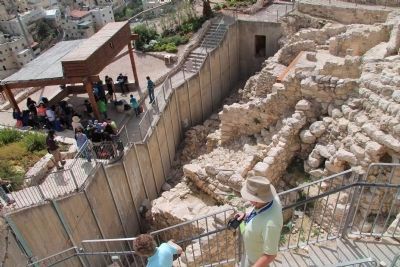
View from park trail route, looking down on the "Ahiel House" (center of picture) with the "Bullae House" in the lower terrace below the "Ahiel House" and the "Burnt Room" to the left (north) of the "Ahiel House" (just over the right shoulder of the person with the light blue top, on the stairway).
Related markers. Click here for a list of markers that are related to this marker. To better understand the relationship, study each marker in the order shown.
Also see . . .
1. City of David. This is a link to information provided by the "City of David - Ancient Jerusalem" website. (Submitted on March 26, 2013, by Dale K. Benington of Toledo, Ohio.)
2. Jebusite Wall (Millo) (2000-1000 BC). This is a link to information provided by a website entitled Jerusalem 101. (Submitted on March 27, 2013, by Dale K. Benington of Toledo, Ohio.)
3. The City of David. This is a link to information provided by a website entitled Jerusalem 101. (Submitted on March 27, 2013, by Dale K. Benington of Toledo, Ohio.)
Credits. This page was last revised on March 7, 2025. It was originally submitted on March 26, 2013, by Dale K. Benington of Toledo, Ohio. This page has been viewed 4,068 times since then and 193 times this year. Photos: 1, 2, 3, 4. submitted on March 27, 2013, by Dale K. Benington of Toledo, Ohio.
