Near Midland City in Dale County, Alabama — The American South (East South Central)
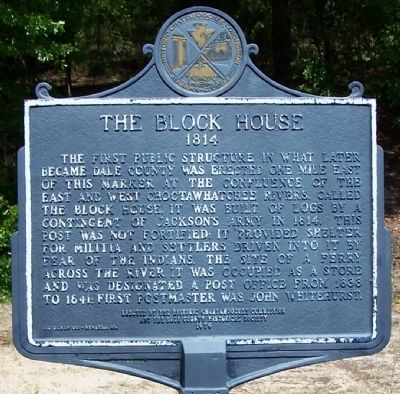
The Block House
⎯⎯⎯
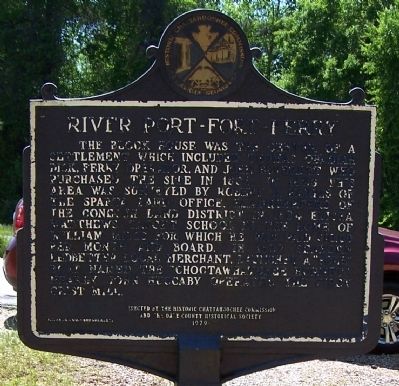
River Port - Fort - Ferry
Photographed by David J Gaines,
1. The Block House
1814
Erected 1979 by Historic Chattahoochee
this page online
Topics. This historical marker is listed in this topic list: Settlements & Settlers. A significant historical year for this entry is 1814.
Location. 31° 20.993′ N, 85° 33.263′ W. Marker is near Midland City, Alabama, in Dale County. It is on U.S. 231 0.6 miles north of County Road 14, on the right when traveling north. Touch for map. Marker is in this post office area: Midland City AL 36350, United States of America. Touch for directions.

Regionally, this marker is in the American South, specifically in the Deep South, and in the Wiregrass. Globally, it is in North America, a Gulf of Mexico state, the Western Hemisphere, the Western World, and the Anglosphere. Historically, it finds itself in what was once the territory of the Mississippian Culture, one of the Confederate States of America, and the Antebellum South.
Other nearby markers. At least 8 other markers are within 7 miles of this marker, measured as the crow flies: The Mack M. Matthews School (approx. 2.4 miles away); Baptist Collegiate Institute (approx. 2.8 miles away); Newton / Newton (approx. 3.1 miles away);
Photographed by David J Gaines, April 20, 2013
2. River Port - Fort - Ferry Marker
More about this marker. Located south of Ozark, AL at Newton, AL, which appears on road signs but not on any map.
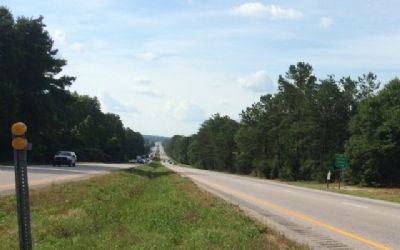
Photographed by Mark Hilton, June 4, 2014
3. Looking North towards marker (front right).
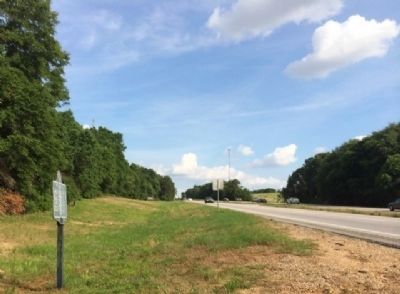
Photographed by Mark Hilton, June 4, 2014
4. Looking South from marker.
Credits. This page was last revised on November 19, 2024. It was originally submitted on April 28, 2013, by David J Gaines of Pinson, Alabama. This page has been viewed 5,662 times since then and 379 times this year. Photos: 1, 2. submitted on April 28, 2013, by David J Gaines of Pinson, Alabama. 3, 4. submitted on June 5, 2014, by Mark Hilton of Montgomery, Alabama. • Craig Swain was the editor who published this page.
