Ayden in Pitt County, North Carolina — The American South (South Atlantic)
Washington's Southern Tour
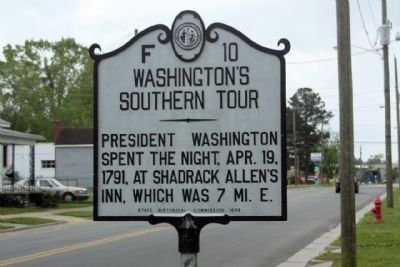
Photographed by Mike Stroud, April 19, 2013
1. Washington's Southern Tour Marker, 222 years ago today
Erected 1939 by Division of Archives and History. (Marker Number F-10.)
Topics and series. This historical marker is listed in these topic lists: Government & Politics • Industry & Commerce • Notable Events. In addition, it is included in the Former U.S. Presidents: #01 George Washington, the George Washington Slept Here, and the North Carolina Division of Archives and History series lists. A significant historical date for this entry is April 19, 1779.
Location. 35° 28.149′ N, 77° 25.073′ W. Marker is in Ayden, North Carolina, in Pitt County. It is on Lee Street near West 5th Street, on the right when traveling south. Touch for map. Marker is in this post office area: Ayden NC 28513, United States of America. Touch for directions.

Regionally, this marker is in North Carolina’s Coastal Plain. It is also in the American South, specifically in the Upper South, and on the Eastern Seaboard. Globally, it is in the North Atlantic Region, North America, the Western Hemisphere, the Western World, and the Anglosphere.
this page online
Other nearby markers. At least 8 other markers are within 7 miles of this marker, measured as the crow flies: Former Colleges (approx. 0.2 miles away); Veteran's Memorial (approx. 0.4 miles away); Fort Fisher Hero (approx. 2.6 miles away); a different marker also named Scuffleton Bridge (approx. 3.9 miles away); Haddocks Crossroads (approx. 4 miles away); Little Creek Original Free Will Baptist Church (approx. 4.1 miles away); Blount Hall (approx. 5.2 miles away); John Lawson (approx. 6.6 miles away). Touch for a list and map of all markers in Ayden.
Another marker is no longer nearby. Scuffleton Bridge (was approx. 3.9 miles away but has been replaced with another marker now near it).
Regarding Washington's Southern Tour.
George Washington, Revolutionary War hero elected as the first president of the United States in February 1789, is one of the most celebrated figures in American history. For more than two centuries,
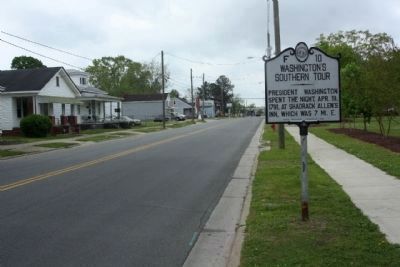
Photographed by Mike Stroud, April 19, 2013
2. Washington's Southern Tour Marker seen along Lee Street, looking south
While on tour, he sought differing viewpoints and wanted to see and be seen by as many people as possible. Soon after taking office, he planned and undertook a successful 28-day tour of New England.
In early 1791, after establishing a site for the new “Federal District” along the Potomac River, Washington embarked on a tour of the Southern states—a product of his desire to visit every state during his term of office. Proceeding from Mount Vernon via Fredericksburg and Richmond (Virginia) into North Carolina, Washington crossed the Roanoke River into Halifax in mid-April 1791. From there, the President’s
carriage tour took him through Tarboro, Greenville, New Bern, Trenton, and Wilmington before entering South Carolina. Washington re-entered North Carolina near Charlotte and traveled northward, visiting Salisbury, Salem, and Guilford Court House.
After two nights in Halifax, Washington left on the morning of Monday, April 18 for Tarboro. He remarked that the town of Tarborough was “more lively and thriving” than Halifax. Washington was met at the Roanoke River by Col. John B. Ashe, who escorted him into town. Washington’s procession was welcomed by a salute from a single cannon but the effort was appreciated by the President. While in town, Washington was entertained at the home of Major Reading Blount. After a single night’s stay, Washington left Tarboro the next morning for Pitt County. (North Carolina Office of Archives & History — Department of Cultural Resources)
Credits. This page was last revised on August 6, 2020. It was originally submitted on May 1, 2013, by Mike Stroud of Bluffton, South Carolina. This page has been viewed 1,529 times since then and 43 times this year. Photos: 1, 2. submitted on May 2, 2013, by Mike Stroud of Bluffton, South Carolina.
