Dodge City in Ford County, Kansas — The American Midwest (Upper Plains)
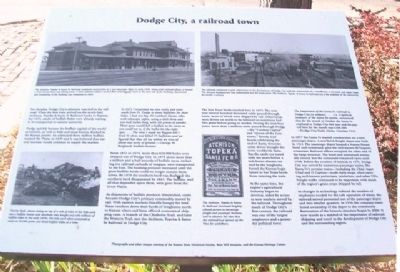
Dodge City, a railroad town
Photographed by William Fischer, Jr., November 10, 2012
1. Dodge City, a railroad town Marker
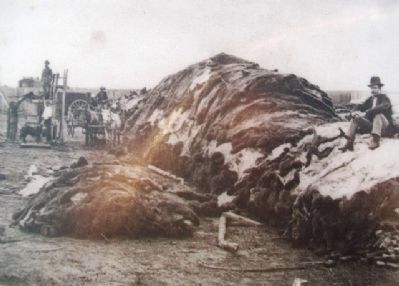
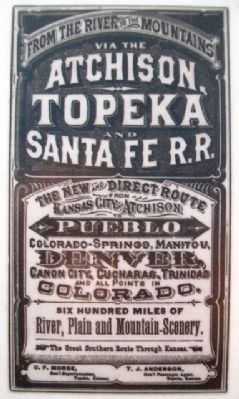
For decades, Dodge City's existence was tied to the railroad. When the first train arrived on the newly-laid Atchison, Topeka & Santa Fe Railroad tracks in September 1872, stacks of buffalo hides were already waiting to be transported to eastern tanneries.
Dodge quickly became the buffalo capital of the world as hunters, as well as hide and meat buyers, flocked to the Kansas prairie. An estimated three million buffalo roamed the Plains in 1870 and it was believed that natural increase would continue to supply the market.
In 1872 I organized my own outfit and went south from Ft. Dodge to shoot buffaloes for their hides. I had two big. 50 [caliber] Sharps rifles with telescopic sights, using a shell three and one-half inches long, with 110 grains of powder. Those guns would kill a buffalo as far away as you could see it, if the bullet hit the right spot....The time I made my biggest kill I fired 91 shots and killed 79 buffaloes and we figured that they all lay within an area of about two acres of ground.
- George W. Reighard, buffalo hunter
From 1872 to 1874, more than 850,000 hides were shipped out of Dodge City. In
this page online
As shipments of buffalo products diminished, cattle became Dodge City's primary commodity moved by rail. With eastern markets literally hungry for beef, Texas ranchers drove their herds of longhorns north to Kansas where rail lines offered economical shipping rates. A branch of the Chisholm Trail, and later the Western Trail, met the Atchison, Topeka & Santa Fe Railroad in Dodge City.
The first Texas herds reached here in 1875. The next year several hundred thousand cattle passed through town, most of which were shipped by rail. Other herds were driven on north to be fattened on nutritious buffalo grass before going to market. During the next four years, more than a million cattle passed through Dodge - the "Cowboy Capital" and "Queen of the Cowtowns."
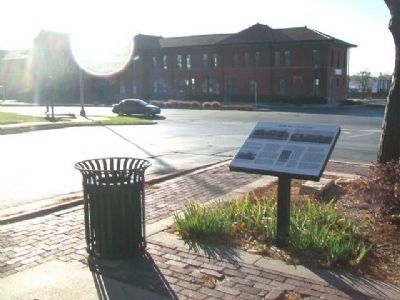
Photographed by William Fischer, Jr., November 10, 2012
2. Dodge City, a railroad town Marker
At the same time, the region's agricultural industry began to develop, aided by access to new markets served by the railroad. Throughout much of Dodge City's first century, the railroad was one of the largest employers and a powerful political force.
The importance of the Santa Fe railroad to Dodge City [is evident]....L.L. Copeland, treasurer of the Santa Fe system, announced that for the month of October the Santa Fe employed at Dodge City 808 men and the payroll here for the month was $108,000.
- Dodge City Daily Globe, October 1923
In 1897 the Santa Fe started construction on a new passenger depot. A new brick freight depot was built in 1913. The passenger depot housed a Harvey House hotel and newsstand, plus the well-known El Vaquero restaurant. Railroad offices occupied the other end of the large structure. The hotel and newsstand eventually closed, but the
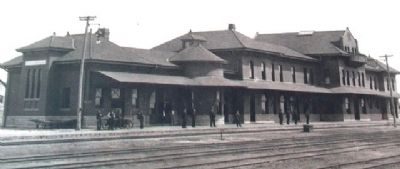
Photographed by Unknown, circa 1900
3. Image on Dodge City, a railroad town Marker
As changes in technology reduced the number of employees needed for the safe operation of trains, the railroad moved personnel out of the passenger depot and into smaller quarters. In 1996 the company transferred ownership of the depot to the community. Restoration of the historic structure began in 2000. It now stands as a symbol of the importance of railroad shipping and travel in the development of Dodge City and the surrounding region.
Photographs and other images courtesy of the Kansas State Historical Society, Boot Hill Museum, and the Kansas Heritage Center.
Topics and series. This historical marker is listed in these topic lists: Animals • Industry & Commerce • Railroads & Streetcars • Settlements & Settlers. In addition,
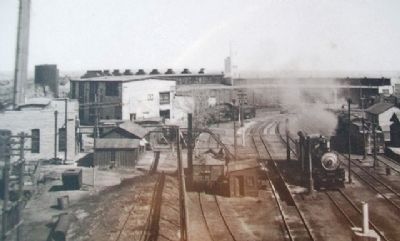
Photographed by Unknown, circa 1922/1936
4. Image on Dodge City, a railroad town Marker
Location. 37° 45.178′ N, 100° 1.022′ W. Marker is in Dodge City, Kansas, in Ford County. It is at the intersection of Central Avenue and Front Street, on the left when traveling north on Central Avenue. Touch for map. Marker is in this post office area: Dodge City KS 67801, United States of America. Touch for directions.

Regionally, this marker is in the American Midwest, in the Corn Belt, on the prairies, on the Great Plains, on the Southern Plains, on the High Plains, and on the Santa Fe Trail Corridor. Globally, it is in North America, the Western Hemisphere, the Western World, and the Anglosphere. Historically, it finds itself in what was once the Comanchería, the Dust Bowl, the Louisiana Purchase, and the Republic of Texas.
Other nearby markers. At least 8 other markers are within walking distance of this marker: "Doc" Holliday (here, next to this marker); The 100th Meridian, Where East Meets West (a few steps from this marker); Wyatt Earp (within shouting distance of this marker); Premier City of the Region
Photographed by Unknown, circa 1878
5. Image on Dodge City, a railroad town Marker
Also see . . .
1. Dodge City Convention & Visitor’s Bureau. Bureau website homepage (Submitted on December 27, 2021, by Larry Gertner of New York, New York.)
2. Santa Fe Railway Historical and Modeling Society. Society website homepage (Submitted on May 12, 2013, by William Fischer, Jr. of Reynoldsburg, Ohio.)
Photographed by Atsf, circa 1870s
6. Image on Dodge City, a railroad town Marker
Credits. This page was last revised on December 15, 2024. It was originally submitted on May 12, 2013, by William Fischer, Jr. of Reynoldsburg, Ohio. This page has been viewed 5,044 times since then and 447 times this year. Photos: 1, 2, 3, 4, 5, 6. submitted on May 12, 2013, by William Fischer, Jr. of Reynoldsburg, Ohio.
