Altavista in Campbell County, Virginia — The American South (Mid-Atlantic)
Origin of Lynch Law
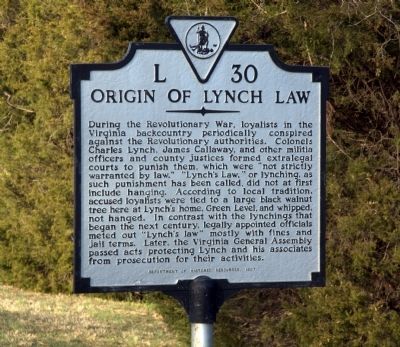
Photographed by J. J. Prats, March 30, 2013
1. Origin of Lynch Law Marker
Erected 1997 by Department of Historic Resources. (Marker Number L-30.)
Topics and series. This historical marker is listed in these topic lists: Government & Politics • War, US Revolutionary. In addition, it is included in the Virginia Department of Historic Resources (DHR) series list.
Location. 37° 7.75′ N,
this page online

Regionally, this marker is in the Piedmont and in Central Virginia. It is also in the American South and specifically in the Upper South. Globally, it is in North America, the Western Hemisphere, the Western World, and the Anglosphere. Historically, it finds itself in what was once the territory of the Mississippian Culture, one of the original Thirteen Colonies, one of the Confederate States of America, and the Antebellum South.
Other nearby markers. At least 8 other markers are within walking distance of this marker: Gen. James Dearing (about 300 feet away, measured in a direct line); Tories, Treachery, Treason, and a Tree (about 400 feet away); Colonel Charles Lynch (about 400 feet away); General James Dearing (about 400 feet away);
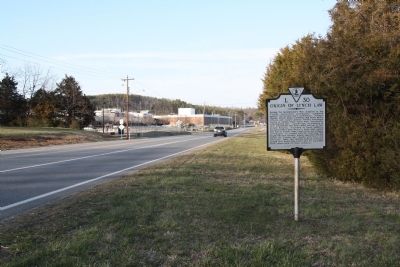
Photographed by J. J. Prats, March 30, 2013
2. Origin of Lynch Law Marker
Another marker is no longer nearby. Origin of Lynch Law (was within shouting distance of this marker but has been replaced with another marker now near it).
More about this marker. This marker replaced a marker with the same name and number dating from the late 1920s that read “A hundred yards west stands a walnut tree under which Colonel Charles Lynch, William Preston, Robert Adams, Jr., James Callaway and others held an informal court for the trial of tories and criminals, 1780. Punishment usually consisted of whipping. From this rude justice the term ‘Lynch Law’ was evolved.”
Also see . . . William Lynch Wikipedia Entry. “The term “Lynch’s Law” was used as early as 1782 by a prominent Virginian named Charles Lynch to describe his actions in suppressing a suspected Loyalist uprising in 1780 during the American Revolutionary War. The suspects were given a

Photographed by C. Ryan Dodson, May 9, 2026
3. Origin of Lynch Law Marker
The Avoca Museum, located on the site of Col. Lynch's home, can be seen in the background.

Photographed by C. Ryan Dodson, May 9, 2026
4. Lynch's tree
The remains of the black walnut tree described on the Marker are on display in the Avoca Museum, across the street from the Marker.
Credits. This page was last revised on September 8, 2026. It was originally submitted on May 17, 2013, by J. J. Prats of Powell, Ohio. This page has been viewed 2,244 times since then and 182 times this year. Photos: 1, 2. submitted on May 17, 2013, by J. J. Prats of Powell, Ohio. 3, 4. submitted on May 14, 2026, by C. Ryan Dodson of Danville, Virginia.
