Stuart in Patrick County, Virginia — The American South (Mid-Atlantic)
Stuart
Photographed by J. J. Prats, May 27, 2013
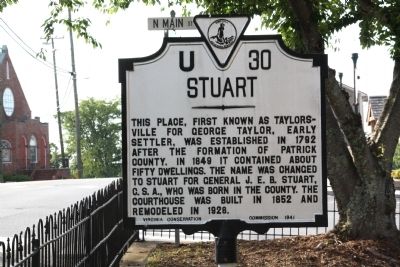
1. Stuart Marker
This place, first known as Taylorsville for George Taylor, early settler, was established in 1792 after the formation of Patrick County. In 1849 it contained about fifty dwellings. The name was changed to Stuart for General J. E. B. Stuart, C. S. A., who was born in the county. The courthouse was built in 1852 and remodeled in 1928.
Erected 1941 by Virginia Conversation Commission. (Marker Number U-30.)
Topics and series. This historical marker is listed in these topic lists: Political Subdivisions • Settlements & Settlers • War, US Civil. In addition, it is included in the Virginia Department of Historic Resources (DHR) series list. A significant historical year for this entry is 1792.
Location. 36° 38.54′ N, 80° 16.172′ W. Marker is in Stuart, Virginia, in Patrick County. It is at the intersection of West Blue Ridge Street (Virginia Route 8) and North Main Street, on the left when traveling west on West Blue Ridge Street. It is at the courthouse. Touch for map. Marker is in this post office area: Stuart VA 24171, United States of America. Touch for directions.

Regionally, this marker is in Southern Virginia
this page online
Other nearby markers. At least 8 other markers are within walking distance of this marker: Our Heroes (here, next to this marker); Captain Eliphaz Shelton (a few steps from this marker); Patrick County World War II and Korean War Memorial (a few steps from this marker); Vietnam Memorial (a few steps from this marker); Bull Mountain Crash (within shouting distance of this marker); The Crooked Road / Patrick County (within shouting distance of this marker); The Bell Tower (within shouting distance of this marker); Virginia's Mountain Spirit Trail (about 500 feet away, measured in a direct line). Touch for a list and map of all markers in Stuart.
Regarding Stuart. Stuart was
Photographed by J. J. Prats, May 27, 2013
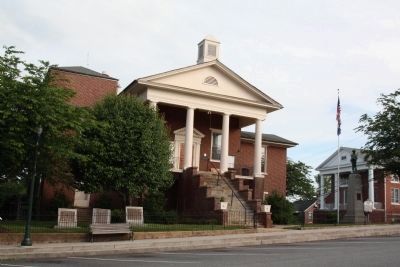
2. Patrick County Courthouse and Stuart Marker
Marker is at the far right, to the right of the J.E.B. Stuart statue.
Also see . . . Wikipedia Entry. “Following the economic difficulties of the civil war, the residents of Taylorsville focused their energies on expanding railroads to boost the economy. The Danville and New River Railroad was chartered in 1873. ... The first train pulled into Taylorsville in August 1884. With the growth associated with the railroad, Taylorsville was incorporated as a town in 1884 and was renamed Stuart in honor of Confederate Major General J.E.B. Stuart, who was born 20 miles southwest of town in Ararat, Virginia.
“Following the completion of the railroad,
Photographed by J. J. Prats, May 27, 2013
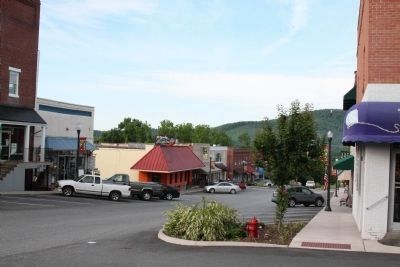
3. Main Street Uptown Shopping District
Credits. This page was last revised on July 6, 2026. It was originally submitted on June 9, 2013, by J. J. Prats of Powell, Ohio. This page has been viewed 980 times since then and 61 times this year. Photos: 1, 2, 3. submitted on June 9, 2013, by J. J. Prats of Powell, Ohio.
Editor’s want-list for this marker. Photo of downtown business district • Can you help?
