Goldsboro in Wayne County, North Carolina — The American South (South Atlantic)
Seymour Johnson AFB History
⎯⎯⎯
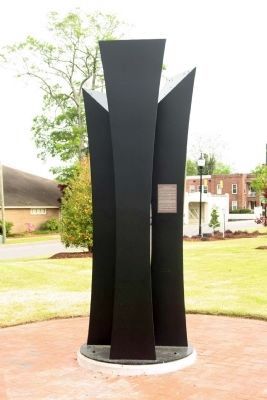
4th Fighter Wing History Memorial
Photographed by Mike Stroud, April 19, 2013
1. Seymour Johnson AFB History Marker
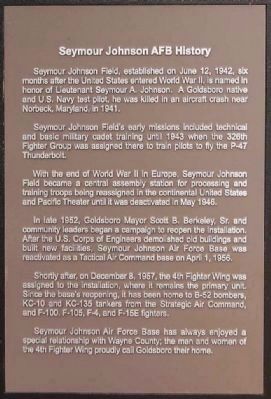
Seymour Johnson is the only Air Force base named for a naval officer.
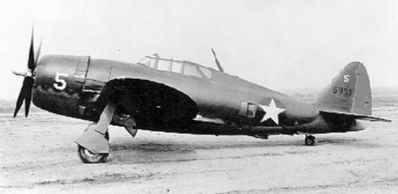
Seymour Johnson Field's early missions included technical and basic military cadet training until 1943 when the 326th Fighter Group was assigned there to train pilots to fly the P-47 Thunderbolts.
With the end of World War II in Europe, Seymour Johnson Field became a central assembly station for processing and training troops being reassigned in the continental United States and Pacific Theater until deactivated in May 1946.
In late 1952, Goldsboro Mayor Scott B. Berkeley, Sr. and community leaders began a campaign to reopen the installation. After the U.S. Corps of Engineers demolished old buildings and built new facilities, Seymour Johnson Air Force Base was reactivated as a Tactical Air Command base on April 1, 1956.
Shortly after, on December 8, 1957, the 4th Fighter Wing was assigned to the installation, where it remains the primary unit. Since the base's reopening, it has been home to B-52 bombers, KC-10 and KC -135 tankers from the Strategic Air Command, and F-100, F-105, F-4, and F-15E fighters.
Seymour Johnson Air Force Base has always enjoyed a special relationship with Wayne County; The men and women of the 4th Fighter Wing proudly call Goldsboro their home.
(Second plaque)
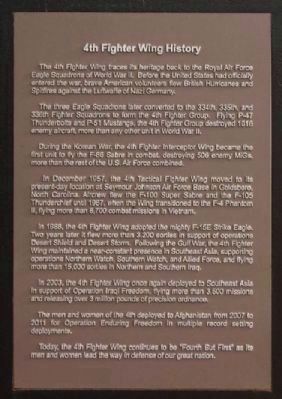
The 4th Fighter Wing traces its heritage back to the Royal Air Force Eagle Squadrons of World War II. Before the United States had officially entered the war, brave American volunteers flew British Hurricanes and Spitfires against the Luftwaffe of Nazi Germany.
The three
this page online
During the Korean War, the 4th Fighter Interceptor Wing became the first unit to fly the F-86 Sabre in combat, destroying 506 enemy MiGs,more than the rest of the U.S. Air Force combined.
In December 1957, the 4th Tactical Fighter Wing moved to its present-day location at Seymour Johnson Air Force Base in Goldsboro, North Carolina. Aircrew flew the F-100 Super Sabre and the F-105 Thunderchief until 1967, when the Wing transitioned to the F-4 Phantom II, flying more than 8,700 combat missions in Vietnam.
In 1988, the 4th Fighter Wing adopted the mighty F-15E Strike Eagle. Two years later it flew more than 3,200 sorties in support of operations Desert Shield and Desert Storm. Following the Gulf War. the 4th Fighter Wing maintained a near-constant presence in Southeast Asia, supporting operations Northern Watch, Southern Watch, and Allied Force, and flying more
Photographed by Mike Stroud, April 19, 2013
2. Second Seymour Johnson History AFB / 4th Fighter Wing History Plaque
In 2003, the 4th Fighter Wing once again deployed to Southeast Asia (?) in support of Operation Iraqi Freedom, flying more than 3,500 missions and releasing over 3 million pounds of precision ordnance.
The men and women of the 4th deployed to Afghanistan from 2007 to 2011 for Operation Enduring Freedom in multiple record setting deployments.
Today. the 4th Fighter Wing continues to be "Fourth But First" as its men and women lead the way in defense of our great nation.
(Third plaque)
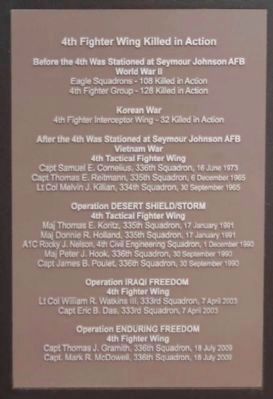
Before the 4th was stationed at Seymour Johnson
World War II
Eagle Squadrons - 108 Killed in Action
4th Fighter Group - 128 Killed in Action
Korean War
4th Fighter Interceptor Wing - 32 Killed in Action
After the 4th Was Stationed at Seymour Johnson AFB
Vietnam War
4th Tactical Fighter Wing
Capt Samuel E. Cornelius, 336th Squadron, 16 June 1973
Capt Thomas E. Reitmann, 335th Squadron, 30 September 1965
Lt Col Melvin J. Killian, 334th Squadron, 30 September 1965
4th Tactical Fighter Wing
Maj Thomas
Photographed by Mike Stroud, April 19, 2013
3. Third Seymour Johnson AFB History / 4th Fighter Wing Killed in Action Plaque
Maj Donnie R. Holland, 335th Squadron,17 January 1991
A1C Rocky J. Nelson, 4th Civil Engineering Squadron, 1 December 1990
Maj Peter J. Hook, 336th Squadron, 30 September 1990
Capt James B. Poulet, 336th Squadron, 30 September 1990
4th Fighter Wing
Lt Col William R. Watkins III, 333rd Squadron, 7 April 2003
Capt Eric B. Das, 333rd Squadron, 7 April 2003
4th Fighter Wing
Capt Thomas J. Gramith, 336th Squadron, 18 July 2009
Erected by City of Goldsboro.
Topics. This historical marker and memorial is listed in these topic lists: War, 1st Iraq & Desert Storm • War, Korean • War, Vietnam • War, World II. A significant historical date for this entry is January 17, 1991.
Location. 35° 22.958′ N, 77° 59.621′ W. Marker is in Goldsboro, North Carolina, in Wayne County. It is on North William Street near East Walnut Street, on the right when traveling south. Touch for map. Marker is in this post office area: Goldsboro NC 27530, United States of America. Touch for directions.

Regionally,
Photographed by Mike Stroud, April 19, 2013
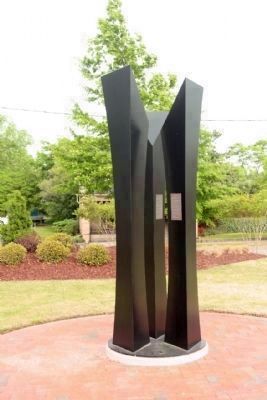
4. Memorial to Seymour Johnson AFB History Plaque (R),. 4th Fighter Wing Killed in Action Plaque (L)
Other nearby markers. At least 8 other markers are within walking distance of this marker: Wayne County Veterans Memorial Map (a few steps from this marker); Wayne County Veterans Memorial (a few steps from this marker); Wayne County Vietnam War Memorial (a few steps from this marker); Wayne County Purple Heart (within shouting distance of this marker); North Carolina Press Association (within shouting distance of this marker); John Lawson (within shouting distance of this marker); Company E, 119th Infantry, Goldsboro Rifles World War I Monument (within shouting distance of this marker); First Pentecostal Holiness Church Congregation (about 300 feet away, measured in a direct
Photographed by Mike Stroud, April 19, 2013
5. Seymour Johnson AFB History / Memorial Plaque Two (4th Fighter Wing History)
Also see . . . Seymour Johnson Air Force Base. occupies over 3,300 acres (13 km²) in the southeast section of Goldsboro. Seymour Johnson Field was opened in April 1942 as Headquarters, Technical School, Army Air Forces Technical Training Command. In June 1943, a secondary mission was added which included preparation of officers and men for overseas duty. (Submitted on July 14, 2013, by Mike Stroud of Bluffton, South Carolina.)
Photographed by Seymour Johnson Air Force Base
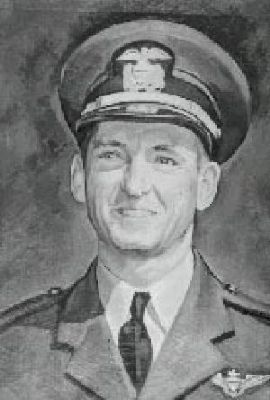
6. Navy Lt. Seymour A. Johnson
Air Force Base, N.C., was named in honor of Navy Lt. Seymour A. Johnson, a Goldsboro native who died in an airplane crash near Norbeck, Md., on March 5, 1941,
He was assigned to Anacostia Naval Air Station in Washington, D.C.
National Museum of the Air Force, `
7. P-47in World War I, as mentioned
National Museum of the Air Force, `
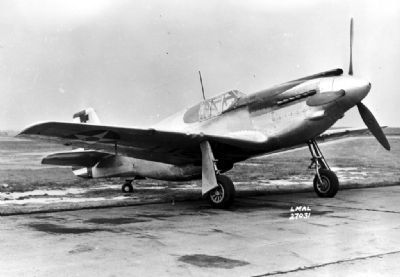
8. P-51in World War II, as mentioned
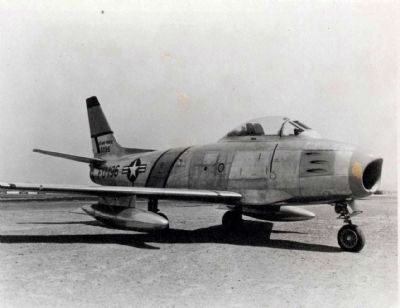
Photographed by Acepilots, `
9. F-86 during the Korean War, as mentioned
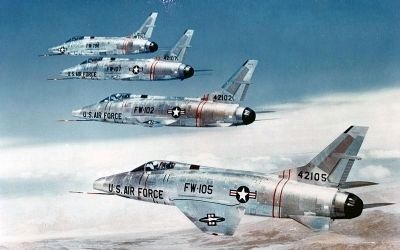
Photographed by U.S Air Force photo no. 060905-F-1234S-064, `
10. F-100 when 4th Tactical Fighter Wing moved to its present-day location at Seymour Johnson
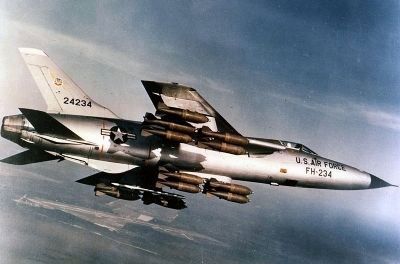
Photographed by US Air Force
11. F-105 Thunderchief until 1967 as mentioned
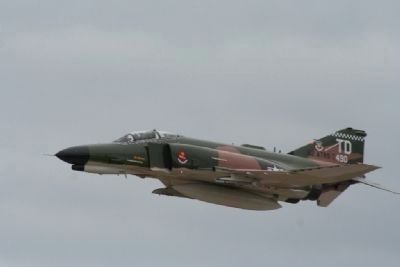
Photographed by Air Combat Command
12. F-4 Phantom for Vietnam as mentioned
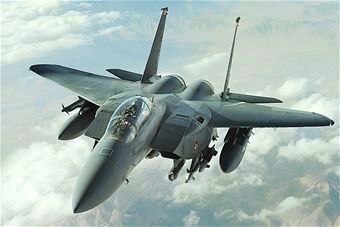
Photographed by US Air Force
13. F-15E in support of operations Desert Shield and Desert Storm as mentioned
Credits. This page was last revised on March 20, 2021. It was originally submitted on July 13, 2013, by Mike Stroud of Bluffton, South Carolina. This page has been viewed 1,968 times since then and 99 times this year. Photos: 1, 2, 3, 4, 5, 6, 7, 8, 9, 10, 11, 12, 13. submitted on July 13, 2013, by Mike Stroud of Bluffton, South Carolina.
