New Ulm in Brown County, Minnesota — The American Midwest (Upper Plains)
German–Bohemian Immigrants Monument
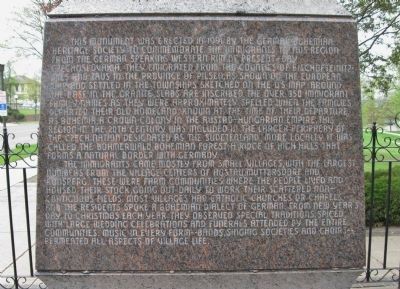
Photographed by K. Linzmeier, May 16, 2013
1. German–Bohemian Immigrants Monument Marker
The immigrants came mostly from small villages with the largest numbers from the village centers of Hostau, Muttersdorf and Ronsberg. These were farm communities where the people lived and housed their stock, going out daily to work their scattered non-contiguous
this page online
Many German-Bohemian traditions crossed the ocean to the New Ulm region. Some immigrants from Bohemia were among the earliest farm settlers arriving by ship on the Minnesota River within two years after German Turners founded the city. Beginning in 1856 they farmed in Cottonwood Township, then extended their settlement northward into St. George and westward into Sigel Township, Sleepy Eye and farther west. As more and more arrived (after 1872 by rail) they could no longer all farm. Beginning around 1880 they acquired homes especially in the southeast section of the city of New Ulm, an area they affectionately called the Ganseviertel, Goosetown. They also concentrated in the Wallachei (Low Land) region to the west. Farther north in the city, retired farmers built
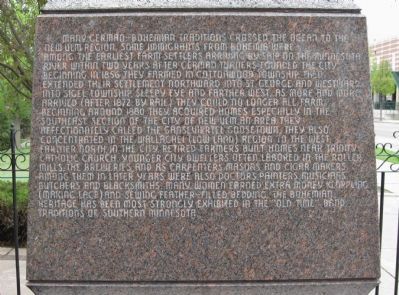
Photographed by K. Linzmeier, May 16, 2013
2. German–Bohemian Immigrants Monument Marker
Erected 1991 by the German-Bohemian Heritage Society.
Topics. This historical marker and monument is listed in this topic list: Settlements & Settlers. A significant historical year for this entry is 1991.
Location. 44° 18.963′ N, 94° 27.562′ W. Marker is in New Ulm, Minnesota, in Brown County. It is at the intersection of North German Street and North 2nd Street, on the right when traveling north on North German Street. Marker is at German Park. Touch for map. Marker is at or near this postal address: 200 North German Street, New Ulm MN 56073, United States of America. Touch for directions.

Regionally, this marker and monument is in Southwest Minnesota and in the Minnesota River Valley. It is
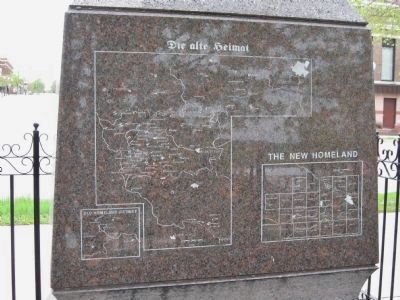
Photographed by K. Linzmeier, May 16, 2013
3. German–Bohemian Immigrants Monument Maps
Other nearby markers. At least 8 other markers are within walking distance of this marker: U.S. - Dakota War Memorial (within shouting distance of this marker); Pioneer Founders of New Ulm (about 400 feet away, measured in a direct line); Barricading New Ulm (about 400 feet away); Grand Hotel (about 500 feet away); Kiesling House (about 500 feet away); Crone Store (about 500 feet away); Erd Building (about 500 feet away); Dacotah House (about 600 feet away). Touch for a list and map of all markers in New Ulm.
More about this marker. The monument was created by Leopold Hafner; the granite pedestal was created by Bloedel Monument Co.
Also see . . . German–Bohemian Immigrants Monument. "Bronze statue of a man, woman and child. On the back, the parents legs are raised to represent their love of music and dancing, valued traditions
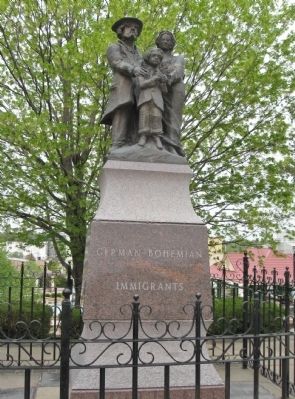
Photographed by K. Linzmeier, May 16, 2013
4. German–Bohemian Immigrants Monument
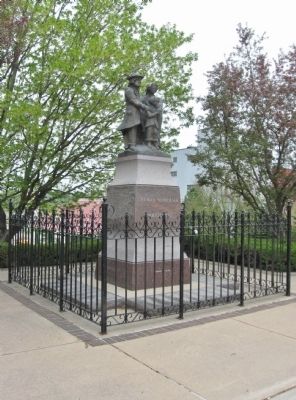
Photographed by K. Linzmeier, May 16, 2013
5. German–Bohemian Immigrants Monument
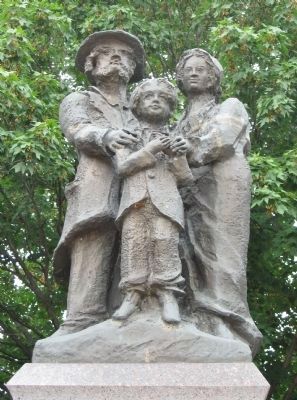
Photographed by K. Linzmeier, July 30, 2013
6. Close-up of Sculpture
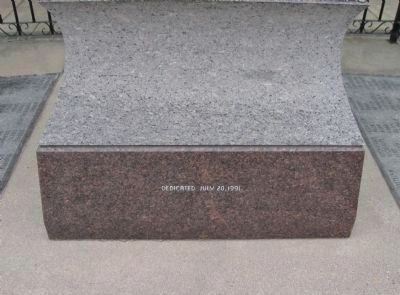
Photographed by K. Linzmeier, May 16, 2013
7. German–Bohemian Immigrants Monument Base
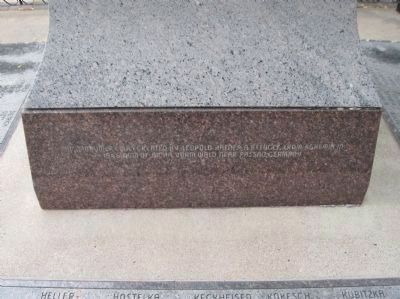
Photographed by K. Linzmeier, July 30, 2013
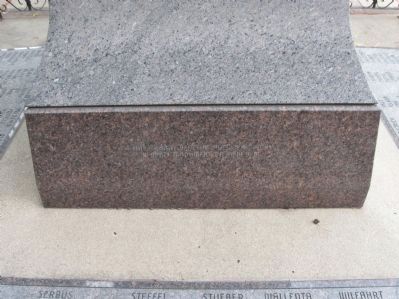
8. German–Bohemian Immigrants Monument Base
This monument was created by Leopold Hafner, a refugee from Bohemia in 1946, now of Aicha vorm Wald near Passau, Germany
Photographed by K. Linzmeier, July 30, 2013
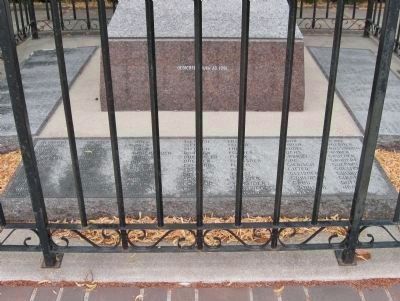
9. German–Bohemian Immigrants Monument Base
This granite pedestal was crafted by Bloedel Monument Co., New Ulm
Photographed by K. Linzmeier, July 30, 2013
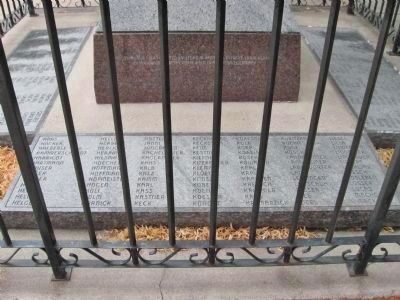
10. Family Names on Granite Tablets
Altmann •
Ambrose •
Anton •
Arbes •
Augustin •
Barr •
Baier •
Barth •
Bartl •
Bashal •
Bauer •
Baumann •
Baumeister •
Baumel •
Beck •
Beranek •
Berdan •
Berle •
Beyer •
Biebel •
Bier •
Borth •
Braulick •
Braun •
Braunreiter •
Brei •
Breu •
Brey •
Brix •
Bruckbauer •
Brunner •
Buchl •
Buringer •
Bushard •
Dauben •
Dauer •
Debart •
Diedrick •
Dietl •
Dietrich •
Dietz •
Dittrich •
Domeier •
Dreschler •
Drexler •
Ebenhoh •
Eberl •
Ebert •
Eckert •
Eckstein •
Eisen •
Faas •
Fast •
Felber •
Fink •
Fischer •
Fleck •
Fleissner •
Floetl •
Flor •
Forst •
Forster •
Forstner •
Fortwengler •
Frandon •
Frank •
Franta •
Frodel •
Fuchs •
Gabriel •
Gag •
Giebisch •
Gitter •
Gleisner •
Goblirsch •
Grau •
Grausam •
Greim •
Griebel •
Groebner •
Grossmann •
Gruber •
Gruener •
Grunert •
Guendner •
Guetter •
Guldan •
Gulden •
Guttum •
Haala
Photographed by K. Linzmeier, July 30, 2013
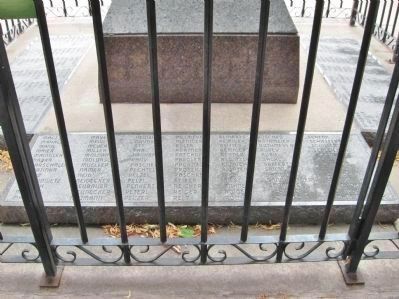
11. Family Names on Granite Tablets
Haas •
Hacker •
Haeberle •
Hammerschmidt •
Harricot •
Hartmann •
Hauser •
Heger •
Hegler •
Heinl •
Held •
Helgert •
Helget •
Heller •
Herbeck •
Herlick •
Herrian •
Hilsmasik •
Hoecherl •
Hoffman •
Hoffmann •
Hofmeister •
Hogen •
Holl •
Holm •
Hornick •
Hostelka •
Janni •
Jungbauer •
Kachelmeier •
Kagermeier •
Kahs •
Kalb •
Kalz •
Kamm •
Karl •
Kass •
Kastner •
Keck •
Keckhesen •
Keckstein •
Keim •
Kestner •
Kiefner •
Kitzberger •
Kelment •
Kloeckl •
Knoedl •
Kober •
Koenig •
Koester •
Kohout •
Kokesch •
Kolb •
Kopp •
Koreis •
Kosek •
Kowasch •
Kral •
Kraus •
Krausen •
Kretsch •
Krippner •
Kroy •
Krzmarzick •
Kubitzka •
Kuehn •
Kunz •
Kusch •
Landsteiner •
Lanendorfer •
Lang •
Landkammer •
Leiminger •
Leitschuh •
Lesser •
Lieb •
Liebl •
Liedel •
Lilla •
Lindemann •
Lindmeier •
Lindmeyer •
Lippert •
Lockway •
Loesch •
Losleben •
Losser •
Lucas •
Macho •
Mack
Photographed by K. Linzmeier, July 30, 2013
12. Family Names on Granite Tablets
Mages •
Mahall •
Maidl •
Maingler •
Marka •
Marschalek •
Martinka •
Marz •
Mathiowetz •
Matsch •
Mattes •
Mauch •
Mayer •
Meidl •
Meyer •
Miller •
Moldan •
Moldaschei •
Mueller •
Namer •
Neid •
Neidecker •
Neubauer •
Neudecker •
Neumann •
Neuwirth •
Novak •
Ott •
Paa •
Pankratz •
Pany •
Pascher •
Pechtel •
Pelzel •
Plezl •
Penkert •
Peterl •
Peuzer •
Pillmeyer •
Pleniger •
Polta •
Portner •
Preckner •
Pregler •
Prokosch •
Prosek •
Raschka •
Reiber •
Reichert •
Reiger •
Reim •
Reinarts •
Reiniger •
Reitter •
Remiger •
Renner •
Rewitzer •
Reznich •
Richter •
Riebl •
Ries •
Rohner •
Roiger •
Roith •
Roschko •
Rothmeier •
Rothmeyer •
Rubey •
Rubie •
Sackl •
Saffert •
Saickl •
Sampel •
Sandhoefner •
Schaeffer •
Schaller •
Schatscko •
Schenk •
Schieffert •
Schiller •
Schleicher •
Schloegel •
Schluck •
Schmaltz •
Schmaus •
Schmidt •
Schneider •
Schnobrich •
Schottenbauer •
Schmid •
Schmidt •
Schneider •
Schnobrich •
Schottenbauer
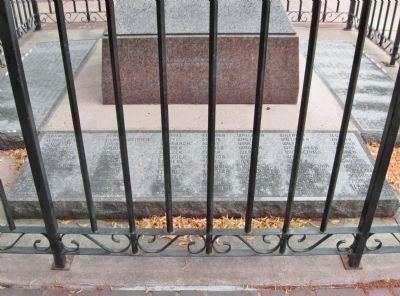
Photographed by K. Linzmeier, July 30, 2013
13. Family Names on Granite Tablets
Schroeder •
Schroepfer •
Schubert •
Schueler •
Schuemann •
Schumacker •
Schwab •
Schwinghammer •
Seidl •
Seifert •
Seitz •
Sellner •
Selmer •
Serbus •
Siebenbrenner •
Simmet •
Simon •
Singer •
Sittauer •
Smasal •
Sorer •
Soukup •
Sperl •
Sprenger •
Stadick •
Stadtherr •
Steffel •
Steffl •
Steinbach •
Steiner •
Stelzer •
Stelzner •
Stoderl •
Stoehr •
Stoerl •
Stolte •
Stoltz •
Straka •
Strohmer •
Stueber •
Sturm •
Suess •
Tauber •
Tauer •
Teynor •
Tietel •
Traurig •
Traxler •
Ubl •
Vogel •
Wagner •
Waiebel •
Wallenta •
Walter •
Warta •
Wartha •
Weber •
Wech •
Weltsch •
Wendinger •
Wenninger •
Wiedl •
Weier •
Wiesner •
Wild •
Wilfahrt •
Willinger •
Wilt •
Wiltcheck •
Windschitl •
Witt •
Wolf •
Woratschka •
Wurmstein •
Wurtzberer •
Zander •
Zangel •
Zeig •
Zeug •
Ziegler •
Zischka •
Zupfer •
Zwach •
Bregel •
Grosam •
Herschman •
Kopetzki •
Schroedl •
Zwaschka •
Lampl •
Schweinfurter
Photographed by K. Linzmeier, May 16, 2013
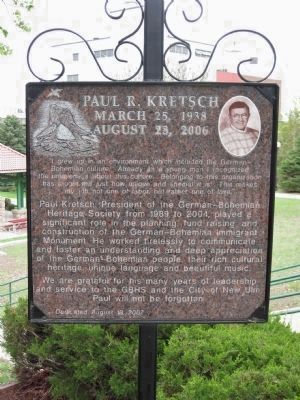
14. Nearby Plaque
March 25, 1938
August 23, 2006
Paul Kretsch, President of the German-Bohemian Heritage Society from 1989 to 2004, played a significant role in the planning, fund raising, and construction of the German-Bohemian Immigrant Monument. He worked tirelessly to communicate and foster an understanding and deep appreciation of the German-Bohemian people, their rich cultural heritage, unique language and beautiful music.
We are grateful for his many years of leadership and service to the GBHS and the City of New Ulm. Paul will not be forgotten.
Dedicated August 18, 2007
Photographed by K. Linzmeier, May 16, 2013
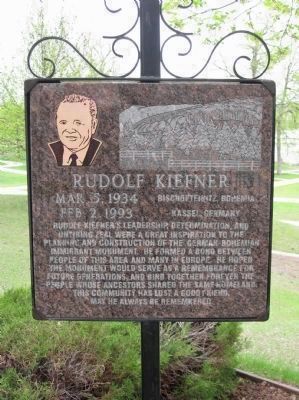
15. Nearby Plaque
Mar. 5, 1934 Bischofteinitz, Bohemia
Feb. 2, 1993 Kassel, Germany
Photographed by K. Linzmeier, May 16, 2013
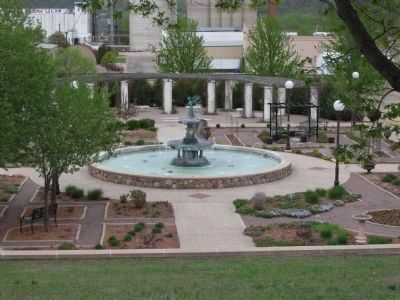
16. View from Monument
Credits. This page was last revised on October 21, 2020. It was originally submitted on July 26, 2013, by Keith L of Wisconsin Rapids, Wisconsin. This page has been viewed 2,978 times since then and 190 times this year. Photos: 1, 2, 3, 4, 5. submitted on July 26, 2013, by Keith L of Wisconsin Rapids, Wisconsin. 6. submitted on March 16, 2014, by Keith L of Wisconsin Rapids, Wisconsin. 7. submitted on July 26, 2013, by Keith L of Wisconsin Rapids, Wisconsin. 8, 9, 10, 11, 12, 13. submitted on March 16, 2014, by Keith L of Wisconsin Rapids, Wisconsin. 14, 15, 16. submitted on July 26, 2013, by Keith L of Wisconsin Rapids, Wisconsin.
