Bahnhofstrasse in Zürich, Switzerland — Central Europe (the Alps)
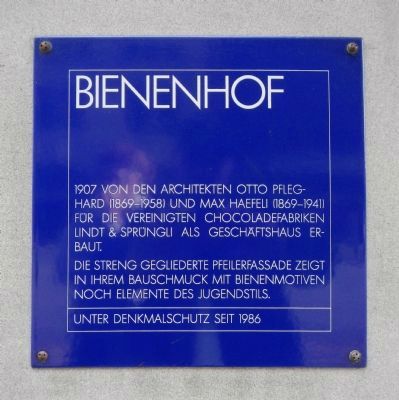
Bienenhof
Photographed by Barry Swackhamer, June 25, 2013
1. Bienenhof Marker
Die streng gegliederte pfeilerfassade zeigt in ihrem bauschmuck mit bienenmotiven noch elemente des jugendstils.
Unter denkmalschutz seit 1986
German–English translation:
Bienenhof
1907 by the architect Otto Pfleg-Hard (1869-1958) and Max Haefeli (1869-1941) for the combined chocolate maker Lindt & Sprüngli built as a commercial building.
The rigorous and pillar facade shows in their architectural decoration with bee motifs still elements of Art Nouveau.
Under monument protection since 1986
Topics and series. This historical marker is listed in this topic list: Industry & Commerce. In addition, it is included in the Zurich Blue Square series list. A significant historical year for this entry is 1907.
Location. 47° 22.467′ N, 8° 32.349′ E. Marker is in Zürich. It is in Bahnhofstrasse. It is on Uraniastrasse, on the right when traveling east. Touch for map. Marker is at or near this postal address: Uraniastrasse 11, Zürich 8001, Switzerland. Touch for directions.

Regionally,
this page online
Other nearby markers. At least 8 other markers are within walking distance of this marker: Urania Observatory (here, next to this marker); Lux Guyer (1894-1955) (within shouting distance of this marker); Akazie (within shouting distance of this marker); Zur Trülle (within shouting distance of this marker); Hohe Tanne (about 90 meters away, measured in a direct line); Fountain from Paris (about 90 meters away); Grave stone of Lucius Aelius Urbicus (about 210 meters away); Pfeife (about 240 meters away). Touch for a list and map of all markers in Zürich.

Photographed by Barry Swackhamer, June 25, 2013
2. Bienenhof Marker
Photographed by Barry Swackhamer, June 25, 2013
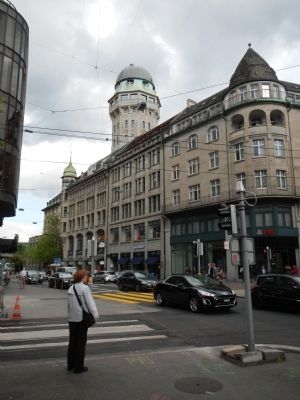
3. Bienenhof
Note the observatory on top of the tower.
Credits. This page was last revised on February 2, 2022. It was originally submitted on July 28, 2013, by Barry Swackhamer of Brentwood, California. This page has been viewed 562 times since then and 10 times this year. Photos: 1, 2, 3. submitted on July 28, 2013, by Barry Swackhamer of Brentwood, California. • Bill Pfingsten was the editor who published this page.
